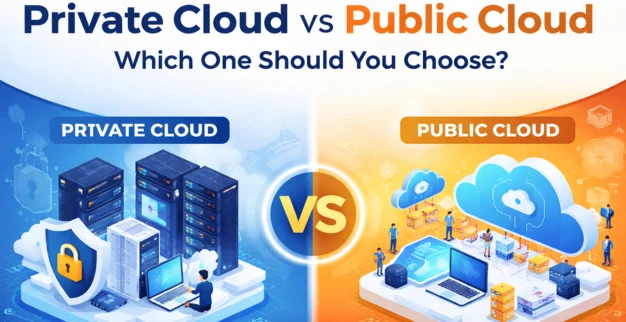
Private Cloud vs Public Cloud: Which One Should You Choose?
13 Feb 2026
Category: Cloud Solutions
Cloud computing is rapidly becoming where work gets done for most companies. So many ways to work in the cloud exist. With that said, it can be difficult to determine whether to use a Private Cloud or a Public Cloud for your business functions. The type of cloud structure you choose will dictate issues such as; security, cost, ability to scale, and how efficiently your technology is used.
What is a Private Cloud?
A Private Cloud is an exclusive cloud platform created for one organization only. It provides complete ownership of your company's data, resources, and security, so it is the best option for organizations that deal with sensitive information or must meet strict regulations by law. A Private Cloud may be hosted either on the premise of the organization or by a third-party but is not shared with any other organization.
Benefits of Using Private Cloud:
- Complete ownership of the organization's data and security
- Ability to build custom solutions for application infrastructure and software
- Easier to comply with laws governing specific industries that are regulated (i.e., finance/healthcare)
- Ability to support organizations with predictable workloads.
What is Public Cloud?
The public cloud is a type of host environment in which various resources (e.g., Servers, Storage and Applications) are provided as service by third-party providers like AWS, Microsoft Azure and Google Cloud. Public Clouds are cost-efficient, scalable and quickly deployed, making them great options for new companies, small/medium-size businesses or any job/project that has unpredictable workloads.
Key Benefits of Using a Public Cloud
- No Upfront Costs: Using a pay-as-you-go pricing model makes it easy to reduce your initial investment.
- Fast Scaling: Rapidly increase your capacity for accommodating changing workloads with public cloud infrastructure.
- Little Maintenance: Public Cloud providers will handle maintenance such as updating hardware/software, securing your information, etc.
- Faster Deployment: Faster deployment of resources will provide you with greater agility for your organization.
Comparing Private and Public Cloud
| Feature |
Private Cloud |
Public Cloud |
Recommendation |
| Security |
High, full control |
Provider-managed |
Private Cloud for sensitive data |
| Compliance |
Easy for regulated industries |
Limited |
Private Cloud preferred for finance, healthcare |
| Control |
Full control over resources |
Limited |
Private Cloud offers flexibility |
| Cost |
Higher upfront |
Pay-as-you-go |
Public Cloud is cost-efficient |
| Scalability |
Limited by internal resources |
Rapid, on-demand |
Public Cloud suits growing workloads |
| Maintenance |
Managed by IT team |
Provider handles updates |
Public Cloud reduces IT overhead |
| Best Use Case |
Enterprises, regulated data |
Startups, SMEs, dynamic workloads |
Hybrid Cloud balances both needs |
Which Option is Right for You?
Select a Private Cloud if your organization needs a high level of security, regulatory compliance or would like complete control over its own IT environment. These types of clouds are best suited to organizations such as banks, healthcare providers or government agencies.
Select a Public Cloud if your business wants to be budget-conscious, deploy quickly or has a more unpredictable workload. These types of clouds are particularly beneficial for startups, small and medium sized businesses, and marketing/IT teams that want to be flexible with their resource usage.
A Hybrid Cloud is a great option when looking to use the best of both worlds – you have your secure private workloads on one side and you can also use your scalable public workloads when needed; it gives you the flexibility to adapt your overall Cloud strategy to ensure you are getting the best value for money available.
In Summary
Your organization’s decision on which type of Cloud to choose must take into consideration the business objectives, security needs, and budget of your organization. A good cloud strategy can significantly improve your overall IT efficiency, reduce your operational risk, and enable you to expand your business. By partnering with experts who are able to assist with Cloud migration will ensure that your Cloud infrastructure is aligned with your organization’s long-term development plans.