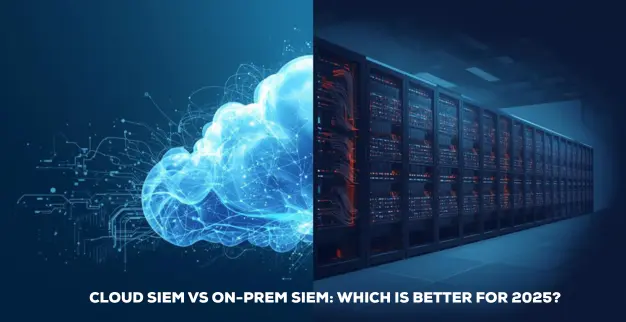
Cloud SIEM vs On-Prem SIEM: Which Is Better for 2025?
29 Apr 2025
Category: Security Operation
As cyber threats grow more advanced and businesses continue shifting to hybrid and multi-cloud environments, choosing the right SIEM platform has become one of the most important security decisions for 2025. Today, organizations mainly choose between two models: Cloud SIEM and On-Prem SIEM. While both solutions offer log management, threat detection, and compliance capabilities, the way they operate — and the value they deliver — are very different.
This guide breaks down the key differences, benefits, limitations, and helps you decide which SIEM approach is best for your organization in 2025.
What Is On-Prem SIEM?
An On-Prem SIEM is installed locally within your data center. Your team manages everything — hardware, storage, updates, scaling, configurations, and security.
Key Features
- Full control over data and infrastructure
- Highly customizable configurations
- Ideal for air-gapped and heavily regulated environments
Strengths
- Complete ownership of security data
- Suitable for strict compliance or data residency requirements
- No reliance on external cloud providers
Limitations
- High upfront investment (hardware, licensing, storage)
- Requires in-house SIEM engineers for management
- Scaling is slow and expensive
- Struggles with hybrid or multi-cloud visibility
In 2025, On-Prem SIEM remains relevant — but mainly for industries like banking, defense, government, critical infrastructure, and organizations requiring complete data control.
What Is Cloud SIEM?
A Cloud SIEM is delivered as a SaaS platform where the vendor manages updates, storage, infrastructure, scaling, and availability. Your SOC team focuses purely on detection and response.
Key Features
- Hosted and maintained in the cloud
- Easy to deploy and scale rapidly
- Flexible pay-as-you-go pricing
Strengths
- Deployment in days instead of months
- Automatic scaling for massive log volumes
- Built-in AI/ML analytics for faster detection
- Perfect for hybrid, multi-cloud, and remote setups
- Zero hardware or maintenance overhead
Limitations
- Data residency or sovereignty concerns
- Depends on vendor uptime and SLAs
- Costs may increase with large log ingestion
In 2025, Cloud SIEM has become the default choice for growing, cloud-native, and agile organizations.
Cloud SIEM vs On-Prem SIEM: Feature Comparison (2025)
| Feature |
Cloud SIEM |
On-Prem SIEM |
| Deployment Speed |
Rapid (hours–days) |
Slow (weeks–months) |
| Scalability |
Automatic, elastic |
Manual, expensive |
| Cost Model |
Subscription / usage-based |
High upfront CAPEX |
| AI & Automation |
Built-in advanced analytics |
Limited unless add-ons are used |
| Maintenance |
Managed by vendor |
Fully self-managed |
| Best For |
Cloud-first or hybrid companies |
Highly regulated sectors |
| Data Control |
Vendor-hosted |
Complete internal control |
| Integration |
Strong with cloud & SaaS |
Better for legacy on-prem |
Which One Is Better for 2025?
⭐ Cloud SIEM is the better choice for most organizations in 2025.
Why?
- Cyberattacks are faster → Cloud SIEM provides real-time analytics.
- Modern environments are hybrid & multi-cloud → On-Prem SIEM struggles to keep up.
- Cybersecurity talent shortage → Cloud SIEM reduces operational workload.
Best choice for:
- Mid-size & enterprise organizations
- Companies using Microsoft 365, Azure, AWS, or GCP
- Teams adopting SOC 2.0 automation and AI-driven security
⭐ On-Prem SIEM is better when:
- You operate in heavily regulated industries
- You manage air-gapped or isolated networks
- You require complete control over all data and detection logic
The Hybrid Approach: The Rising Trend for 2025
Many organizations now combine both models:
- Cloud SIEM for real-time analytics, automation, and scalability
- On-Prem SIEM for sensitive or regulated log workloads
This gives businesses the best of both worlds — flexibility + compliance.
Conclusion
For 2025 and beyond, Cloud SIEM is the more scalable, cost-effective, and future-proof option for the majority of organizations. As cyber threats evolve and cloud adoption accelerates, businesses need a SIEM that can adapt quickly, scale effortlessly, and deliver AI-powered detection and response. Choosing the right SIEM model today will define your organization's security resilience for years to come.