Cyber Security Partner vs IT Support Company: What's the Difference?
18 July 2026
Technology plays a critical role in modern business operations, but maintaining business continuity requires more than simply keeping systems running. While many organizations rely on an IT support company to manage day-to-day technical issues, today's evolving cyber threats require a dedicated cybersecurity strategy. As ransomware, phishing attacks, and data breaches become more common, businesses are increasingly investing in managed security services alongside traditional managed IT services.
Understanding the difference between IT support and a cybersecurity partner helps organizations choose the right solution to protect both their operations and digital assets.
What Does an IT Support Company Do?
An IT support company focuses on maintaining the organization's IT infrastructure and ensuring systems operate efficiently. Their primary objective is to minimize downtime and resolve technical issues that affect business operations.
Typical IT Support Services
- Help desk and technical support
- Server and network maintenance
- Hardware and software installation
- System updates and patch management
- Email and printer support
- Backup and basic IT administration
Many providers also offer managed IT services that include proactive system monitoring, infrastructure maintenance, and performance optimization.
While IT support improves operational efficiency, it is not designed to provide comprehensive cybersecurity protection.
What Does a Cyber Security Partner Do?
A cybersecurity partner focuses on protecting an organization's systems, applications, networks, and data from cyber threats.
Professional cyber security services help businesses prevent, detect, investigate, and respond to security incidents before they impact operations.
Typical Cyber Security Services
- Security Operations Center (SOC) monitoring
- Threat detection and incident response
- Vulnerability assessments and penetration testing
- Endpoint and cloud security
- Security awareness training
- Compliance and risk assessments
Many organizations choose managed security services to gain 24/7 cybersecurity monitoring and access to experienced security professionals without building an internal security team.
Key Differences
Although both services support business technology, their objectives are different.
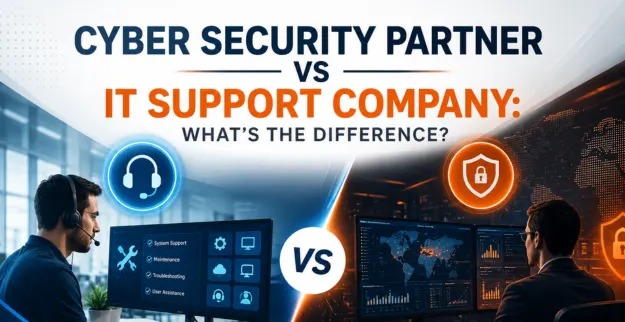
IT Support Company
- Focuses on IT performance and availability
- Resolves technical issues and system failures
- Maintains hardware and software
- Supports employee productivity
- Delivers managed IT services
Cyber Security Partner
- Focuses on protecting business data and systems
- Detects and responds to cyber threats
- Conducts security monitoring and risk assessments
- Supports regulatory compliance
- Delivers managed security services
In simple terms, IT support keeps your business running, while a cybersecurity partner keeps your business protected.
Which One Does Your Business Need?
Most modern businesses benefit from both IT support and cybersecurity services.
You should consider an IT support company if you need:
- Infrastructure maintenance
- Technical troubleshooting
- Network and server support
- User help desk services
You should consider a cybersecurity partner if you need:
- Continuous threat monitoring
- Protection against ransomware and phishing
- Vulnerability management
- Compliance support
- Advanced incident response
For organizations handling sensitive business or customer data, combining managed IT services with managed security services provides the strongest protection and operational resilience.
Conclusion
While an IT support company ensures your technology operates efficiently, a cybersecurity partner protects your business from evolving cyber threats. Both play important roles, but they serve different business objectives.
By combining reliable managed IT services with expert cyber security services and managed security services, organizations can improve system performance, reduce cyber risks, and maintain long-term business continuity.