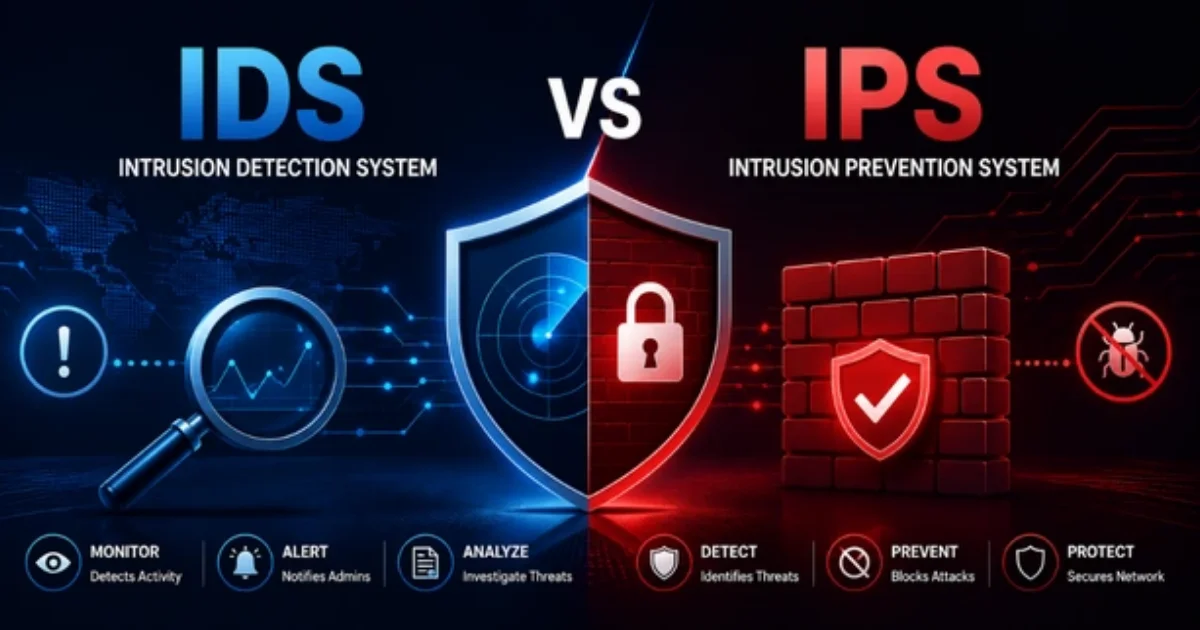
IDS vs IPS: Which Network Security Solution Should You Deploy?
By:
Ganesan D
1 Sep 2026
Category:
Network Security
Introduction
Modern businesses rely on networks to connect employees, applications, servers, cloud services, and critical business systems. As cyber threats become more sophisticated, organizations need effective solutions to identify and respond to suspicious network activity.
Two commonly used Network Security Solutions are an Intrusion Detection System (IDS) and an Intrusion Prevention System (IPS). Although both monitor network traffic and identify potential threats, they differ in how they respond to detected attacks.
Understanding IDS vs IPS can help businesses choose the right level of network protection based on their security requirements, infrastructure, and risk profile.
Intrusion Detection System (IDS)
An Intrusion Detection System (IDS) monitors network traffic and analyzes activity to identify potential security threats or suspicious behavior.
When an IDS detects a possible attack, it typically generates an alert for security or IT teams to investigate. It does not normally block the traffic automatically.
Key IDS Functions
- Monitors network traffic
- Detects suspicious activity
- Identifies potential intrusion attempts
- Generates security alerts
- Provides visibility into network activity
- Supports security investigations
IDS is particularly useful when organizations want greater visibility into what is happening across their network without automatically disrupting traffic.
Intrusion Prevention System (IPS)
An Intrusion Prevention System (IPS) goes a step further by actively detecting and blocking malicious or suspicious network activity.
When an IPS identifies a threat based on configured security rules, signatures, or behavioral indicators, it can automatically take action to prevent the activity from continuing.
Key IPS Functions
- Continuously monitors network traffic
- Detects malicious activity
- Blocks suspicious connections
- Prevents known attack patterns
- Helps reduce exposure to network-based threats
- Supports automated threat prevention
IPS is particularly valuable for organizations that require active protection against network attacks and want security controls to respond automatically.
Comparison
| Feature |
IDS |
IPS |
| Primary Purpose |
Detect threats |
Detect and prevent threats |
| Traffic Monitoring |
Yes |
Yes |
| Threat Alerts |
Yes |
Yes |
| Automatic Blocking |
Generally No |
Yes |
| Response |
Alerts security teams |
Automatically blocks or stops threats |
| Risk of Disruption |
Lower |
Requires careful configuration |
| Best For |
Visibility and detection |
Active threat prevention |
In simple terms, IDS tells you that an attack may be happening, while IPS can detect and take action to stop it.
Deployment Scenarios
When to Deploy IDS
An IDS may be suitable when:
- Network visibility is the primary requirement
- Security teams want detailed alerts for investigation
- Organizations need monitoring without automatic traffic blocking
- The environment requires passive detection
When to Deploy IPS
An IPS may be appropriate when:
- Active threat prevention is required
- Organizations face significant network-based attack risks
- Automated blocking is important
- Security teams need immediate protection against known threats
Using Both
Many organizations can benefit from deploying both technologies as part of a layered Network Security Solution.
IDS can provide additional visibility and detection, while IPS actively blocks malicious traffic. Their effectiveness can be further improved when combined with firewalls, endpoint protection, vulnerability management, and continuous security monitoring.
Recommendation
There is no universal answer to IDS vs IPS because the right choice depends on your organization's network architecture, risk profile, security objectives, and operational requirements.
Choose IDS when visibility, detection, and investigation are the primary priorities.
Choose IPS when the organization requires active, automated prevention of network threats.
For businesses with higher security requirements, combining IDS and IPS with other security controls can provide a more comprehensive defense strategy.
Conclusion
Both Intrusion Detection Systems and Intrusion Prevention Systems play important roles in modern network security. IDS focuses on identifying suspicious activity and alerting security teams, while IPS adds an active prevention layer by blocking detected threats.
Rather than viewing IDS vs IPS as competing technologies, businesses should consider how each solution fits into their broader cybersecurity architecture. A layered approach combining detection, prevention, monitoring, and incident response can provide stronger protection against evolving network-based cyber threats.