How to Mitigate Cybersecurity Risks in UAE Organizations
03 Mar 2026
Category: Cybersecurity
The UAE has become one of the most rapidly expanding digital economies throughout the world. Digital infrastructure serves as the essential foundation which organizations use to support their operations in banking, healthcare and logistics and government services. The rapid transformation process of current technologies creates higher risks of cyber threats to organizations.
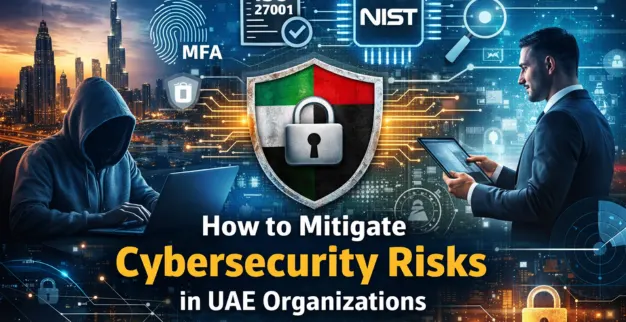
UAE organizations need to establish security frameworks and deploy effective security measures and develop a complete security document which follows international standards in order to achieve successful risk management.
1. Identifying Vulnerabilities in UAE Organizations
Starting off, a clear picture of potential threats shapes how defenses take form. Only after seeing what could go wrong does setting up safeguards make sense.
Common Vulnerabilities:
- Outdated software and unpatched systems
- Weak access controls and password policies
- Faulty setups in online storage systems
- Insider threats
- Phishing and social engineering attacks
How to Spot Potential Problems:
- Conduct vulnerability assessments and penetration testing
- Perform asset inventory and data classification
- Map data flows across departments
- Evaluate third, party vendor risks
- Review existing compliance posture
Starting with a clear look at risks makes it easier to sort dangers by how serious they are and how often they might happen.
2. Implementing International Security Standards
Starting strong with global benchmarks boosts how well cyber defenses grow. In UAE businesses, one common path follows ISO 27001, while another leans on NIST guidelines
National Institute of Standards and Technology NIST Framework
The NIST Cybersecurity Framework Built Around Five Core Functions
- Identify
- Protect
- Detect
- Respond
- Recover
With this method, tracking never stops, better results follow over time. Because it runs constantly, progress shows up more often than expected.
ISO/IEC 27001
A framework takes shape when ISO 27001 sets up an organized approach to handling information security. Because risks need consistent attention, controls follow a clear plan instead of random fixes:
- Risk, based controls
- Policy documentation
- Continuous auditing
- Leadership accountability
Facing new rules becomes easier when groups follow these guidelines, since they also boost their ability to handle shocks.
3. Establishing Strong Security Controls
Facing threats means putting up multiple barriers, one after another. Security works better when defenses stack, each piece doing its part.
Technical Controls
- Firewalls and intrusion detection systems
- Multi-factor authentication (MFA)
- Endpoint protection solutions
- Regular patch management
Administrative Controls
- Information security policies
- Employee awareness training
- Incident response procedures
- Vendor risk management policies
Physical Controls
- Secured data centers
- Access control systems
- Surveillance monitoring
Fences stacked one behind another make breaking through much harder. Successful hacks often fail when faced with multiple barriers standing firm.
4. Developing a Comprehensive System Security Plan
A system security plan (SSP) documents how an organization protects its IT systems and data.
An effective SSP includes:
- Asset inventory and classification
- Risk assessment results
- Implemented security controls
- Incident response procedures
- Backup and disaster recovery strategies
- Continuous monitoring plans
This document serves as evidence of due diligence during audits and regulatory inspections.
5. Case Studies from UAE Organizations
Case Study 1: Financial Institution in Dubai
A mid-sized financial firm experienced repeated phishing attempts. By implementing MFA, conducting employee training, and adopting ISO 27001-based controls, phishing success rates dropped significantly, and audit compliance improved.
Case Study 2: Healthcare Provider in Abu Dhabi
A healthcare organization faced data privacy risks due to legacy systems. After conducting a NIST-based risk assessment and upgrading endpoint security controls, the organization strengthened patient data protection and improved regulatory alignment.
Case Study 3: Logistics Company in UAE
A logistics firm operating across GCC countries improved resilience by implementing a centralized system security plan, continuous monitoring tools, and vendor risk management practices.
These examples demonstrate how structured frameworks and layered controls effectively mitigate cybersecurity risks.
Best Practices for UAE Organizations
- Conduct regular risk assessments
- Align with NIST and ISO standards
- Document and update system security plans
- Train employees regularly
- Monitor threats continuously
- Perform periodic internal audits
Cybersecurity should be treated as an ongoing process — not a one-time project.
Conclusion
Mitigating cybersecurity risks in UAE organizations requires a proactive and structured approach. By identifying vulnerabilities, implementing international standards such as NIST and ISO 27001, deploying robust security controls, and maintaining a comprehensive system security plan, businesses can significantly reduce their exposure to threats.
In the UAE’s rapidly evolving digital landscape, organizations that prioritize risk mitigation strengthen trust, ensure compliance, and secure long-term operational success.