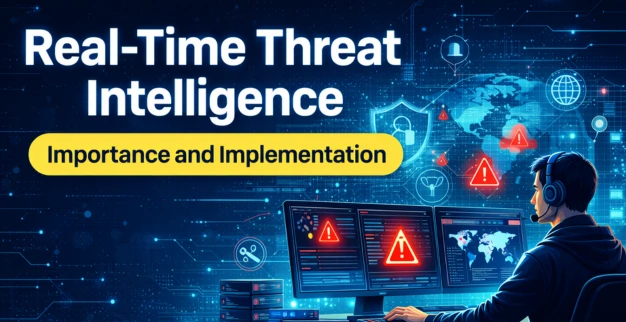
Real-Time Threat Intelligence: Importance and Implementation
06 Apr 2026
Category: Cyber Security
In today’s fast-paced digital environment, cyber threats evolve in seconds. Organizations can no longer rely on delayed responses to protect their systems. This is where real time threat intelligence becomes essential.
By continuously monitoring and analyzing threats as they happen, businesses can strengthen cyber threat detection, improve security monitoring, and respond instantly to potential attacks.
Importance
The importance of real time threat intelligence lies in its ability to provide immediate insights into active threats.
- Enables faster cyber threat detection
- Reduces response time to security incidents
- Improves overall security monitoring
- Helps prevent data breaches before they escalate
- Supports better threat analysis and decision-making
With real-time insights, organizations can stay ahead of attackers instead of reacting after damage occurs.
How It Works
Real time threat intelligence works by collecting and analyzing data from multiple sources continuously.
- Data is gathered from internal systems and external feeds
- Advanced tools analyze patterns and detect anomalies
- Alerts are generated for suspicious activities
- Security teams take immediate action
By combining automation with threat intelligence tools, organizations can identify threats as they emerge and respond effectively.
Implementation Steps
To successfully implement real time threat intelligence, organizations should follow these steps:
1. Use Advanced Threat Intelligence Tools
Deploy reliable threat intelligence tools to collect and process real-time data.
2. Integrate with Security Systems
Connect intelligence with SIEM, SOC, and endpoint systems for seamless security monitoring.
3. Enable Continuous Monitoring
Ensure 24/7 monitoring to detect threats instantly and improve cyber threat detection.
4. Automate Threat Analysis
Use automation to speed up threat analysis and reduce manual workload.
5. Train Security Teams
Equip teams with the knowledge to interpret intelligence and respond quickly.