Threat Hunting vs Threat Detection: Understanding the Difference
By:
Ganesan D
2 Sep 2026
Category:
Cyber Security
Introduction
Modern cyber threats can remain hidden inside business networks for extended periods, making it important for organizations to detect suspicious activity as quickly as possible. Security teams use both Threat Detection and Threat Hunting to identify potential attacks, investigate unusual behavior, and strengthen their overall security posture.
Although these terms are closely related, they serve different purposes. Understanding Threat Hunting vs Threat Detection helps businesses build a more proactive cybersecurity strategy and make better use of security tools and Cyber Threat Intelligence.
Definitions
What is Threat Detection?
Threat Detection is the process of identifying potentially malicious activity using automated security technologies, predefined rules, behavioral analysis, and security alerts.
Security teams may use detection systems to identify:
- Malware activity
- Suspicious login attempts
- Unauthorized access
- Unusual network traffic
- Endpoint threats
- Indicators of compromise
When suspicious activity is detected, security teams investigate the alert and determine whether further action is required.
Main Goal
The primary goal of Threat Detection is to identify potential security incidents quickly so that they can be investigated and addressed.
What is Threat Hunting?
Threat Hunting is a proactive security activity where cybersecurity professionals actively search for hidden or previously undetected threats within an organization's environment.
Instead of waiting for an alert, threat hunters investigate systems, network activity, user behavior, and security data to identify suspicious patterns that automated detection may have missed.
Main Goal
The goal of Threat Hunting is to find threats that may already exist but have not yet triggered conventional security alerts.
Key Differences
| Feature |
Threat Detection |
Threat Hunting |
| Approach |
Primarily reactive |
Proactive |
| Starting Point |
Security alert or detected anomaly |
Hypothesis, intelligence, or suspicious pattern |
| Main Focus |
Identify known or detectable threats |
Discover hidden or unknown threats |
| Automation |
High |
Often requires human expertise |
| Activity |
Continuous monitoring |
Proactive investigations |
| Objective |
Detect threats quickly |
Find threats that may evade detection |
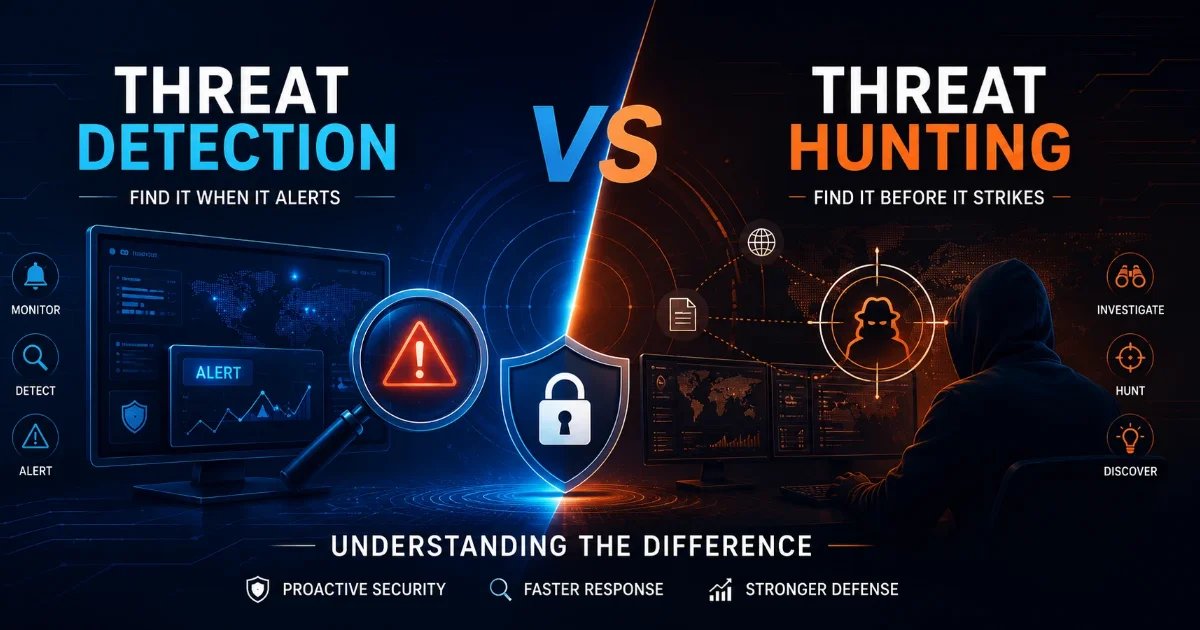
In simple terms, Threat Detection looks for signs of an attack, while Threat Hunting actively searches for threats that may be hiding in the environment.
Tools
Both activities use security technologies, but the way they are used can differ.
Threat Detection Tools
- Security Information and Event Management (SIEM)
- Endpoint Detection and Response (EDR)
- Intrusion Detection and Prevention Systems
- Firewalls
- Email security platforms
- Security monitoring tools
These solutions continuously collect and analyze security events to identify suspicious activity.
Threat Hunting Tools
Threat hunters may use:
- SIEM platforms
- EDR and XDR solutions
- Network traffic analysis tools
- Threat intelligence platforms
- Security logs
- Endpoint and cloud telemetry
Cyber Threat Intelligence can provide information about threat actors, attack techniques, malicious domains, IP addresses, file hashes, and other indicators that help security teams develop hunting hypotheses.
Business Benefits
Using Threat Detection and Threat Hunting together provides broader security coverage.
Benefits of Threat Detection
- Faster identification of security incidents
- Continuous security monitoring
- Automated alert generation
- Improved visibility into security events
- Faster response to known threats
Benefits of Threat Hunting
- Identifies threats that bypass automated detection
- Helps uncover suspicious activity earlier
- Improves understanding of attacker behavior
- Supports proactive security investigations
- Helps strengthen existing detection rules
Combining both approaches can help businesses reduce security gaps and improve their overall cyber resilience.
Conclusion
Threat Hunting vs Threat Detection is not about choosing one approach over the other. Both play important roles in a modern cybersecurity strategy.
Threat Detection provides continuous monitoring and alerts when suspicious activity is identified, while Threat Hunting takes a proactive approach by actively searching for hidden threats that may have bypassed existing security controls.
By combining security monitoring, skilled analysts, threat hunting, and Cyber Threat Intelligence, businesses can improve visibility, identify threats more effectively, and strengthen their ability to respond to evolving cyber risks.