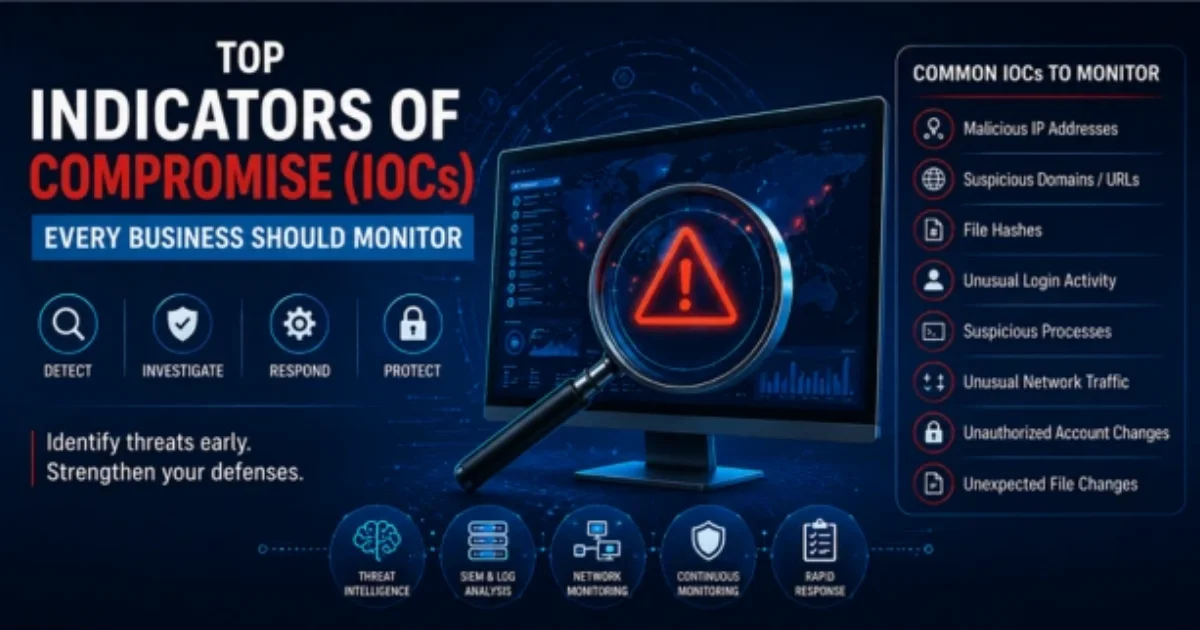
Top Indicators of Compromise (IOCs) Every Business Should Monitor
By: Ganesan D
3 Sep 2026
Category:
Cyber Security
Introduction
Cyberattacks do not always become obvious immediately. Attackers may remain inside an organization's environment while attempting to steal data, compromise accounts, or move between systems. Identifying suspicious activity early can help businesses limit the impact of a security incident.
Indicators of Compromise (IOCs) provide security teams with valuable clues that may indicate a system, account, or network has been compromised. By monitoring IOCs alongside Threat Intelligence, businesses can improve threat detection, investigate suspicious activity, and respond to potential attacks more effectively.
What are IOCs?
Indicators of Compromise (IOCs) are pieces of evidence or observable information that may suggest malicious activity or a security breach has occurred.
IOCs can help security teams:
-
Identify potentially compromised systems
-
Detect malicious activity
-
Investigate security incidents
-
Connect related security events
-
Support incident response
-
Improve threat detection rules
IOCs can be obtained from internal security monitoring, security investigations, threat intelligence feeds, and previous incidents.
Common Indicators
Organizations should monitor multiple types of Cyber Threat Indicators rather than relying on a single IOC.
Malicious IP Addresses
Connections to known malicious or suspicious IP addresses can indicate potential communication with attacker-controlled infrastructure.
Suspicious Domains and URLs
Unexpected connections to malicious domains or URLs may indicate phishing, malware activity, or command-and-control communication.
File Hashes
Hashes can help security teams identify known malicious files across endpoints and servers.
Unusual Login Activity
Multiple failed logins, unexpected locations, unusual login times, or abnormal authentication behavior may indicate compromised credentials.
Suspicious Processes
Unexpected applications, scripts, or processes running on business devices can indicate malicious activity.
Unusual Network Traffic
Unexpected data transfers, connections to unfamiliar destinations, or abnormal traffic patterns may require further investigation.
Unauthorized Account Changes
Unexpected changes to user privileges, passwords, or account configurations can be signs of unauthorized activity.
Unexpected File Changes
Large numbers of modified, encrypted, or deleted files can indicate malware or ransomware activity.
These indicators become more useful when correlated with other security events and relevant Threat Intelligence.
Detection Tools
Businesses can use multiple security technologies to identify and analyze IOCs.
SIEM
Security Information and Event Management (SIEM) platforms collect and correlate logs from different systems, helping security teams identify suspicious patterns.
EDR
Endpoint Detection and Response (EDR) solutions monitor endpoint activity and can help identify malicious processes, files, and unusual behavior.
Threat Intelligence Platforms
A Threat Intelligence platform can collect and analyze information about malicious IP addresses, domains, file hashes, threat actors, and attack techniques.
Network Monitoring
Network security tools can identify unusual connections, traffic patterns, and communication with suspicious infrastructure.
SOC Monitoring
A Security Operations Center (SOC) can continuously monitor security events, investigate potential IOCs, and coordinate incident response.
Response
Detecting an IOC is only the first step. Organizations should have a structured process for investigating and responding to potential compromises.
Recommended Actions
-
Validate the indicator and determine its severity
-
Identify affected users, devices, and systems
-
Isolate compromised endpoints when necessary
-
Block confirmed malicious IPs, domains, or files
-
Reset compromised credentials
-
Investigate related security events
-
Remove malicious files or unauthorized access
-
Restore affected systems where required
-
Document the incident and actions taken
-
Update security controls based on lessons learned
After an incident, newly identified IOCs can be added to security monitoring and detection systems to help identify similar activity in the future.
Conclusion
Indicators of Compromise provide valuable evidence that can help businesses identify potential cyberattacks and compromised systems. Monitoring malicious IP addresses, suspicious domains, file hashes, unusual login activity, abnormal network traffic, and other Cyber Threat Indicators can improve early detection.
When combined with Threat Intelligence, SIEM, EDR, network monitoring, and SOC capabilities, IOCs become an important part of a proactive cybersecurity strategy. Regularly updating and analyzing these indicators helps organizations respond faster and strengthen their defenses against evolving cyber threats.