What Does SOC Mean in Business? Why Companies Need a SOC
10 Jan 2026
Category: Security Operation
Introduction – Cyber Threats to Businesses
In today’s digital world, businesses rely heavily on technology to run daily operations.
From emails and customer data to cloud systems and online payments, everything is connected.
While this improves efficiency, it also opens the door to cyber threats such as hacking,
ransomware, phishing attacks, and data breaches.
These threats are no longer limited to large enterprises—small and medium businesses are
equally targeted. This is where a Security Operations Center (SOC) becomes critical for
business protection.
What Does SOC Mean? (Business View)
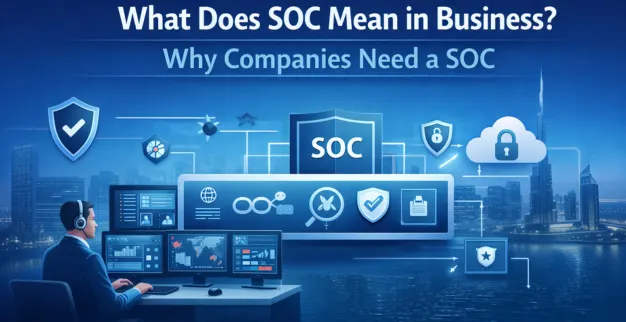
SOC meaning in business refers to a centralized function or team responsible for
continuously monitoring, detecting, and responding to cybersecurity threats.
A Security Operations Center acts as the “command center” for an organization’s IT security.
From a business perspective, a SOC is not just about technology—it’s about protecting
revenue, customer trust, brand reputation, and business continuity. It ensures that
security incidents are identified early and handled before they cause serious damage.
Role of SOC in Protecting Business Operations
A SOC works 24/7 to keep an eye on all digital activities within a company. It monitors
networks, servers, applications, endpoints, and cloud systems to identify suspicious behavior.
When a threat is detected, the SOC team investigates the issue, contains the attack,
and prevents it from spreading further. This quick response minimizes downtime,
data loss, and financial impact. In short, SOC IT security ensures that business
operations continue smoothly without unexpected disruptions.
SOC vs Traditional IT Security
Traditional IT security mainly focuses on setting up firewalls, antivirus software,
and access controls. While these tools are important, they are often reactive and
limited to basic protection.
A SOC, on the other hand, is proactive. It uses advanced monitoring tools,
threat intelligence, and skilled security analysts to detect threats in real time.
Unlike traditional IT teams that handle multiple responsibilities, a SOC is fully
dedicated to cybersecurity, making it more effective against modern, sophisticated attacks.
Key Benefits of SOC Services
- 24/7 threat monitoring and response
- Early detection of cyberattacks
- Reduced risk of data breaches
- Faster incident response and recovery
- Regulatory compliance and reporting support
- Lower long-term security costs compared to breach recovery
SOC services also allow businesses to focus on growth while security experts handle cyber risks.
Industries That Need SOC Services
Almost every industry can benefit from SOC services, especially those handling sensitive data.
Key industries include:
- Banking and financial services
- Healthcare and pharmaceuticals
- Retail and e-commerce
- Manufacturing
- IT and technology companies
- Government and education
Any business that depends on digital systems and customer data needs strong SOC IT security.
Secure Your Business with SOC
Cyber threats are evolving every day, and no business can afford to ignore security.
A Security Operations Center provides the visibility, expertise, and response capabilities
needed to stay protected.
Secure your business with SOC services and take a proactive step toward safeguarding
your operations, data, and reputation.