What Are the 5 Pillars of Security? A Modern Business Perspective
19 Jan 2025
Category: Security Operation
Today, in a world dominated by digital technologies, companies face increasingly frequent, sophisticated, and damaging cyber-attacks.
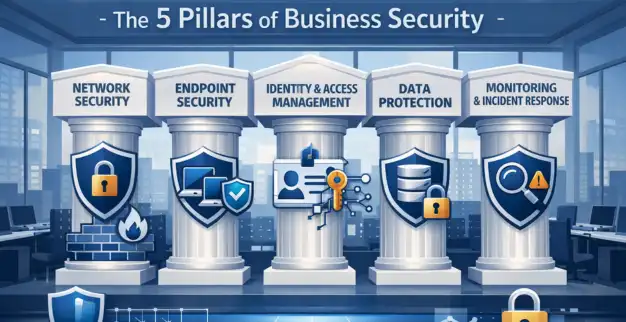
Relying on a single security tool is no longer enough. Threats such as ransomware, data breaches, and insider attacks are becoming more prevalent. Modern organizations adopt a multi-layered security approach based on the 5 pillars of security.
Together, these pillars form a robust cybersecurity framework that protects internal systems, company data, and ensures business continuity.
Here, we outline the five key cybersecurity pillars every organization should prioritize.
Pillar 1: Network Security
Network security is the first line of defense, focused on protecting internal and external networks from unauthorized access, malware, and cyber threats. Tools such as firewalls, intrusion detection and prevention systems (IDS/IPS), secure VPNs, and network segmentation help limit an attacker's lateral movement even if part of the system is breached.
For enterprises, strong network security is crucial for uninterrupted operations and safeguarding essential systems.
Pillar 2: Endpoint Security
Endpoints—laptops, desktops, servers, and mobile devices—are prime targets due to remote work and cloud access. Endpoint security goes beyond antivirus software, incorporating Endpoint Detection and Response (EDR), behavior monitoring, and threat isolation.
Effective endpoint security reduces risks from phishing, malware, and unauthorized device access.
Pillar 3: Identity & Access Management (IAM)
IAM ensures the right individuals have the appropriate access when needed. Weak or stolen credentials remain a major cause of breaches. IAM includes multi-factor authentication (MFA), role-based access control, privileged access management, and single sign-on (SSO). Proper IAM controls block intruders and mitigate insider threats.
Pillar 4: Data Protection
Data is an organization’s most valuable asset. Data protection secures sensitive information, including customer records, financial data, and intellectual property. Techniques such as encryption, data loss prevention (DLP), secure backups, and regulatory compliance ensure data remains confidential, intact, and available even during incidents.
Pillar 5: Monitoring & Incident Response (SOC Role)
Continuous monitoring and rapid response are essential. Security Operations Centers (SOC) monitor logs, alerts, and network activity 24/7 to detect threats early. Well-planned incident response processes enable organizations to contain, investigate, and recover quickly, limiting damage and ensuring business continuity.
Strengthen Your Security Foundation
The 5 pillars collectively provide a strong and flexible cybersecurity framework. Omitting any pillar leaves gaps that attackers can exploit.
At Agan Cybersecurity LLC, we partner with clients to design, implement, and operate the five pillars, ensuring businesses are fully protected against evolving threats. Layered defense is no longer optional—it is essential.