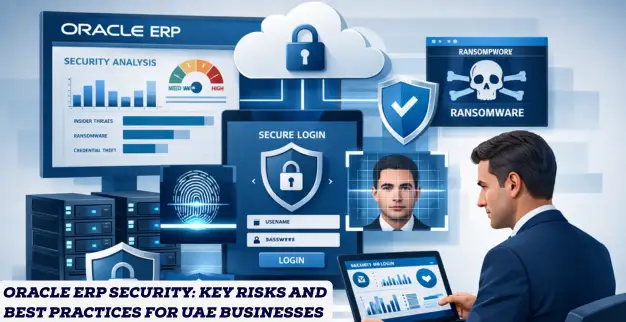
Oracle ERP Security: Key Risks and Best Practices for UAE Businesses
31 Jan 2026
Category: ERP Security
Oracle ERP is the most popular choice in the UAE for running business operations related to finance, procurement, HR, and supply chain management. Its strong design and cloud features make it a very capable system, but at the same time, such a system becomes a very attractive target for cybercriminals. With companies in Dubai and throughout the Emirates managing an ever-growing amount of sensitive information, securing Oracle ERP is not a matter of choice anymore but a very critical requirement.
Knowing the Oracle ERP security risks really well and controlling them effectively can be what separates continuous business activities from getting into heavy financial-loss and compliance issues.
Overview of Oracle ERP Security
Oracle ERP systems, whether on-premise or Oracle Fusion Cloud, store the most vital business data in one place such as:
- Financial records
- Payroll and employee data
- Vendor and customer information
Since ERP systems link different departments and users, one insecure point can make the whole organization vulnerable. With the UAE seeing an increase in regulatory compliances and cyber-attacks, ERP security should be viewed as a business risk and not merely an IT issue.
Common Security Gaps in Oracle ERP
Even though Oracle has several security features for its products, a lot of UAE businesses are exposed and vulnerable due to configuration and operational loopholes.
1. Excessive User Privileges
Misuse of access rights is probably one of the major Oracle ERP security risks. It has been noticed that employees are given far more permissions than what they actually require, thus the risk and potential damage resulting from insider threats or hacked accounts get multiplied.
2. Weak Identity and Access Management
Oracle ERP is susceptible to credential theft and account takeover due to lack of multi-factor authentication (MFA), shared accounts, and weak password policies.
3. Limited Activity Monitoring
Without ongoing surveillance, suspicious behavior such as unauthorized data exports or financial changes may remain invisible for weeks or even months.
4. Insecure Integrations
Oracle ERP is usually connected with third-party systems such as banking platforms, CRMs, or payroll tools. Weakly secured APIs and integrations make it easier for hackers to attack since they increase the attack surface.
5. Delayed Patch Management
One of the ways attackers commonly get in is through unpatched vulnerabilities in ERP modules or the underlying infrastructure.
Best Practices for Access Control & Monitoring
One of the main ways to lower the Oracle ERP security risks is for the companies in the UAE to use a layered security method:
1. Implement Role-Based Access Control (RBAC)
Only provide users with the access necessary for their job. Continuously check and remove permissions that have not been used or that have become obsolete.
2. Enforce Multi-Factor Authentication
MFA greatly diminishes the risk of unauthorized access, particularly for finance and admin personnel.
3. Continuous ERP Activity Monitoring
Keep an eye on user behaviors, financial transactions, and changes in configurations at the moment of the event to uncover irregularities.
4. Segregation of Duties (SoD)
Do not allow a single user to perform all the critical work activities, for example, creating a vendor and approving a payment, as this is a potential risk for fraud.
5. Regular Security Audits
Perform regular Oracle ERP security audits to discover misconfigurations and unknown risks.
Compliance Considerations for UAE Businesses
UAE organizations should ensure ERP security compliance with local and regional laws such as:
- UAE data protection laws
- Financial audit and VAT compliance requirements
- Industry-specific standards (banking, healthcare, government)
Non-compliance with Oracle ERP security measures can result in regulatory penalties, audit failures, and damage to the company's reputation.
Final Thoughts
Oracle ERP naturally provides robust security features. However, the actual strength of these features depends on correct setup, continuous monitoring, and appropriate governance.
It is a must for all businesses in the UAE to have a proactive Oracle ERP security strategy in place to safeguard their data, comply with regulations, and keep operations running smoothly.
Don’t wait until a security incident occurs—put your Oracle ERP system in a secure environment today.