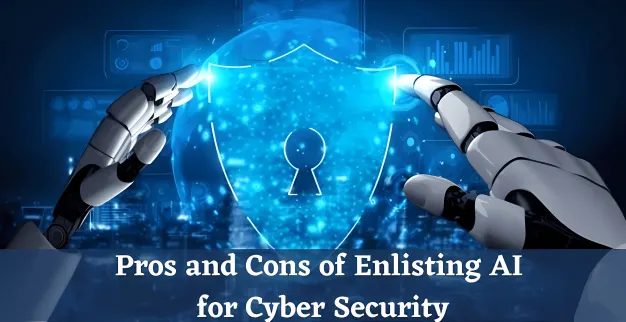
The Impact of AI on Cybersecurity: Pros and Cons
13 May 2025
Category: Artificial Intelligence
The integration of Artificial Intelligence (AI) in cybersecurity
has transformed the way businesses protect digital assets. While
AI introduces powerful defense mechanisms, it also comes with
unique risks. Here's a balanced look at the pros and cons of AI in
cybersecurity.
Pros of AI in Cybersecurity
1. Threat Detection and Response
-
AI can detect patterns and anomalies in real time, identifying
threats faster than traditional systems.
-
It improves response time to cyberattacks, potentially stopping
threats before damage occurs.
2. Predictive Capabilities
-
AI uses machine learning to predict potential vulnerabilities
and attack vectors.
-
It helps organizations prepare for and prevent future attacks.
3. Automation of Routine Tasks
-
AI can automate tasks like monitoring logs, scanning for
malware, and handling basic responses.
-
This reduces the workload on human analysts and speeds up
response time.
4. Improved Accuracy
-
AI reduces false positives by learning from past incidents and
refining its detection capabilities.
5. 24/7 Monitoring
-
AI systems can operate continuously, ensuring constant
protection without fatigue or downtime.
Cons of AI in Cybersecurity
1. Use by Cybercriminals
-
Hackers can also use AI to develop sophisticated attacks, such
as adaptive malware and deepfakes.
-
AI can help them automate and scale attacks more efficiently.
2. Over-Reliance on Automation
-
Dependence on AI can lead to reduced human oversight, increasing
the risk if the AI fails or is misled.
-
Complex attacks may still require human intuition and expertise.
3. High Cost and Complexity
-
Implementing AI solutions can be expensive and
resource-intensive, especially for small to mid-sized
businesses.
-
Requires skilled personnel to manage and maintain AI systems.
4. Bias and Errors in Algorithms
-
AI systems can inherit biases from the data they are trained on,
leading to incorrect threat assessments.
-
Poor-quality training data can degrade system performance.
5. Privacy Concerns
-
AI systems often process large amounts of personal data, raising
concerns about data privacy and surveillance.
| Pros |
Cons |
| Threat Detection and Response |
Use by Cybercriminals |
| Predictive Capabilities |
Over-Reliance on Automation |
| Automation of Routine Tasks |
High Cost and Complexity |
| Improved Accuracy |
Bias and Errors in Algorithms |
| 24/7 Monitoring |
Privacy Concerns |
Conclusion
AI is reshaping cybersecurity by enhancing detection, prediction,
and response capabilities. However, it's not a silver bullet. A
balanced approach that combines AI tools with skilled human
oversight is essential for robust protection in 2025 and beyond.
At AGAN Cyber Security LLC, we help businesses in Dubai and across
the UAE leverage AI-driven cybersecurity while managing its
challenges. Contact us to build an intelligent and secure future.