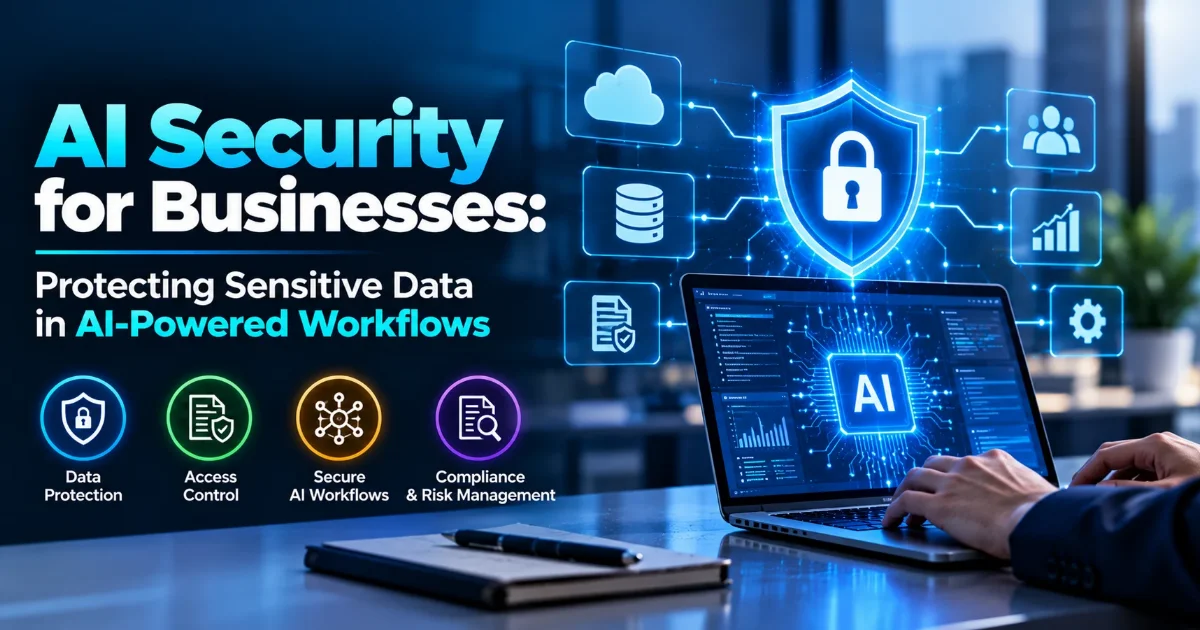
AI Security for Businesses: Protecting Sensitive Data in AI-Powered Workflows
By: Ganesan D
21 Oct 2026
Category:
Cyber Security
Introduction
Businesses are increasingly using artificial intelligence (AI) to automate tasks, analyse information, and improve productivity. However, AI-powered workflows can introduce risks involving sensitive data, unauthorised access, and malicious inputs. Implementing effective AI security helps organisations adopt AI while protecting business information.
What Is AI Security?
AI security involves protecting AI systems, models, applications, and the data they process from cyber threats and misuse. It includes securing AI tools, controlling access to sensitive information, monitoring activity, and reducing vulnerabilities throughout the AI lifecycle.
Businesses adopting AI security solutions in the UAE can use these measures to support safer AI implementation and strengthen their overall cybersecurity posture.
Common AI-Related Security Risks
AI-powered workflows may introduce several security challenges. Common risks include:
-
Data Leakage:
Confidential information may be exposed through AI prompts, outputs, or connected applications.
-
Prompt Injection:
Malicious instructions may manipulate an AI system into ignoring intended safeguards or disclosing information.
-
Model Manipulation:
Attackers may exploit weaknesses in training data or model behaviour.
-
Excessive Permissions:
AI assistants may access more data or perform more actions than necessary.
-
Third-Party Risks:
External AI platforms and integrations may introduce additional privacy and security concerns.
Preventing Data Exposure and Prompt Injection
Employees may unintentionally submit customer records, financial information, credentials, or internal documents to AI tools. Unauthorised users may also attempt to extract sensitive information through carefully crafted prompts.
Organisations should classify sensitive data, restrict what AI applications can access, validate inputs, and test systems against prompt injection attacks. Output filtering and human review can provide additional protection, although no single control eliminates every risk.
Implementing Strong Access Controls
Access controls help ensure that AI systems interact only with authorised users and information. Businesses should implement the following measures:
-
Role-Based Access Control:
Grant permissions according to job responsibilities.
-
Least Privilege:
Limit AI agents and applications to the minimum access required.
-
Multi-Factor Authentication (MFA):
Strengthen account protection by requiring additional verification.
-
Activity Logging:
Record important AI interactions and access events to support monitoring and investigations.
-
Regular Permission Reviews:
Remove unnecessary access and outdated credentials.
Secure AI Practices for Businesses
Organisations implementing AI-based security solutions should establish clear AI usage policies, assess vendors, encrypt sensitive data where appropriate, and monitor AI activity for suspicious behaviour.
Businesses seeking AI security services in Dubai should also evaluate how AI security integrates with existing UAE cybersecurity solutions, including identity management, data loss prevention, and security monitoring.
Frequently Asked Questions
1. Why Is AI Security Important for Businesses?
AI security helps reduce data exposure, unauthorised access, AI misuse, and risks associated with AI-powered workflows. It supports safer AI adoption while helping organisations protect confidential business information.
2. Can Prompt Injection Be Completely Prevented?
No. Prompt injection remains a security challenge, so organisations should combine testing, access restrictions, monitoring, and human oversight to reduce the likelihood and impact of attacks.
3. Should Employees Use Public AI Tools for Business Data?
Employees should use public AI tools with business data only when permitted by company policy and supported by appropriate privacy and security safeguards. Sensitive information should not be shared with unapproved AI applications.
Conclusion
AI can improve business efficiency, but secure implementation is essential to protect sensitive information. Strong access controls, careful data handling, continuous monitoring, and regular security assessments help organisations manage AI-related risks.
Secure Your AI-Powered Workflows with Agan Cyber Security LLC
Protecting AI-powered workflows requires a security strategy that addresses data exposure, unauthorised access, prompt injection, and emerging cyber threats. Agan Cyber Security LLC helps businesses identify security risks, protect business data, and strengthen their cybersecurity strategy.
Explore our cybersecurity services to assess risks, improve security monitoring, and protect your organisation's digital infrastructure in Dubai and across the UAE.
Contact us today to discuss your AI security requirements.