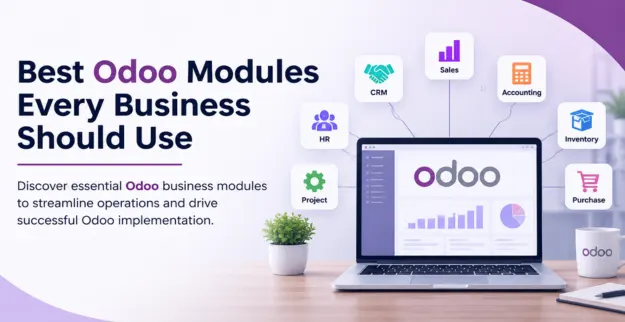
Best Odoo Modules Every Business Should Use
27 July 2026
Managing multiple business processes using different software can lead to inefficiencies, data duplication, and increased operational costs. Businesses today require an integrated solution that connects departments, automates workflows, and provides real-time insights for better decision-making. This is where Odoo ERP stands out as one of the most flexible and comprehensive business management platforms.
Why Odoo?
Odoo ERP is an all-in-one business management solution that integrates multiple business functions into a single platform. Instead of using separate applications for accounting, sales, inventory, HR, and customer management, Odoo allows businesses to manage everything from one centralized system.
Why Businesses Choose Odoo
- Modular and highly scalable
- Easy to customize based on business requirements
- User-friendly interface
- Real-time reporting and analytics
- Cloud and on-premise deployment options
- Seamless integration between departments
Its flexibility makes Odoo suitable for businesses across various industries, from retail and manufacturing to healthcare and professional services.
Top Odoo Modules
Choosing the right modules is essential for maximizing the benefits of Odoo ERP.
1. Sales Module
Manages quotations, sales orders, customer information, and sales reporting, helping businesses improve their sales process.
2. CRM Module
Tracks leads, opportunities, customer interactions, and sales pipelines, enabling better customer relationship management.
3. Accounting Module
Simplifies invoicing, payments, bank reconciliation, tax management, and financial reporting.
4. Inventory Module
Provides real-time inventory tracking, warehouse management, stock movements, and automated replenishment.
5. Purchase Module
Automates supplier management, purchase orders, approvals, and procurement processes.
6. Manufacturing (MRP)
Supports production planning, bill of materials, work orders, quality checks, and manufacturing operations.
7. Human Resources (HR)
Manages employee records, attendance, payroll, recruitment, leave management, and performance tracking.
8. Project Management
Helps teams manage projects, assign tasks, track progress, and collaborate efficiently.
9. Website & eCommerce
Enables businesses to build professional websites and manage online stores without additional software.
10. Helpdesk Module
Improves customer support by managing service requests, tickets, SLAs, and customer communication.
Industry-wise Recommendations
Different industries benefit from different Odoo business modules based on their operational requirements.
Retail
- Sales
- Inventory
- POS (Point of Sale)
- Accounting
Manufacturing
- Manufacturing (MRP)
- Inventory
- Purchase
- Quality Management
Trading & Distribution
- Sales
- Purchase
- Inventory
- Accounting
Service-Based Businesses
- CRM
- Project Management
- Timesheets
- Helpdesk
Healthcare
- CRM
- Inventory
- Accounting
- HR
Selecting industry-specific modules ensures businesses get the maximum value from their Odoo implementation.
Choosing the Right Modules
Every business has unique operational needs, so selecting modules should be based on current processes and future growth plans.
Consider These Factors
- Business size and industry
- Existing operational challenges
- Budget and implementation timeline
- Scalability requirements
- Integration with existing systems
- Employee training and user adoption
Working with an experienced Odoo implementation partner helps businesses choose the right combination of modules and ensures smooth deployment.
Conclusion
The right Odoo modules can transform the way businesses manage their daily operations by integrating multiple departments into a single, efficient platform. From sales and accounting to inventory, HR, and manufacturing, Odoo ERP provides the flexibility to support organizations of all sizes.
A successful Odoo implementation starts with selecting the right Odoo business modules based on your operational goals. With proper planning and expert guidance, businesses can improve efficiency, reduce costs, and drive sustainable growth.
Frequently Asked Questions
1. What are Odoo modules?
Odoo modules are individual applications within Odoo ERP that manage specific business functions such as Sales, CRM, Accounting, Inventory, HR, Manufacturing, and Project Management.
2. Which Odoo module should I implement first?
Most businesses begin with CRM, Sales, Accounting, and Inventory modules, then add additional modules as business requirements grow.
3. Can Odoo modules be customized?
Yes. Odoo modules are highly customizable and can be configured to meet your organization's specific business processes.