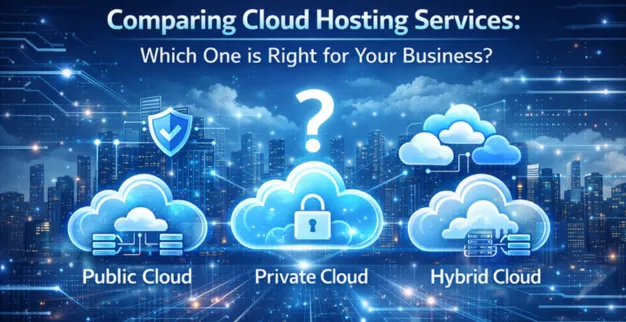
Comparing Cloud Hosting Services: Which One is Right for Your Business?
11 Feb 2026
Category: Cloud Solutions
Selecting the appropriate cloud hosting option has become one of the more critical factors in determining how successful an organisation ecommerce presence will be. Traditional hosting solutions have reached their limit and do not provide the performance levels, uptime requirements, and utility demanded by modern websites and their corresponding applications. Cloud hosting solutions have now advanced significantly to provide businesses with a reliable, flexible, and affordable way to achieve their desired outcomes in today's digital world.
When examining which type of cloud hosting option best meets the needs of your business, it is crucial to carefully analyse all aspects of your website's hosting requirements and also take into account both basic cloud setups along with fully managed hosting solutions.
The Need For Cloud Hosting Today
Cloud hosting has become essential for businesses of all sizes today because it utilises a network of virtual servers rather than one physical server, allowing businesses to provide better levels of performance, greater reliability, and more easily scale their resources based on traffic patterns. This means that regardless of fluctuating user demands on their websites and/or applications, businesses utilising cloud hosting will have the ability to deliver the performance, security, and scalability that modern websites require in order to meet future demands for growth.
Common Types of Cloud Hosting
1. Public Cloud Hosting
Overview: Shared among various users of the hosting provider, including other businesses and individuals.
Benefits: More scalable, lower cost than a private cloud, ideal solution for startups and other small-business owners with very limited funds to invest.
2. Private Cloud Hosting
Overview: Provides a solitary entity usage.
Benefits: High-security level, full control over the hosting platform, ideal for organizations that have high compliance or data protection requirements.
3. Hybrid Cloud Hosting
Overview: The hosting provider will combine both the public and private cloud services.
Benefits: Host private data on the private cloud and leverage the public cloud for operations with less sensitive data while having a balance between security and flexibility.
4. Cloud Hosting Services with Management
Overview: A cloud hosting service provider handles all aspects of server management and operation - including software updates (applications), monitoring (performance), firewalls (security) and more.
Benefits: When your business uses managed cloud hosting, you get an entire cloud-dedicated hosting experience, with only minimal technical management by your business.
5. Cloud Hosting Services Without Management
Overview: Your organization handles all aspects of running your server: user account administration; application updates; and security.
Benefits: There are high levels of flexibility and customisation, but there is also a requirement for highly skilled and competent in-house technical staff.
6. Hosting Services For Websites With Large Volumes Of Traffic
Overview: These types of services are designed to handle vast amounts of traffic and deliver large volumes of content.
Benefits: Automatic scaling allows for continuous service delivery, and fast load times, during times of peak traffic.
7. Enhanced Security Cloud Hosting
Overview: Firewalls. DDoS protection. Encryption of data.
Benefits: Necessary for companies that have private customer data.
8. Cost-Efficient Cloud Hosting
Overview: Pay as you go pricing.
Benefits: Businesses only pay for what they use, thus helping them keep their technology costs down.
9. Scalable Cloud Hosting
Overview: Easily able to grow in terms of storage, bandwidth, and computing power.
Benefits: Helping support a business' growth, whilst providing consistent performance.
10. Performance Optimized Cloud Hosting
Overview: Caching technologies, global data centre, and optimally designed system support.
Benefits: Users enjoy faster website load times and a better overall experience.
Cloud Hosting Comparison Table
| Type |
Cost |
Security |
Management |
Best For |
| Public Cloud |
Low |
Basic |
User-managed |
Startups / Small businesses |
| Private Cloud |
High |
High |
User-managed |
Enterprises / Compliance-focused |
| Hybrid Cloud |
Medium |
High (private) |
Mixed |
Flexible businesses |
| Managed Cloud |
Medium |
High |
Fully managed |
Businesses with limited IT staff |
| Unmanaged Cloud |
Low-Medium |
Depends |
User-managed |
Tech-savvy organizations |
| High-Traffic Cloud |
Medium-High |
Medium |
Managed / Unmanaged |
E-commerce / Content-heavy sites |
| Enhanced Security Cloud |
Medium-High |
Very High |
Managed / Unmanaged |
Sensitive data handling |
| Cost-Optimized Cloud |
Low |
Medium |
Managed / Unmanaged |
Budget-conscious businesses |
| Scalable Cloud |
Medium-High |
Medium |
Managed / Unmanaged |
Growing businesses |
| Performance-Focused Cloud |
Medium-High |
High |
Managed / Unmanaged |
Speed & user experience-focused sites |
Final Thoughts
Your selection of cloud hosting options will be driven by your company size, technology skills, and anticipated expansion. While there are many common features available in all three of the types of cloud hosting services mentioned above; public, private, and managed clouds have different characteristics and can help you select the best options for your needs. Choosing the right type of cloud hosting solution will significantly increase your website's ability to protect itself, perform well, and easily expand with your growing needs.
Take Action: Determine your business needs now so you can pick the best type of cloud hosting solution to guarantee a scalable, secure, and high-performing website!