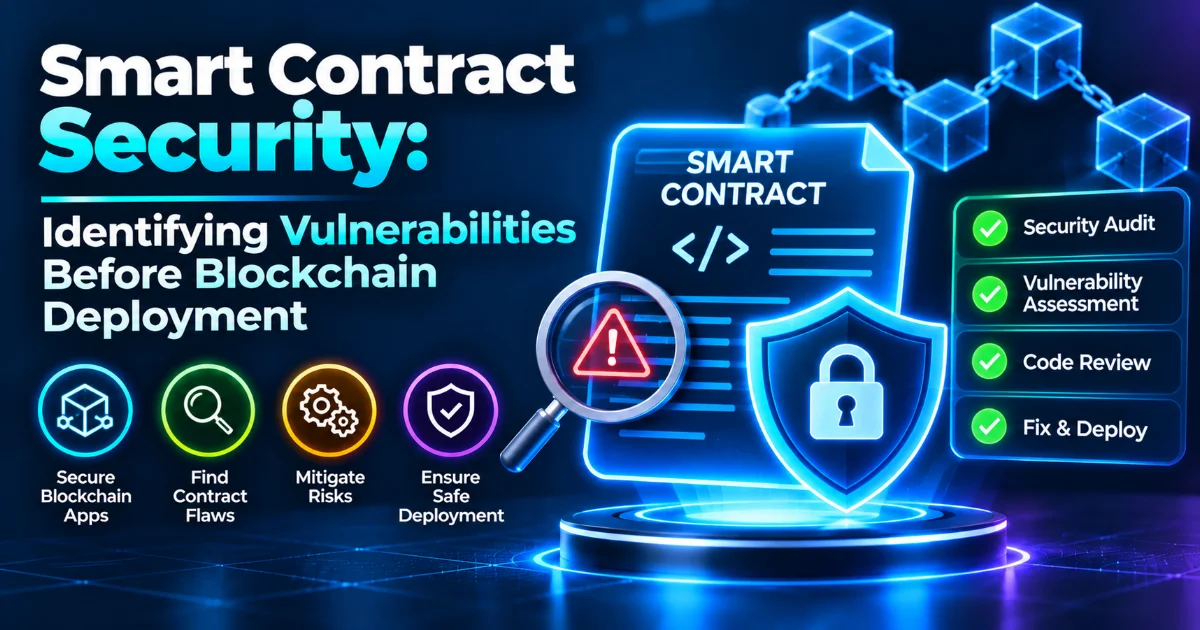
Smart Contract Security: Identifying Vulnerabilities Before Blockchain Deployment
By: Ganesan D
9 Nov 2026
Category:
Network Security
Introduction
Blockchain technology enables businesses to build decentralised applications, digital assets and automate financial processes. Unfortunately, vulnerabilities in smart contracts can cause issues such as financial losses, unwanted actions and exploitation. Implementing smart contract security helps reduce these risks.
What Is Smart Contract Security?
Smart contract security involves identifying potential vulnerabilities in blockchain applications both before and after deployment.
A smart contract audit helps identify issues related to:
- Contract logic and business rules.
- Access control and permission management.
- Transaction handling and execution.
- External integrations and dependencies.
- Potential attack scenarios and security weaknesses.
Why Is Smart Contract Immutability Important?
Blockchain technology is designed to be immutable. Once a smart contract has been deployed, modifying its code may not be possible, depending on its architecture and upgrade mechanisms.
Therefore, it is important to carry out security checks to ensure potential issues are identified before deployment. If vulnerabilities are discovered in deployed code, resolving them can be difficult and costly.
Smart contracts often handle financial transactions, digital assets and business-critical processes, making security testing an essential part of blockchain development.
Common Smart Contract Vulnerabilities
There are several vulnerabilities that attackers may exploit in smart contracts:
-
Reentrancy Attacks:
An attacker repeatedly calls a vulnerable contract function before the previous execution is completed, potentially affecting balances and withdrawals.
-
Integer Overflow and Underflow:
Arithmetic calculations can produce unexpected results when values exceed their permitted ranges or fall below zero. Modern Solidity versions include built-in arithmetic checks.
-
Access Control Vulnerabilities:
Missing or incorrectly configured permissions may allow unauthorised users to perform privileged actions.
-
Logic Errors:
Incorrect business logic or contract conditions can lead to unexpected behaviour and unwanted transactions.
-
Oracle Manipulation:
Attackers may exploit unreliable or manipulated external data sources used by smart contracts.
-
Front-Running Attacks:
Attackers may observe pending transactions and submit their own transactions with higher priority to gain an advantage.
These are some of the common vulnerabilities that security professionals aim to identify during a comprehensive smart contract audit.
Risks of Deploying Unverified Smart Contract Code
If organisations do not carry out security checks before deploying smart contracts, they may expose themselves to financial and operational risks.
Attackers could exploit coding weaknesses to:
- Steal digital assets and cryptocurrency.
- Manipulate or alter transactions.
- Bypass access controls and permissions.
- Exploit application logic and contract functions.
- Disrupt blockchain applications and business operations.
Blockchain transactions can be difficult or impossible to reverse, depending on the network and transaction circumstances. This can create long-term financial and business consequences.
Conducting a professional security assessment before deployment helps identify weaknesses and reduce the likelihood of exploitation.
Static Analysis and Manual Code Reviews
A comprehensive smart contract audit combines automated security tools with manual code reviews to identify different types of vulnerabilities.
Static analysis examines source code without executing the contract. Tools such as Slither and Mythril can help identify suspicious code patterns, potential vulnerabilities and programming weaknesses.
Manual code reviews allow security experts to examine contract logic, business requirements, access permissions and complex attack scenarios that automated tools may not fully identify.
Combining automated analysis with expert reviews provides broader security coverage and helps organisations understand their smart contract risks.
Formal Verification and Smart Contract Testing
Formal verification uses mathematical techniques to verify whether smart contracts satisfy defined properties and security requirements.
Other important smart contract testing methods include:
-
Unit and Integration Testing:
Verifies individual contract functions and interactions between components.
-
Fuzz Testing:
Uses random or unexpected inputs to identify unusual behaviour and potential vulnerabilities.
-
Boundary Testing:
Checks how contracts behave when values reach minimum, maximum or unexpected limits.
-
Adversarial Testing:
Simulates malicious actions to identify weaknesses in contract security.
-
Testnet Deployment:
Deploys contracts in a test environment to verify transactions and contract behaviour before production deployment.
-
Gas Usage and Execution Testing:
Evaluates transaction execution costs and identifies inefficient operations.
A blockchain security audit should identify technical vulnerabilities and verify that smart contracts behave as expected under defined conditions.
Security Throughout the Web3 Development Lifecycle
Smart contract security should be considered throughout the entire Web3 development lifecycle rather than only before deployment.
-
Design:
Define security requirements, review architecture and identify potential attack surfaces.
-
Development:
Follow secure coding standards and use trusted libraries and development frameworks.
-
Testing:
Perform automated scanning, unit testing and vulnerability assessments.
-
Security Audit:
Conduct manual code reviews and detailed security assessments to identify complex vulnerabilities.
-
Deployment:
Verify contract configurations, access permissions and deployment settings before launching on the blockchain.
-
Maintenance:
Monitor contract activity, review upgrades and conduct additional security assessments when changes introduce new risks.
Frequently Asked Questions
1. What Is a Smart Contract Audit?
A smart contract audit is a security assessment that identifies vulnerabilities, logical flaws, coding errors and access control weaknesses in blockchain-based smart contracts.
2. Can Automated Tools Replace Manual Smart Contract Audits?
No. Automated tools can identify many common vulnerabilities, but manual testing is important for understanding complex contract logic, business requirements and sophisticated attack scenarios. Combining both approaches provides more comprehensive security coverage.
3. Should Smart Contracts Be Audited After Deployment?
Yes. Changes to smart contracts, dependencies, integrations or supporting infrastructure may introduce new security risks. Additional testing and security reviews should be performed whenever significant changes occur.
Conclusion
Smart contract security is an important part of protecting blockchain applications, digital assets and decentralised business processes. Using automated security tools, manual code reviews, formal verification and pre-deployment testing helps organisations identify vulnerabilities and minimise security risks.
Strengthen Your Blockchain Security with Agan Cyber Security LLC
Agan Cyber Security LLC can help organisations improve their blockchain security through professional cybersecurity assessments and vulnerability identification. Our team has expertise in identifying security weaknesses and assessing risks within business applications.
Get in touch with our team to discuss your smart contract security needs and blockchain security requirements in Dubai and throughout the UAE.
Contact us today to discuss your security requirements.