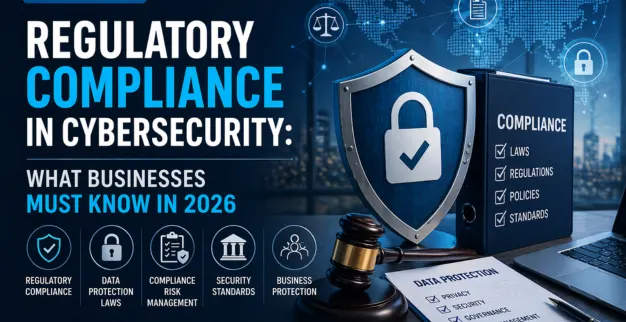
Regulatory Compliance in Cybersecurity: What Businesses Must Know in 2026
23 Apr 2026
Category: Cyber Security
In 2026, cybersecurity is not just about protecting systems—it’s about meeting strict legal and regulatory requirements. Businesses must ensure regulatory compliance cybersecurity to avoid penalties, protect data, and maintain customer trust.
With evolving data protection laws and global security standards, organizations need strong compliance risk management strategies to stay secure and compliant.
What is Cybersecurity Compliance
Regulatory compliance cybersecurity refers to following laws, regulations, and security standards designed to protect sensitive data and digital systems.
It ensures that organizations:
- Protect customer and business data
- Follow industry-specific data protection laws
- Implement proper security controls
- Reduce risks through effective compliance risk management
Compliance is not a one-time task—it is an ongoing process that requires continuous monitoring and improvement.
Key Regulations Businesses Must Know
To achieve regulatory compliance cybersecurity, organizations must understand key global and industry regulations:
1. GDPR (General Data Protection Regulation)
Focuses on protecting personal data and privacy for individuals.
2. ISO 27001
An international standard for information security management systems.
3. PCI DSS (Payment Card Industry Data Security Standard)
Ensures secure handling of payment card information.
4. HIPAA (Health Insurance Portability and Accountability Act)
Protects sensitive healthcare data.
These regulations define strict security standards and enforce adherence to data protection laws.
Risks of Non-Compliance
Failing to meet regulatory compliance cybersecurity requirements can have serious consequences:
- Heavy financial penalties and fines
- Legal actions and regulatory sanctions
- Data breaches and loss of sensitive information
- Damage to brand reputation and customer trust
- Increased compliance risk management challenges
Ignoring data protection laws not only impacts security but also affects business continuity.
How to Stay Compliant
To maintain regulatory compliance cybersecurity, businesses should adopt a structured approach:
1. Understand Applicable Regulations
Identify which data protection laws and security standards apply to your industry.
2. Implement Strong Security Controls
Use encryption, access control, and monitoring tools to protect data.
3. Conduct Regular Audits
Assess systems and processes to ensure compliance requirements are met.
4. Employee Training
Educate staff on security policies and compliance practices.
5. Continuous Monitoring
Track security activities and update strategies to reduce risks.
6. Develop a Compliance Strategy
Use effective compliance risk management to identify and mitigate potential risks.
Following these steps helps businesses stay aligned with regulations and avoid compliance issues.
Conclusion
In 2026, regulatory compliance cybersecurity is essential for every organization. By understanding data protection laws, adhering to security standards, and implementing strong compliance risk management, businesses can protect their data and avoid costly penalties.
A proactive approach to compliance ensures long-term security, trust, and business success.
FAQ
1. What is regulatory compliance in cybersecurity?
It refers to following laws and standards to protect data and systems.
2. Why are data protection laws important?
They ensure the privacy and security of sensitive information.
3. What is compliance risk management?
It is the process of identifying and reducing risks related to non-compliance.
4. What happens if a business is non-compliant?
It may face fines, legal issues, and reputational damage.
5. How can businesses stay compliant?
By following regulations, implementing security controls, and conducting regular audits.