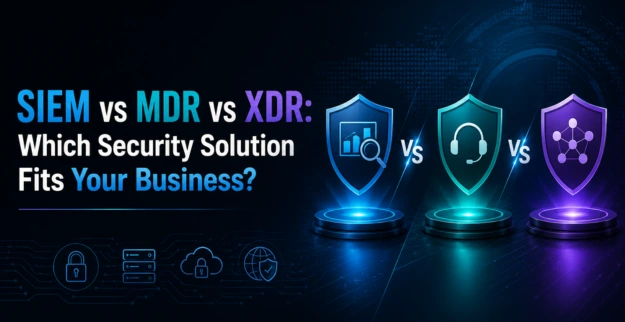
SIEM vs MDR vs XDR: Which Security Solution Fits Your Business?
22 July 2026
As cyber threats continue to evolve, businesses need advanced security solutions that can detect, investigate, and respond to attacks before they cause serious damage. However, choosing between SOC SIEM, Managed Detection and Response (MDR), and Extended Detection and Response (XDR) can be challenging, as each solution serves a different purpose.
Understanding how these technologies work helps organizations build a stronger cybersecurity strategy. Whether you need centralized visibility through a cloud based SIEM, expert-managed threat detection, or AI-driven security automation, selecting the right solution depends on your business size, security maturity, and operational requirements.
SIEM Overview
A Security Information and Event Management (SIEM) platform collects, analyzes, and correlates security logs from multiple sources across an organization's IT environment.
A SOC SIEM serves as the foundation of a Security Operations Center by providing centralized visibility into security events.
Key Features of SIEM
- Collects logs from servers, endpoints, firewalls, cloud platforms, and applications
- Correlates security events from multiple sources
- Generates real-time security alerts
- Supports compliance reporting and auditing
- Enables security investigations
Many organizations now prefer a cloud based SIEM because it offers faster deployment, scalability, lower infrastructure costs, and simplified management.
MDR Overview
Managed Detection and Response (MDR) is a fully managed cybersecurity service where experienced security professionals continuously monitor, detect, investigate, and respond to cyber threats.
Unlike SIEM, MDR combines advanced security technologies with human expertise to provide active threat hunting and rapid incident response.
Benefits of MDR
- 24/7 threat monitoring
- Continuous threat hunting
- Rapid incident response
- Expert security analysts
- Reduced workload for internal IT teams
MDR is an excellent choice for organizations that require enterprise-level protection without maintaining an in-house Security Operations Center.
XDR Overview
Extended Detection and Response (XDR) is a modern security platform that integrates data from multiple security layers, including endpoints, email, cloud workloads, networks, and identities.
XDR uses automation and artificial intelligence to detect complex attacks across the entire IT environment.
Key Features of XDR
- Unified visibility across multiple security tools
- Automated threat correlation
- AI-driven threat detection
- Faster investigation and response
- Improved security efficiency
XDR helps reduce alert fatigue by combining related security events into a single, prioritized incident.
Comparison
| Feature |
SIEM |
MDR |
XDR |
| Primary Focus |
Centralized log management and monitoring |
Managed threat detection and response |
Integrated threat detection across multiple security layers |
| Management |
Internal security team |
Security experts manage the service |
Internal team with automated platform capabilities |
| Threat Detection |
Rule-based correlation |
Human-led threat hunting and analysis |
AI-driven detection and automated correlation |
| Incident Response |
Requires internal response team |
Included as a managed service |
Automated response with analyst support |
| Best For |
Organizations with dedicated SOC teams |
Businesses lacking in-house cybersecurity expertise |
Organizations seeking unified, intelligent threat detection |
Each solution addresses different cybersecurity needs and can also complement one another.
Which Solution Is Best?
The right solution depends on your organization's cybersecurity maturity and available resources.
Choose SOC SIEM if you need:
- Centralized log management
- Compliance reporting
- Security monitoring within an existing SOC
Choose Managed Detection and Response (MDR) if you need:
- 24/7 expert monitoring
- Threat hunting and incident response
- Managed cybersecurity operations
Choose Extended Detection and Response (XDR) if you need:
- Unified security across endpoints, cloud, email, and networks
- AI-powered threat detection
- Faster automated investigations
Many businesses achieve the best protection by combining a cloud based SIEM with MDR or XDR capabilities for comprehensive visibility and rapid threat response.
Conclusion
Choosing between SOC SIEM, Managed Detection and Response (MDR), and Extended Detection and Response (XDR) depends on your organization's security goals, resources, and risk profile. SIEM provides centralized visibility, MDR delivers expert-managed security operations, and XDR offers intelligent, automated threat detection across the entire IT environment.
By selecting the right solution—or combining multiple technologies—businesses can improve threat detection, strengthen incident response, and build a resilient cybersecurity strategy for the future.