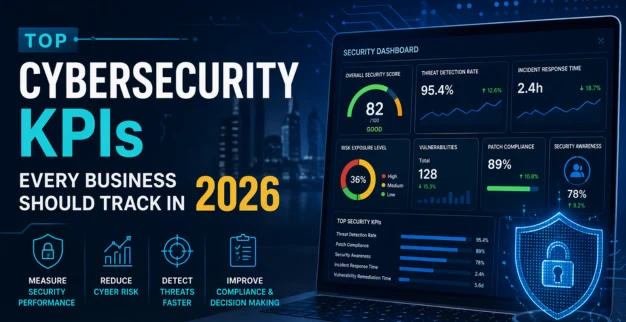
Top Cybersecurity KPIs Every Business Should Track in 2026
22 Apr 2026
Category: Cyber Security
In 2026, cybersecurity is no longer just a technical function—it’s a business priority. Organizations must continuously evaluate their security posture using measurable indicators. This is where cybersecurity KPIs become essential.
By tracking the right security performance metrics, businesses can improve visibility, strengthen defenses, and make informed decisions through effective KPI reporting and security scorecards.
What are Cybersecurity KPIs
Cybersecurity KPIs (Key Performance Indicators) are measurable values used to evaluate how effectively an organization is managing its cybersecurity efforts.
These indicators help track performance, identify gaps, and support strategic planning. When combined with security scorecards, they provide a clear overview of an organization’s security health.
Using proper KPI reporting, businesses can communicate risks and improvements to stakeholders in a structured way.
Important Metrics to Track
To build an effective KPI framework, organizations should focus on key security performance metrics:
1. Incident Detection Time
Measures how quickly threats are identified. Faster detection reduces damage.
2. Incident Response Time
Tracks how quickly security teams respond to and contain incidents.
3. Number of Security Incidents
Monitors the frequency of cyberattacks over a specific period.
4. Vulnerability Remediation Time
Measures how long it takes to fix identified vulnerabilities.
5. Patch Management Rate
Tracks how quickly systems are updated with security patches.
6. User Awareness & Training Metrics
Evaluates employee participation in cybersecurity training programs.
7. Compliance Rate
Measures adherence to regulatory and internal security standards.
These cybersecurity KPIs provide actionable insights and improve overall security posture.
How to Measure Cybersecurity KPIs
Accurate measurement is critical for meaningful insights. Here’s how businesses can effectively track security performance metrics:
- Use automated monitoring and analytics tools
- Integrate data from multiple security systems
- Set clear benchmarks and targets
- Continuously review and update KPI thresholds
- Align KPIs with business objectives
By combining data from various sources, organizations can create reliable security scorecards for better evaluation.
KPI Reporting Strategies
Effective KPI reporting ensures that cybersecurity performance is clearly communicated across the organization.
1. Use Security Scorecards
Visual security scorecards help present complex data in a simple and understandable format.
2. Customize Reports for Stakeholders
Different teams require different insights—technical teams need detailed data, while executives need high-level summaries.
3. Regular Reporting Schedule
Conduct weekly, monthly, or quarterly reports to track progress consistently.
4. Focus on Actionable Insights
Reports should not just present data—they should highlight risks and recommend actions.
5. Use Visual Dashboards
Graphs and dashboards make KPI reporting more engaging and easier to interpret.
These strategies ensure that cybersecurity KPIs drive real business value.
Conclusion
Tracking the right cybersecurity KPIs is essential for maintaining a strong security posture in 2026. By focusing on relevant security performance metrics, using clear security scorecards, and implementing effective KPI reporting, businesses can stay ahead of evolving threats.
A data-driven approach to cybersecurity not only improves protection but also supports smarter decision-making and long-term success.
FAQ
1. What are cybersecurity KPIs?
They are measurable indicators used to evaluate the effectiveness of cybersecurity efforts.
2. Why are security performance metrics important?
They help identify gaps, improve security, and support decision-making.
3. What are security scorecards?
They are visual tools used to track and present cybersecurity performance.
4. How often should KPI reporting be done?
It depends on the organization, but monthly or quarterly reporting is common.
5. What is the goal of KPI reporting?
To provide insights, track progress, and support strategic cybersecurity decisions.