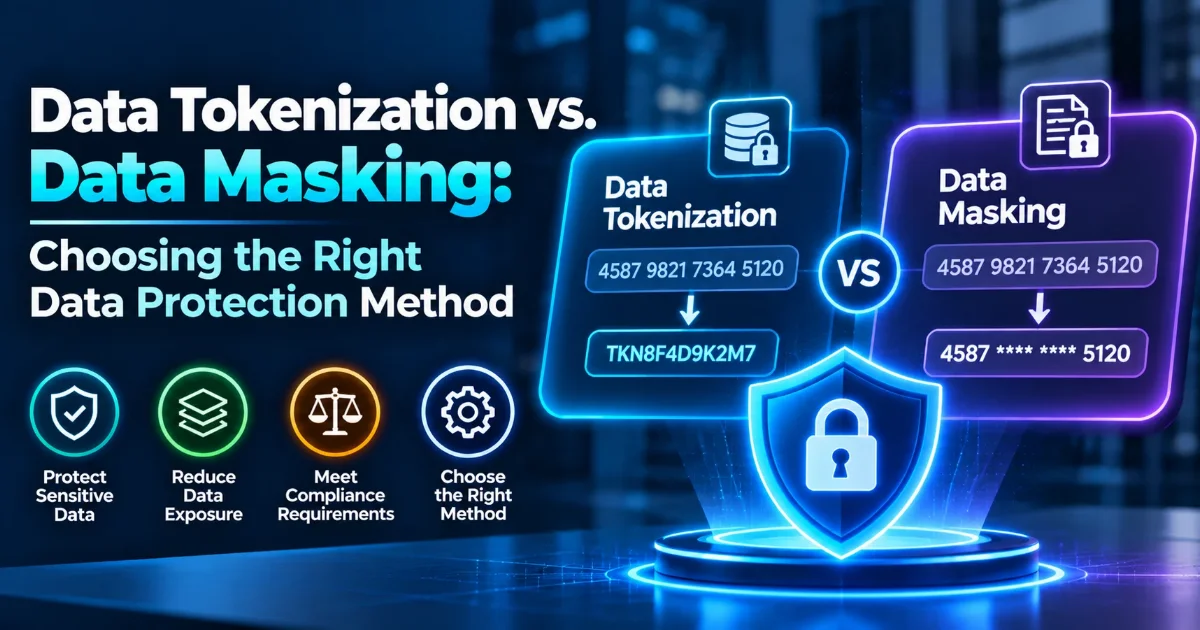
Data Tokenization vs Data Masking: Choosing the Right Data Protection Method
By:
Ganesan D
3 Nov 2026
Category:
Cyber Security
Introduction
Businesses handle sensitive information such as customer details,
payment records, employee information, and financial data. Protecting
this information is essential to reduce data exposure and maintain privacy.
Data tokenization and data masking are two techniques organisations
use to protect sensitive information. Although both reduce exposure,
they work differently and serve different purposes.
What Is Data Tokenization?
Data tokenization replaces sensitive information with a randomly
generated value called a token. The original data is stored separately
in a secure token vault or protected system.
For example, a payment card number can be replaced with a token that
applications use without directly exposing the original card details.
Tokenization is commonly used in payment processing, financial
applications, and systems that need to reference sensitive data securely.
What Is Data Masking?
Data masking replaces or hides sensitive information with modified,
fictional, or partially concealed values. It allows authorised teams
to work with data without exposing the original information.
For example, a customer email address such as
customer@example.com
may be displayed as
c******r@example.com.
Data masking is frequently used in software development, testing,
analytics, and training environments where realistic data is useful
but actual personal information is unnecessary.
How Do Tokenization and Data Masking Work?
Data Tokenization:
- Sensitive data is submitted to a tokenization system.
- The system generates a replacement token.
- The original value is stored securely.
- Authorised applications retrieve the original value only through approved processes.
Data Masking:
- Sensitive information is identified.
- A masking rule modifies or replaces the original values.
- Users access the masked dataset instead of the original information.
- Masking can be applied to production views, test environments, or exported datasets.
Key Differences Between Data Masking and Tokenization
| Comparison |
Data Tokenization |
Data Masking |
| Main Purpose |
Replace sensitive data with tokens |
Hide or modify sensitive values |
| Original Data |
Stored separately |
May remain in the original system |
| Reversibility |
Possible through authorised token mapping |
Depends on the masking technique |
| Common Use |
Payment processing and data protection |
Testing, analytics, and development |
| Data Usability |
Supports controlled retrieval of original values |
Provides modified data for selected uses |
Understanding tokenization vs data masking helps businesses select
the right approach for their data protection requirements.
Security Benefits and Limitations
Benefits of Tokenization
- Reduces direct exposure of sensitive information.
- Limits access to original data through controlled systems.
- Helps protect payment and customer information.
Limitations of Tokenization
- Requires secure token storage and management.
- Token vault compromise can expose original information.
- Integration and operational complexity may increase.
Benefits of Data Masking
- Reduces exposure in testing and development environments.
- Supports safer data sharing and analytics.
- Can preserve useful data structures for business activities.
Limitations of Data Masking
- Poorly designed masking may allow sensitive information to be inferred.
- Static masking may affect data accuracy or relationships.
- Masked values may not support every business operation.
Common Business Use Cases
Businesses can use tokenization for payment transactions, customer
identifiers, financial records, and applications that need controlled
access to original data.
Data masking is useful when creating test datasets, sharing information
with external teams, training employees, or conducting analytics without
revealing actual personal details.
In some environments, organisations use both methods to provide
additional protection.
Compliance and Data Privacy Considerations
Data protection methods should support applicable privacy, security,
and industry requirements. Businesses should consider access controls,
encryption, data retention, audit logging, and secure handling of
original information.
Tokenized or masked data should not automatically be assumed to be
anonymous or outside regulatory requirements. The level of protection
depends on whether the original information can be recovered or linked
back to individuals.
How to Choose the Right Approach
Choose tokenization when applications need to reference sensitive
values while restricting access to the original information.
Choose data masking when teams need realistic but modified data
for development, testing, reporting, or analytics.
Consider combining both techniques when protecting highly sensitive
business information across multiple systems.
Frequently Asked Questions
1. Is tokenization more secure than data masking?
Neither is universally more secure. The right choice depends on the
data, implementation, access requirements, and threat model.
2. Can data masking be reversed?
Some masking methods are reversible, while others permanently
replace or remove original values.
3. Can businesses use tokenization and masking together?
Yes. Tokenization can protect sensitive production values, while
masking can provide safer datasets for testing and analytics.
Conclusion
Data tokenization and data masking help businesses reduce sensitive
data exposure, but they serve different purposes. Understanding their
capabilities and limitations allows organisations to choose suitable
protection methods for their applications and workflows.
Strengthen your data protection strategy with Agan Cyber Security LLC.
Our cybersecurity services can help identify data security risks,
assess vulnerabilities, and improve information protection controls.
Contact our team to discuss data security and cybersecurity
requirements in Dubai and across the UAE.