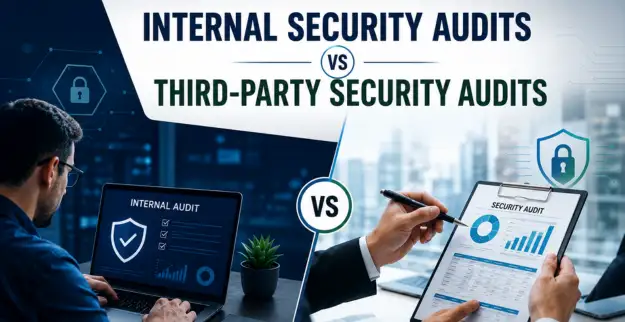
Internal Security Audits vs Third-Party Security Audits
01 July 2026
As cyber threats continue to grow and regulatory requirements become more demanding, organizations must regularly evaluate their security posture. Conducting a cyber security audit helps identify vulnerabilities, improve compliance, and strengthen overall security. However, businesses often face an important question: should they perform an internal security audit or hire an independent third-party auditor?
Understanding the differences between an internal security audit vs third party security audit helps organizations choose the right approach based on their business objectives, compliance requirements, and risk profile.
What is an Internal Security Audit?
An internal security audit is conducted by an organization's own IT or cybersecurity team to evaluate the effectiveness of existing security controls, policies, and procedures.
The primary goal is to identify weaknesses before they become serious security issues.
Internal Audit Activities
- Review security policies and procedures
- Assess network and system configurations
- Perform internal security assessments
- Identify vulnerabilities and security gaps
- Monitor compliance with internal policies
Internal audits provide continuous visibility into an organization's cybersecurity posture and support ongoing improvements.
What is a Third-Party Security Audit?
A third-party security audit is performed by an independent cybersecurity firm or external auditor with no involvement in the organization's daily IT operations.
These audits provide an unbiased assessment of the organization's security controls and are often required for regulatory or customer compliance.
Third-Party Audit Activities
- Independent cyber security audit
- Compliance audit against industry standards
- Penetration testing and vulnerability validation
- Risk analysis and reporting
- Recommendations for remediation
Because external auditors provide an objective perspective, they often identify risks that internal teams may overlook.
Key Differences
Although both audits evaluate security, they differ in several important ways.
| Internal Security Audit |
Third-Party Security Audit |
| Conducted by internal employees |
Conducted by independent experts |
| Continuous or scheduled assessments |
Objective and unbiased evaluation |
| Focuses on operational improvements |
Supports regulatory compliance audits |
| Lower implementation cost |
Validates security controls independently |
| Strong understanding of internal systems |
Provides industry best-practice recommendations |
Both approaches play an important role in maintaining a strong cybersecurity program.
Pros & Cons
Internal Security Audit
Pros
- Continuous monitoring and improvement
- Faster issue identification
- Lower long-term cost
- Better knowledge of business operations
Cons
- Potential bias in assessments
- Limited specialized expertise
- May overlook hidden vulnerabilities
Third-Party Security Audit
Pros
- Independent and objective assessment
- Greater technical expertise
- Supports compliance requirements
- Identifies overlooked security risks
Cons
- Higher initial cost
- Conducted periodically rather than continuously
- External teams require time to understand the environment
Which One is Better?
The best approach is not choosing one over the other—it is combining both.
An internal audit helps organizations continuously improve security, while a third-party audit validates those controls through an independent review.
Businesses should use internal audits for routine security assessments and operational improvements, while third-party audits are ideal for regulatory compliance, customer assurance, penetration testing, and independent risk validation.
Using both methods provides stronger security, better compliance, and improved cyber resilience.
Conclusion
Choosing between an internal security audit vs third party security audit depends on business goals, compliance requirements, and risk tolerance. Internal audits support ongoing security management, while third-party audits provide independent validation and expert recommendations.
By combining regular cyber security audits, continuous security assessments, and independent compliance audits, organizations can identify vulnerabilities early, strengthen security controls, and maintain a proactive cybersecurity strategy.