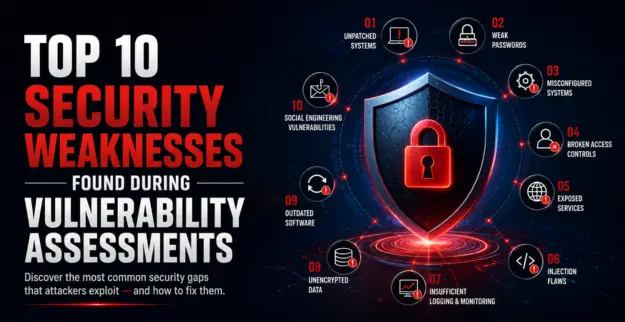
Top 10 Security Weaknesses Found During Vulnerability Assessments
12 August 2026
Introduction
Cyberattacks often begin with a small security gap that attackers can identify and exploit. Organizations may have firewalls, antivirus software, and other security controls in place, but hidden weaknesses can still exist across servers, applications, networks, endpoints, and cloud environments.
A regular Vulnerability Assessment helps organizations discover these weaknesses before cybercriminals can exploit them. Through vulnerability scanning and detailed analysis, security teams can identify security gaps, evaluate their severity, and recommend appropriate corrective actions. A comprehensive Cyber Security Assessment provides businesses with greater visibility into their overall security posture.
Why Vulnerability Assessments Matter
A Vulnerability Assessment provides a proactive approach to identifying and managing security risks.
Key Benefits
- Identifies security vulnerabilities across IT environments
- Detects outdated and vulnerable software
- Highlights configuration weaknesses
- Helps prioritize critical security risks
- Supports compliance and audit requirements
- Reduces the likelihood of successful cyberattacks
- Strengthens the organization's overall security posture
Regular assessments help businesses identify problems before they become major security incidents.
Top 10 Weaknesses
During vulnerability scanning and security assessments, organizations commonly discover the following weaknesses.
1. Outdated Software
Older operating systems, applications, and firmware may contain known vulnerabilities that attackers can exploit.
2. Missing Security Patches
Delayed patching can leave systems exposed to publicly known security weaknesses. Regular patch management helps reduce this risk.
3. Weak Password Policies
Simple, reused, or compromised passwords can make user accounts easier to access without authorization.
4. Missing Multi-Factor Authentication
Systems that rely only on passwords are more vulnerable to credential theft and account compromise.
5. Misconfigured Firewalls
Incorrect firewall rules can unintentionally expose internal services or allow unnecessary network access.
6. Open Network Ports
Unnecessary open ports and exposed services increase the organization's attack surface and may provide attackers with additional entry points.
7. Excessive User Privileges
Users with more permissions than necessary increase the risk of unauthorized access, accidental changes, and insider threats.
8. Insecure Applications
Poorly secured applications may contain vulnerabilities such as injection flaws, authentication weaknesses, or inadequate access controls.
9. Poor Data Protection
Sensitive business information may be exposed when encryption, access controls, or secure data-handling practices are inadequate.
10. Inadequate Logging and Monitoring
Without sufficient security logs and monitoring, organizations may struggle to identify suspicious activities and respond to incidents quickly.
Risk Prioritization
Not every vulnerability requires immediate remediation. Security teams should prioritize findings according to their potential impact and likelihood of exploitation.
Factors to Consider
- Vulnerability severity
- Exploit availability
- Criticality of the affected system
- Sensitivity of exposed data
- Potential business impact
- Likelihood of exploitation
Critical vulnerabilities affecting business-critical systems should generally receive immediate attention, while lower-risk issues can be addressed according to a defined remediation schedule.
Remediation Tips
Once vulnerabilities have been identified, organizations should take corrective action.
Recommended Actions
- Apply security patches and software updates promptly
- Strengthen password and authentication policies
- Enable Multi-Factor Authentication
- Remove unnecessary open ports and services
- Review firewall configurations
- Apply least-privilege access controls
- Secure applications and APIs
- Encrypt sensitive information
- Improve security logging and monitoring
- Conduct follow-up vulnerability scanning
After remediation, organizations should perform a reassessment to confirm that identified weaknesses have been properly addressed.
Conclusion
A regular Vulnerability Assessment is an important part of a proactive cybersecurity strategy. Common weaknesses such as outdated software, missing patches, weak authentication, misconfigurations, excessive privileges, and inadequate monitoring can provide attackers with opportunities to compromise business systems.
By combining vulnerability scanning, risk prioritization, remediation, and follow-up testing, businesses can continuously improve their security posture. A professional Cyber Security Assessment can provide deeper visibility into existing risks and help organizations build stronger defenses against evolving cyber threats.