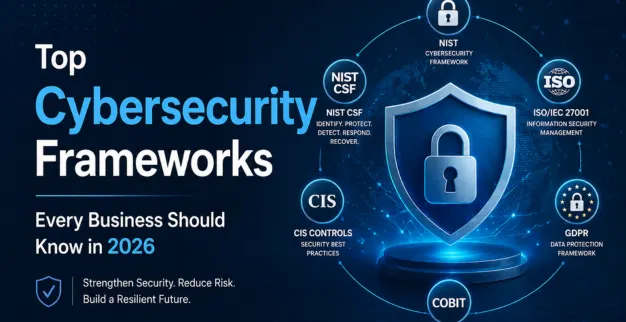
Top Cybersecurity Frameworks Every Business Should Know in 2026
27 Apr 2026
Category: Cyber Security
In 2026, businesses face increasing cyber threats and stricter regulatory requirements. To manage these challenges effectively, organizations must adopt a strong cybersecurity governance framework.
Frameworks like the NIST framework and ISO standards provide structured approaches to managing risks, ensuring compliance, and strengthening overall security posture.
Overview of Frameworks
A cybersecurity governance framework is a structured set of guidelines, policies, and best practices that help organizations manage cybersecurity risks.
Some of the most widely used frameworks include:
1. NIST Framework
The NIST framework (National Institute of Standards and Technology) provides a flexible approach to identifying, protecting, detecting, responding to, and recovering from cyber threats.
2. ISO Standards
ISO standards, such as ISO 27001, define international best practices for information security management systems.
3. CIS Controls
A set of prioritized security actions designed to protect systems and data from common threats.
These frameworks help organizations achieve better compliance and improve their cybersecurity strategies.
Comparison of Frameworks
Understanding the differences between frameworks helps in selecting the right cybersecurity governance framework:
NIST Framework
Flexible and risk-based approach
Suitable for organizations of all sizes
Focuses on continuous improvement
ISO Standards
Globally recognized and certification-based
Strong focus on documentation and processes
Ideal for organizations seeking formal compliance
CIS Controls
Practical and action-oriented
Focuses on critical security controls
Easier to implement for small and medium businesses
Each framework supports compliance but varies in complexity and implementation style.
Implementation of Cybersecurity Frameworks
To successfully adopt a cybersecurity governance framework, businesses should follow these steps:
1. Assess Current Security Posture
Evaluate existing systems and identify gaps.
2. Choose the Right Framework
Select between the NIST framework, ISO standards, or other frameworks based on business needs.
3. Define Policies and Procedures
Establish clear security policies aligned with chosen frameworks.
4. Implement Security Controls
Deploy tools and processes to address identified risks.
5. Monitor and Improve
Continuously monitor performance and update strategies to maintain compliance.
A structured implementation ensures effective risk management and security improvement.
Benefits of Using Cybersecurity Frameworks
Adopting a cybersecurity governance framework provides several benefits:
Improved risk management and threat detection
Enhanced compliance with regulations and standards
Better decision-making and resource allocation
Increased trust among customers and stakeholders
Stronger overall security posture
Frameworks like the NIST framework and ISO standards help businesses stay resilient against evolving cyber threats.
Conclusion
In 2026, adopting the right cybersecurity governance framework is essential for business success. Whether you choose the NIST framework, ISO standards, or other models, these frameworks provide the foundation for strong security and compliance.
A proactive and structured approach ensures long-term protection and growth in an increasingly digital world.
FAQ
1. What is a cybersecurity governance framework?
It is a structured approach to managing cybersecurity risks and policies.
2. What is the NIST framework?
It is a widely used framework for managing and improving cybersecurity practices.
3. What are ISO standards in cybersecurity?
They are international standards for information security management.
4. Why is compliance important in cybersecurity?
It helps businesses meet legal requirements and avoid penalties.
5. Which framework is best for businesses?
It depends on business size, industry, and security requirements.