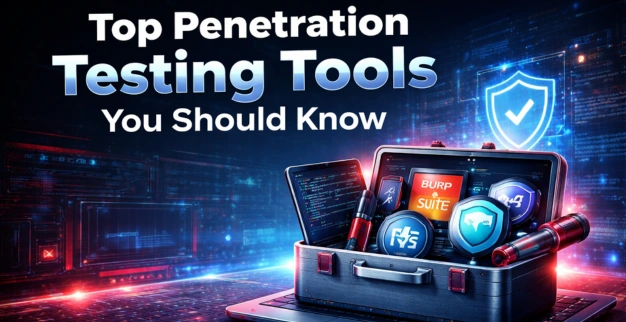
Top Penetration Testing Tools You Should Know
24 Feb 2026
Category: Cyber Security
The digital world today experiences a rapid increase in cyber threats, which makes security testing essential for current security requirements. Organizations need to conduct regular system assessments to discover security weaknesses that hackers could potentially use to their advantage. Organizations use penetration testing tools as essential resources to safeguard their networks and applications and their confidential information.
What Is Penetration Testing?
Penetration testing functions as a cybersecurity method which tests systems and networks and applications through simulated actual cyberattacks. The process helps organizations discover their security vulnerabilities before they become targets of actual cyberattacks. Organizations can enhance their security systems through professional penetration testing tools which help them decrease operational dangers.
Top Penetration Testing Tools and Their Features
1. Metasploit by (Rapid7)
- Offers security professionals with access to their extensive collection of documented security flaws and exploitation techniques.
- The system enables security teams to replicate actual hacking scenarios through its testing capabilities.
- The system enables security professionals to conduct both automatic testing and manual security assessment work.
2. Burp Suite / Burp Scanner (by PortSwigger)
- The software tests websites to find security vulnerabilities through its SQL injection and XSS detection capabilities.
- The system provides advanced proxy tools that enable users to conduct manual testing.
- The system creates comprehensive vulnerability assessment documents.
3. Nessus (by Tenable)
- The system executes automated processes to conduct vulnerability detection.
- The system detects both misconfigured settings and software programs that need to be updated.
- The system provides reports which assess compliance requirements and evaluate risk factors.
4. OWASP ZAP (by OWASP)
- The web application scanner provides its users with both free access and complete source code.
- The system can identify typical web security weaknesses through its straightforward detection method.
- The system provides access to both entry-level users and advanced users who need professional capabilities.
5. Nmap (by Nmap Project)
- The system detects all devices and services which operate on the networked environment.
- The system performs port scanning together with security vulnerability detection.
- The tool serves as an essential resource for conducting penetration tests at the network level.
Tool Categories in Penetration Testing
1. Network Penetration Testing Tools
The tools conduct network infrastructure examinations to discover security vulnerabilities which include open ports and weak firewall protection and insecure protocol usage. Nmap and Nessus serve as two examples of such tools.
2. Web Application Testing Tools
Web pentest tools focus on detecting vulnerabilities in websites and web applications, such as SQL injection, XSS, and authentication flaws. The security testing of web applications takes advantage of Burp Suite and OWASP ZAP as its primary tools.
3. Mobile Application Testing Tools
The tools test security threats for both Android and iOS applications by assessing their protection against insecure APIs and weak encryption and data leakage. The applications provide security measures for both mobile users and corporate environments.
Pros and cons:
Pros
- Finds security weaknesses early
- Helps prevent cyber attacks
- Improves system and network security
- Supports compliance standards
- Provides detailed security reports
Cons
- Some tools are costly
- Requires skilled professionals
- Setup and configuration can be complex
- Testing may affect system performance
- False positives may occur
Use Case Examples
1. Website Security Testing
The company employs Burp Scanner and OWASP ZAP to identify security weaknesses in its customer portal before it activates a new product feature.
2. Network Security Assessment
The IT department employs Nmap and Nessus to perform network scans which help them eliminate security vulnerabilities throughout their internal systems.
3. Ethical Hacking Simulation
Security professionals use Metasploit to create realistic cyberattack simulations which help them enhance their incident response strategies.
4. Compliance Audits
Organizations implement pentest tools to achieve compliance with ISO, GDPR, and cybersecurity requirements.
Steps of penetration testing:
- The testing plan needs approval for its testing components.
- The system needs detailed information collection through the process.
- The process identifies system vulnerabilities through its scanning function which detects open ports.
- The safe hacking test checks system security through testing.
- The process verifies which data resources are available for access.
- The report documents all discoveries together with their associated dangers.
- The team will resolve existing problems before conducting another round of testing.
Frequently Asked Questions:
1. How much do penetration testers make in Dubai?
The monthly salary range for penetration testers in Dubai starts at AED 8,000 and reaches AED 20,000 depending on their professional background.
2. What are the top 5 penetration testing techniques?
The primary methods of testing networks include network scanning and vulnerability assessment and social engineering and web application testing and wireless testing.
3. Is Dubai good for cyber security?
Dubai serves as a major cybersecurity center because it has strong demand for cybersecurity professionals and advanced cybersecurity infrastructure and expanding cybersecurity job opportunities.
4. Can AI replace pentesters?
The testing process can benefit from AI support but human experts are essential to perform critical thinking tasks and realistic attack simulation operations.
5. Do pentesters need CCNA?
Penetration testing skills can be improved through CCNA training, which provides essential networking knowledge, although CCNA certification is not a required skill for the profession.
You should contact Agan Cyber Security LLC today to receive their professional penetration testing services and their complete cybersecurity protection solutions.