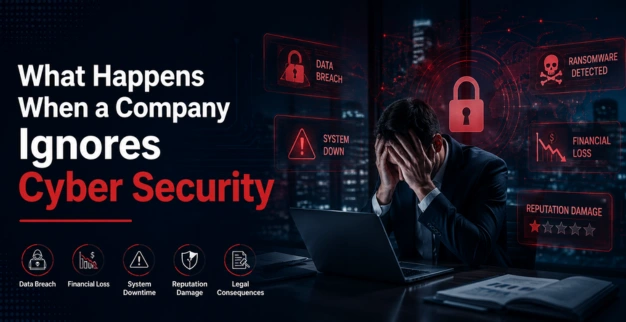
What Happens When a Company Ignores Cyber Security
30 June 2026
In today's digital world, businesses rely heavily on technology to manage operations, communicate with customers, and store sensitive information. Despite this growing dependence, many organizations continue to delay cybersecurity investments, assuming they are too small to become targets or that existing security measures are sufficient.
Unfortunately, cybercriminals actively target businesses of all sizes. Ignoring cybersecurity can expose organizations to serious cyber security risks, including ransomware attacks, data breaches, financial losses, and operational disruption. Investing in professional cyber security services and effective data breach prevention strategies is no longer optional—it's essential for protecting modern business security.
Why Businesses Ignore Cyber Security
Many organizations underestimate the importance of cybersecurity until an incident occurs.
Common reasons include:
- Believing cyberattacks only affect large enterprises
- Limited cybersecurity budgets
- Dependence on outdated security tools
- Lack of employee cybersecurity awareness
- Assuming antivirus software alone provides complete protection
These misconceptions often leave businesses vulnerable to evolving cyber threats.
Immediate Risks
Ignoring cybersecurity can quickly expose organizations to multiple threats.
1. Data Breaches
Weak security controls allow attackers to access confidential customer, financial, and business information.
2. Ransomware Attacks
Cybercriminals can encrypt critical business data, disrupting operations and demanding ransom payments.
3. Unauthorized Access
Poor identity management and weak passwords increase the risk of compromised user accounts.
4. Operational Downtime
Cyber incidents can interrupt business operations, reduce productivity, and delay customer services.
Without effective data breach prevention, these incidents can escalate rapidly.
5. Financial Impact
Cybersecurity incidents can create significant financial consequences.
Businesses may experience:
- Revenue loss due to operational downtime
- Recovery and remediation costs
- Regulatory fines and legal expenses
- Increased IT and cybersecurity investments
- Loss of future business opportunities
In many cases, recovering from an attack costs far more than implementing preventive cybersecurity measures.
Reputation Damage
A cyberattack affects more than technology—it can damage a company's reputation.
Organizations may face:
- Loss of customer trust
- Negative media attention
- Reduced stakeholder confidence
- Declining customer retention
- Long-term brand damage
Rebuilding trust after a data breach often takes years and requires significant investment.
Real-World Examples
Many organizations have experienced severe business disruption after neglecting cybersecurity.
Common examples include:
- Companies forced to suspend operations following ransomware attacks
- Businesses losing sensitive customer information due to data breaches
- Organizations facing regulatory penalties for inadequate security controls
- Extended downtime caused by poor incident response planning
These incidents demonstrate how cyber security risks can impact organizations regardless of their size or industry.
Conclusion
Ignoring cybersecurity is one of the greatest risks modern businesses can take. Cyber threats continue to evolve, and organizations that delay security improvements become increasingly vulnerable to attacks, financial losses, and reputational damage.
By investing in professional cyber security services, implementing strong data breach prevention strategies, and strengthening overall business security, organizations can reduce risks, protect sensitive information, and maintain long-term operational resilience.