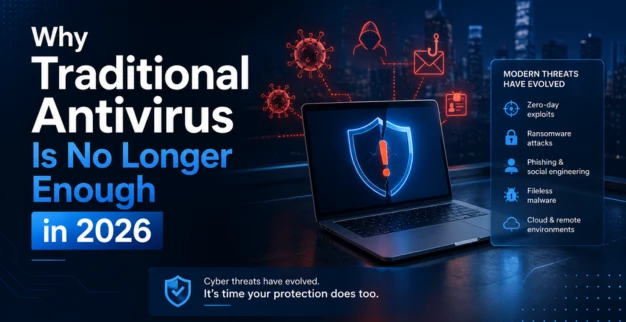
Why Traditional Antivirus Is No Longer Enough in 2026
15 June 2026
Businesses today face cyber threats that are more advanced and sophisticated than ever before. While traditional antivirus software was once effective at blocking known malware, modern cybercriminals now use techniques that can bypass signature-based security tools. As organizations increasingly adopt cloud services, remote work, and connected devices, relying solely on antivirus is no longer sufficient.
To stay protected, businesses must invest in advanced threat detection, robust endpoint security, and modern cyber security solutions.
Evolution of Cyber Threats
Cyber threats have evolved significantly over the years. Attackers no longer rely only on viruses but use sophisticated methods to infiltrate systems and remain undetected.
Modern Threat Landscape
- Ransomware attacks targeting critical data
- Phishing campaigns stealing credentials
- Fileless malware that leaves no signature
- Insider threats and unauthorized access
- Advanced Persistent Threats (APTs)
These attacks can bypass traditional security tools and cause significant operational damage.
Limitations of Traditional Antivirus
1. Signature-Based Detection
Limitation: Traditional antivirus depends on known malware signatures to detect threats.
Impact: New or modified malware can evade detection, leaving systems exposed to attacks.
2. Limited Visibility
Limitation: Antivirus solutions often monitor individual devices without broader network visibility.
Impact: Security teams may miss suspicious activities occurring across the environment.
3. Reactive Protection
Limitation: Antivirus typically responds only after malware is identified.
Impact: Organizations may experience damage before threats are detected and contained.
Modern Attack Techniques
Cybercriminals use increasingly advanced methods to compromise systems.
Fileless Attacks
Attackers exploit legitimate system tools without installing malware files, making detection difficult.
Zero-Day Exploits
Hackers target unknown vulnerabilities before security patches become available.
Social Engineering
Phishing emails and fraudulent messages trick employees into revealing sensitive information.
Ransomware
Modern ransomware encrypts business data and often steals information before demanding payment.
Advanced Security Solutions
Organizations now require multiple layers of security protection.
Advanced Threat Detection
Uses artificial intelligence and behavioral analytics to identify suspicious activities in real time.
Endpoint Security
Protects laptops, servers, and mobile devices from malware and unauthorized access.
Security Monitoring
Continuous monitoring helps detect and respond to threats before they escalate.
Threat Intelligence
Provides insights into emerging cyber risks and attack patterns.
Modern cyber security solutions help organizations proactively defend against evolving threats.
Recommended Security Stack
Businesses should implement a layered security approach:
- Endpoint Detection and Response (EDR)
- Multi-Factor Authentication (MFA)
- Advanced Firewalls
- Security Information and Event Management (SIEM)
- Regular Vulnerability Assessments
- Backup and Disaster Recovery Solutions
This security stack significantly improves resilience against cyber threats.
Conclusion
In 2026, traditional antivirus alone is no longer enough to defend against sophisticated cyberattacks. Organizations need advanced threat detection, comprehensive endpoint security, and integrated cyber security solutions to protect their digital assets.
A proactive and layered cybersecurity strategy helps businesses reduce risks, improve visibility, and maintain operational continuity in an evolving threat landscape.