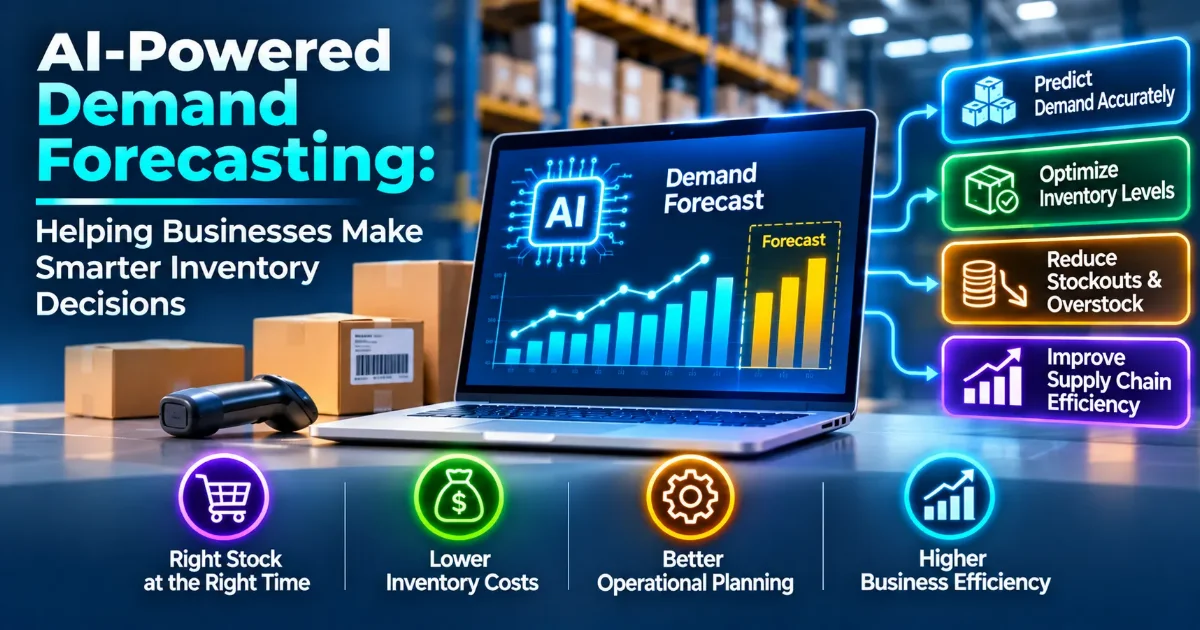
AI-Powered Demand Forecasting: Helping Businesses Make Smarter Inventory Decisions
By: Ganesan D
27 Nov 2026
Category:
Custom
Introduction
Stock control is an area of commerce which requires careful consideration. Excess inventory leads to higher storage costs, while understocking may result in lost revenue and customer dissatisfaction. AI can analyse previous sales, along with industry and consumer data, to estimate future demand for goods within a company.
Companies can utilise artificial intelligence and machine learning to make better inventory management decisions, reduce wastage and improve their supply chain operations.
What Is AI-Powered Demand Forecasting?
Artificial intelligence (AI) is used to analyse data and make predictions about consumer demand. It identifies trends within information and uses them to forecast future customer requirements.
Compared to basic prediction techniques, artificial intelligence can analyse extensive datasets. Furthermore, it can update predictions based on new information, allowing organisations to respond more effectively to an evolving marketplace.
Traditional vs. AI Forecasting
Many organisations use spreadsheets and calculate averages based on historical sales data when analysing demand. While these methods can be effective for businesses with relatively stable demand, they may be less accurate in rapidly changing markets.
AI utilises machine learning to analyse multiple data sources and recognise complex patterns. It can then refine its predictions by incorporating fresh information.
AI-powered forecasting is particularly useful for companies that:
-
Manage a wide range of products.
-
Experience fluctuating customer demand.
-
Face seasonal variations in sales.
-
Operate in competitive and fast-changing markets.
By using AI, businesses can improve forecasting accuracy and make more informed inventory decisions.
Historical Sales Data and Demand Patterns
Historical data helps companies create more effective demand forecasts. AI systems can assess different types of business information, including:
-
Sales volumes and revenue.
-
Product performance and availability.
-
Customer purchasing behaviour.
-
Pricing changes and marketing activities.
-
Inventory levels and purchasing records.
In addition, AI can recognise sales trends and seasonal factors. For instance, many retailers experience increased demand during particular times of the year, while certain products may sell better depending on weather conditions.
By recognising these patterns, companies can plan their purchasing activities and order the right stock ahead of peak demand periods.
Predictive Models and Inventory Planning
Machine learning is used to analyse historical and real-time data to generate sales forecasts. Time-series forecasting, regression and other machine learning techniques may be used depending on a company's business requirements and available data.
AI-powered sales forecasting can help businesses with:
-
Calculating future inventory requirements.
-
Identifying products that may run out of stock.
-
Minimising excess inventory and overstocking.
-
Improving purchasing and reorder decisions.
-
Enhancing warehouse and supply chain operations.
Furthermore, modern AI inventory forecasting solutions can integrate with ERP, warehouse management and procurement systems. This allows businesses to access updated stock information and automate reorder recommendations where appropriate.
Forecasting Challenges
Although artificial intelligence can improve demand forecasting, its effectiveness depends on data quality and the forecasting tools being used. Common challenges include:
-
Missing or inaccurate historical sales data.
-
Unexpected changes in customer behaviour.
-
Incorrect inventory and supplier information.
-
Seasonal fluctuations and market uncertainty.
-
Integration difficulties with existing business systems.
Businesses should regularly update their data, evaluate forecasting accuracy and investigate unusual results. Human oversight is also important to address unexpected situations and support major purchasing decisions.
Frequently Asked Questions
1. How Does AI Improve Demand Forecasting?
AI analyses a business's historical sales and other relevant information to identify patterns, understand customer behaviour and predict future product demand.
2. Can AI Forecasting Reduce Overstocking?
Yes. AI forecasting helps companies estimate the quantity of stock required based on predicted demand, reducing the risk of maintaining excessive inventory.
3. Can AI Integrate with Inventory Management Systems?
Yes. AI forecasting solutions can integrate with compatible ERP and warehouse management systems to provide inventory insights, generate reorder recommendations and support stock management activities.
4. Is AI Demand Forecasting Suitable for Small Businesses?
Yes. Small businesses can use AI forecasting to improve purchasing decisions, monitor stock levels and understand customer demand. They can start with essential products and expand their forecasting capabilities as their requirements grow.
Conclusion
Companies can utilise artificial intelligence to analyse business data and generate intelligent demand forecasts. By assessing historical sales, identifying trends and predicting customer requirements, businesses can optimise inventory levels, reduce wastage and improve operational efficiency.
Agan Cyber Security LLC assists companies in exploring secure technological solutions that support digital transformation and business process automation. Contact us in Dubai and throughout the UAE to discuss how AI technologies can help your organisation improve inventory management and business operations.