Confidential Computing: Protecting Sensitive Data During Processing
By: Ganesan D
28 Nov 2026
Category:
Data Protection
Introduction
Alongside the cloud, artificial intelligence (AI) and data analysis, businesses are now utilising these technologies to handle data. Although data can be encrypted at rest and in transit, there can also be situations where data is unsecured during analysis.
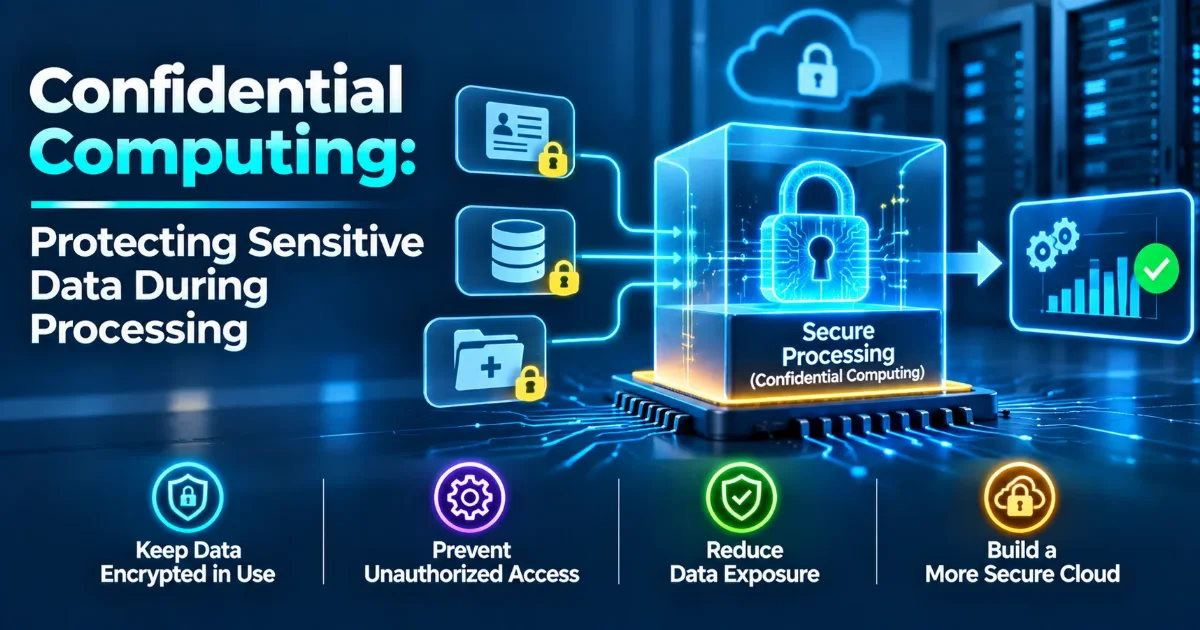
Confidential computing secures data during analysis by physically separating it. Confidential computing can thus further secure data within a company and enable companies to implement a private AI solution, and exert further control over their data.
It can also offer an extra level of security for a company’s confidential data and AI analysis if they are investigating Enterprise Private AI within the UAE.
Understanding the Three States of Data
Data can be categorised into three types, and each requires its own security provision:
-
Data at rest – Data stored on databases, servers, cloud platforms or backups. Data can be encrypted to aid security.
-
Data in transit – Data being transferred, for example, between applications, servers and networks. Encryption technologies such as TLS can improve data security during transfer.
-
Data in use – Data currently being analysed or processed by applications, databases or AI systems.
Whilst standard security solutions are used to secure both stored and transferred data, sensitive data can sometimes be accessed by authorised and malicious software. Confidential computing is a solution which aims to secure data during processing and analysis.
How TEEs and Secure Enclaves Work
Confidential computing is underpinned by a Trusted Execution Environment (TEE). This is a protected area within a computer's processing environment that isolates and enables secure processing.
Alongside other security mechanisms, a TEE helps prevent unauthorised access to and interaction with protected processing areas, including from parts of the host operating system or hypervisor that may themselves have privileged access.
Secure enclaves are a form of TEE. Within these secure processing environments, organisations can carry out confidential activities and control access to the data and processes so that they remain isolated from the wider system.
As such, an organisation can securely process confidential customer-related data within a secure enclave and help ensure that this data is not exposed to the wider host environment.
Hardware Isolation and Attestation
Hardware enclaves are used to isolate workloads. Processor security technologies help manage access to protected memory and secure processing environments.
Remote attestation provides additional functionality. It enables a workload or service to cryptographically prove that it is operating within a recognised and trusted secure environment.
This helps businesses verify the computing environment before sharing confidential information or encryption keys.
Nonetheless, whilst remote attestation can provide assurance, further measures are still required to ensure computer system security, including secure configurations, key management, software protection and appropriate operational processes.
Enterprise and AI Use Cases
Some examples of where confidential computing can be utilised include:
-
Private AI – Helps protect prompts, sensitive datasets and model inference processes within AI systems.
-
Financial Services – Allows confidential analysis of financial information and customer data.
-
Healthcare – Supports data analysis while maintaining the confidentiality of patient information.
-
Cloud Computing – Provides additional workload protection within shared cloud environments.
-
Collaborative Analytics – Enhances confidentiality when multiple organisations need to analyse specific datasets.
Within Dubai, confidential computing can assist organisations wishing to implement a Private AI structure by allowing secure and confidential data analysis. It can also help facilitate data residency for Large Language Models (LLMs) within the UAE by integrating it with appropriate UAE infrastructure, implementation and data management.
As previously mentioned, whilst confidential computing can help support data residency objectives, it is essential that an organisation confirms the location of data storage, processing and sharing.
Adoption Challenges
Confidential computing can be complex to implement. Issues that may arise relate to hardware compatibility, software integration, performance requirements, attestation and secure data management.
Where a business is considering implementing confidential computing within the UAE, it should analyse its workloads, suitable hardware, cloud provider capabilities and relevant data security regulations.
Careful planning, testing and continuous monitoring can help organisations implement confidential computing effectively while maintaining operational efficiency.
Frequently Asked Questions
1. What Is the Main Purpose of Confidential Computing?
Confidential computing protects data during processing through hardware-based isolation, helping prevent unauthorised access to sensitive information while applications are using it.
2. Does Confidential Computing Replace Encryption?
No. It complements encryption technologies used to protect data at rest and in transit by providing additional protection for data during processing.
3. Can Confidential Computing Support Private AI?
Yes. Suitable confidential computing environments can enhance the protection of sensitive AI data, prompts and processing activities.
4. Does Confidential Computing Guarantee UAE Data Residency?
No. Data residency depends on infrastructure location, system configuration, data movement, service agreements and applicable regulations. Organisations must verify where their data is stored, processed and shared.
Conclusion
Confidential computing is used to provide additional protection for sensitive data during processing. By utilising TEEs, secure enclaves, hardware isolation and remote attestation, companies can establish an improved level of security for both business-critical workloads and in-house AI functions.
Agan Cyber Security LLC advises businesses on secure technologies which enable them to successfully digitally transform and protect their data. Please get in touch with us in Dubai and throughout the UAE to discuss confidential computing and in-house AI requirements.