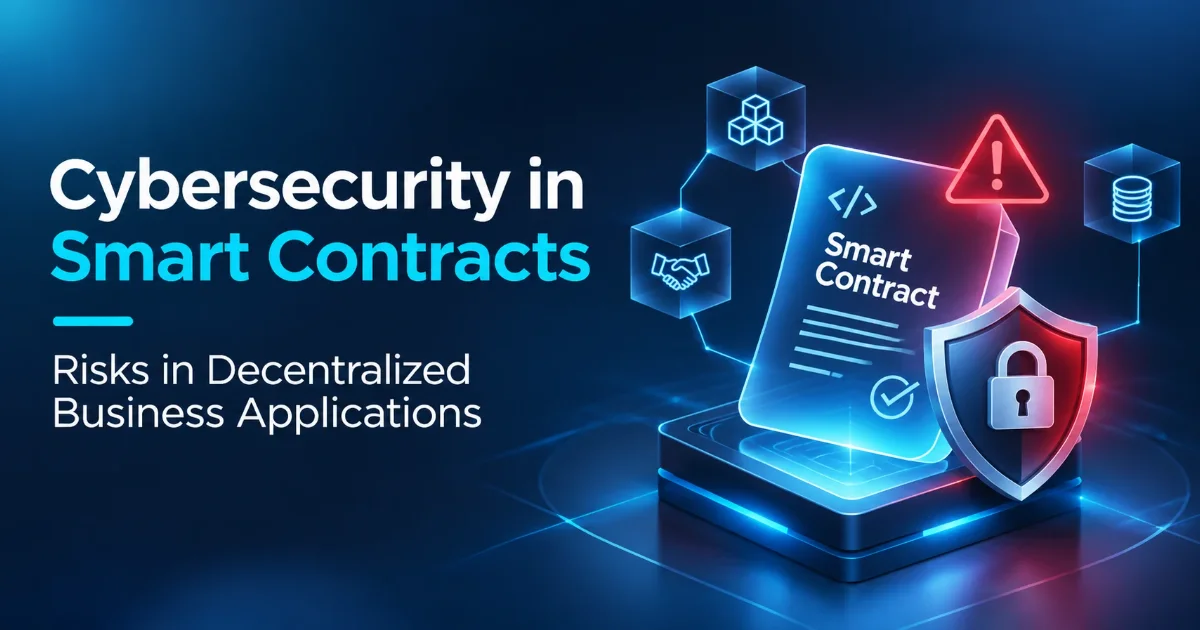
Cybersecurity in Smart Contracts: Risks in Decentralized Business Applications
By: Ganesan D
13 Nov 2026
Category:
Cyber Security
Introduction
Decentralised applications (dApps) are changing how we interact with financial services, digital assets, supply chains & business. They use smart contracts to automate processes. However, they can put businesses at risk if there are weaknesses in the logic of the contracts, the integration with the blockchain & third-party data sources. Implementing strong cybersecurity strategies around the blockchain will help to secure decentralised applications & ensure integrity of transactions.
What Are Decentralized Business Applications and Smart Contracts?
Decentralized applications are software that can run on a blockchain or distributed system. Transactions are automated with self-executing smart contracts, which are programs stored on a blockchain network.
Smart contracts could be used to manage digital assets, and could even execute transactions themselves. As such it is important to perform security testing of smart contracts prior to deployment, and during their lifetime.
Unique Threat Vectors in Multi-Chain and Decentralized Ecosystems
When working with decentralised environments there will be additional security issues to consider. Common issues include:
-
Cross chain attacks – Vulnerabilities in bridges and communication protocols can leave assets vulnerable.
-
Private key compromise – Administrator or validator keys could be stolen allowing unauthorised activity.
-
Protocol vulnerabilities – Vulnerabilities in DeFi protocols can impact a number of applications.
-
Governance attacks – Attacks on the voting system and/or compromised governance credentials.
-
External libraries – Additional risk from using external wallets, libraries or infrastructure providers.
Organisations need to consider individual contracts and also look at the wider blockchain environment.
Oracle Manipulation, Flash Loan Attacks, and Economic Logic Flaws
When working with decentralised environments there will be additional security issues to consider. Common issues include:
-
Cross chain attacks – Vulnerabilities in bridges and communication protocols can leave assets vulnerable.
-
Private key compromise – Administrator or validator keys could be stolen allowing unauthorised activity.
-
Protocol vulnerabilities – Vulnerabilities in DeFi protocols can impact a number of applications.
-
Governance attacks – Attacks on the voting system and/or compromised governance credentials.
-
External libraries – Additional risk from using external wallets, libraries or infrastructure providers.
Organisations need to consider individual contracts and also look at the wider blockchain environment.
Challenges in Securing Decentralized Logic Across Distributed Ledgers
This is a non-trivial challenge due to: Irreversibility of transactions, and difficulty of modifying smart contracts. Other challenges include:
-
Lack of visibility into third-party protocols.
-
Complexity of smart contract dependencies.
-
Variations in security standards across different blockchains.
-
Difficulties in incident coordination.
-
Upgrade, bridge and admin risks.
This means that continuous security assessment is an important factor in blockchain business applications.
Threat Modeling and Decentralized Security Architecture Design
Threat modelling can help organisations identify vulnerabilities that could be exploited. The assessment should consider:
-
Identify assets: Smart Contracts, Digital Assets, Wallets, Private Keys, Sensitive Data.
-
Attack Surface: APIs, Blockchain Nodes, Bridges, Oracles and Integrations.
-
Threats: Weak Access Controls, Economic attacks and Malicious Transactions.
-
Secure Architecture: Design Authentication, Key Management, Transaction Verification and Access Controls.
-
Testing: Smart Contract Reviews, Penetration Testing, Scenario Analysis.
A secure Cybersecurity Strategy for a blockchain infrastructure should take into consideration secure node configuration, protection of keys, monitoring of networks and secure administrative access.
Continuous Monitoring and Incident Response for dApps
It is crucial to ensure that your organisation has appropriate monitoring processes in place to track blockchain, smart contract, privileged and anomalous asset activity. Key steps to take:
-
Real-time monitoring of transactions and anomalies.
-
Alerts on unexpected changes to administrators and ownership.
-
Monitoring any suspicious activity within your wallets or contracts.
-
Private keys secured and emergency access protocols.
-
Response plan for any exploited contracts and compromised wallets.
-
Review regularly once upgraded or changes made to infrastructure.
If you are a regulated organisation, your VARA Rulebook security audit should ensure that you are compliant with any relevant requirements relating to cybersecurity, technology governance, risk management and controls based on your licence type and activities within the UAE.
A VASP security review in Dubai will also help to identify any gaps within your wallet, keys, transaction and underlying technology infrastructure.
Best Practices for Resilient Web3 Deployments
Businesses should do the following:
-
Perform third party smart contract security audits.
-
Utilise well known and audited smart contract libraries.
-
Use least privilege access for admin functions.
-
Use hardware-based security for private keys.
-
Use trusted decentralised oracle solutions.
-
Perform thorough testing of cross chain bridges.
-
Set up transaction monitoring and emergency protocols.
-
Regularly check third party protocols.
Frequently Asked Questions
1. How can smart contracts be exploited?
Due to programming errors, poor access control, oracle tampering, and incorrect economic mechanism design.
2. Is a smart contract audit enough to secure my dApp?
No. There needs to be security of the blockchain infrastructure, wallet, APIs, 3rd party integration, private keys and monitoring.
3. Why would a VASP require specific security testing?
VASPs conduct business with virtual assets and related infrastructure, therefore it is important to ensure wallet security, access control, transaction monitoring and any relevant regulations are in place.
Conclusion
Securing smart contracts is vital to protect decentralised applications and blockchain business processes. Through threat modelling, third-party security audits, designing a secure infrastructure and ongoing monitoring organisations can minimise risks and increase their Web3 security.
Agan Cyber Security LLC can help you improve your blockchains security. Using our expertise in cyber security we can help analyse smart contracts and find any risks to your blockchain infrastructure. Get in touch with our team to discuss blockchain security audits, VASP assessments and your cybersecurity needs in Dubai and throughout the UAE.