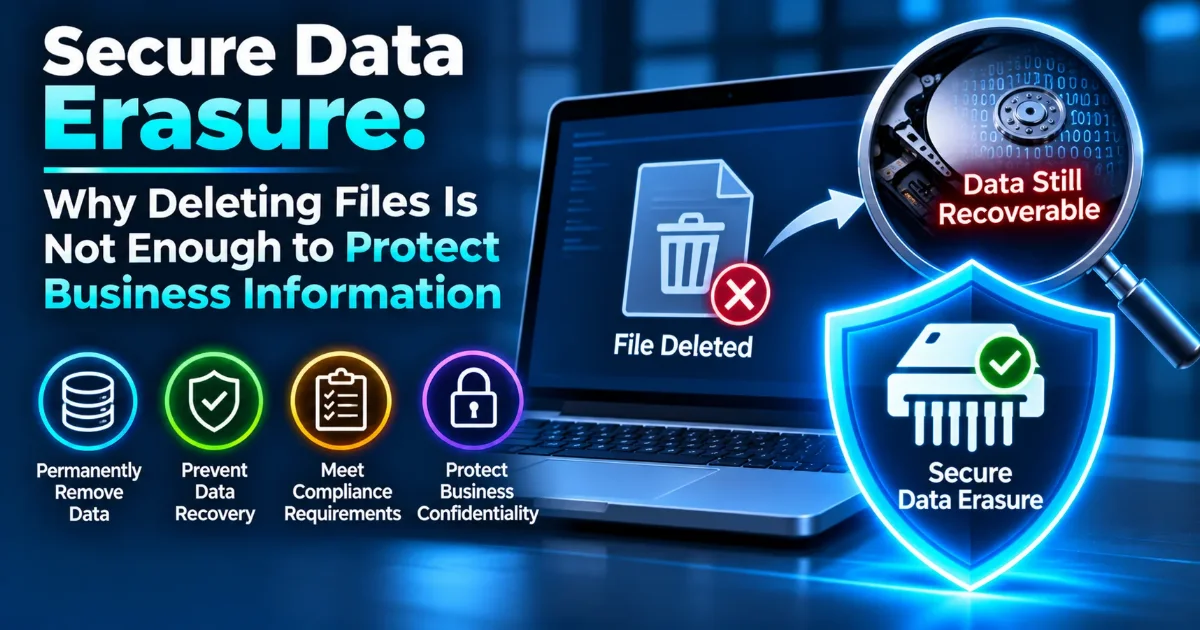
Secure Data Erasure: Why Deleting Files Is Not Enough to Protect Business Information
By: Ganesan D
11 Nov 2026
Category:
Data Protection
Introduction
A lot of confidential information is stored on various storage devices, including hard drives, SSDs, servers and other digital storage media. When these devices are replaced, recycled or disposed of, simply deleting files may not completely remove the stored information.
This can create serious security risks for organisations because deleted information may still be recovered using specialised data recovery techniques. Secure data erasure ensures that sensitive business information is properly sanitised before storage devices leave an organisation's control.
What Is Secure Data Erasure?
Secure data erasure is the process of permanently removing information from storage devices so that it cannot be recovered using appropriate data recovery methods.
Unlike normal file deletion, which often removes references to files rather than the actual stored data, secure erasure uses appropriate sanitisation techniques to make the information inaccessible.
Investing in secure data erasure can help businesses in the UAE reduce the risk of sensitive information being exposed when replacing, recycling or disposing of IT equipment.
Why Standard File Deletion and Formatting Are Not Enough
When files are deleted, the operating system may simply mark the storage space occupied by those files as available for new data. The original information may remain on the device until it is overwritten or properly sanitised.
Similarly, formatting a drive does not always guarantee complete data removal. A factory reset may also leave certain information recoverable, depending on the device and reset method used.
This creates a security risk when businesses sell, donate, recycle or dispose of storage devices without following an appropriate data sanitisation process.
Legal and Financial Risks of Data Remanence
Data remanence refers to residual information that remains on storage media even after files have been deleted or removed. If discarded devices contain recoverable customer, employee, financial or confidential business information, organisations may face several risks.
-
Privacy Breaches:
Personal and sensitive information may become accessible to unauthorised individuals.
-
Regulatory Non-Compliance:
Improper data disposal may result in violations of applicable data protection and information security requirements.
-
Financial Losses:
Organisations may incur expenses related to investigations, incident response, legal support and recovery activities.
-
Reputational Damage:
Customers and business partners may lose confidence in an organisation that fails to protect their information.
-
Legal and Contractual Issues:
Exposure of confidential information may create legal liabilities or breaches of contractual obligations.
Properly sanitising storage devices before disposal can help organisations minimise these risks and maintain better control over sensitive business information.
Challenges in Decommissioning HDDs, SSDs, and Servers
Different storage technologies require different data sanitisation methods. Businesses should understand the characteristics of each device before selecting an appropriate erasure or destruction technique.
-
Hard Disk Drives (HDDs):
Deleted or formatted information may remain recoverable unless an appropriate sanitisation method is used.
-
Solid State Drives (SSDs):
Wear levelling, overprovisioning and internal storage management can make conventional overwriting methods less reliable.
-
Servers:
Multiple drives, RAID configurations and internal storage components increase the complexity of securely sanitising server infrastructure.
-
USB Drives and Memory Cards:
Portable storage devices may contain sensitive information and can easily be overlooked during equipment disposal.
Organisations should maintain an accurate inventory of storage components and select an appropriate sanitisation method based on the media type, device condition and security requirements.
Certified Data Sanitization Standards and Overwriting Protocols
Organisations should follow recognised data sanitisation guidelines when disposing of storage devices. NIST Special Publication 800-88 provides guidance on media sanitisation and identifies three general sanitisation methods.
-
Clear:
Applies logical techniques to sanitise data so it cannot be recovered through normal access interfaces using standard data recovery methods.
-
Purge:
Uses stronger sanitisation techniques, such as supported cryptographic erase or appropriate device-specific methods, to make data recovery significantly more difficult.
-
Destroy:
Physically destroys storage media so that it can no longer be used to store data.
The US Department of Defense (DoD) is also associated with historical data overwriting techniques. However, traditional DoD overwriting patterns should not automatically be considered suitable for every modern storage device.
Organisations should select sanitisation methods based on the storage technology, manufacturer recommendations and recognised security guidelines.
Physical Destruction and Degaussing Workflows
When reliable data sanitisation cannot be performed, physical destruction may be an appropriate option. Common storage destruction methods include:
-
Shredding:
Storage devices are cut into small fragments, making the media unusable.
-
Crushing:
Physical force is applied to damage the storage device and its internal components.
-
Degaussing:
A strong magnetic field is used to disrupt magnetic data stored on suitable magnetic media, such as traditional HDDs and magnetic tapes.
Degaussing is not suitable for SSDs because they use flash memory rather than magnetic storage. Therefore, businesses must select destruction techniques that are compatible with the specific storage technology.
Professional data destruction services in the UAE should follow secure handling procedures and provide appropriate documentation, including certificates of destruction where applicable.
IT Asset Disposition (ITAD) Best Practices
IT Asset Disposition (ITAD) refers to the secure and responsible process of managing IT equipment that is no longer required by an organisation. A structured ITAD process helps businesses protect sensitive information while replacing, recycling or disposing of old equipment.
Organisations should follow these best practices:
-
Maintain an Asset Inventory:
Keep an updated record of all storage devices and IT equipment scheduled for disposal.
-
Classify Sensitive Information:
Identify the type and sensitivity of information stored on each device.
-
Select the Correct Sanitisation Method:
Choose an appropriate data erasure or destruction technique based on the storage media.
-
Restrict Physical Access:
Control access to storage devices during collection, transportation and disposal.
-
Use Verified Erasure Methods:
Ensure that data sanitisation is performed using reliable and validated procedures.
-
Maintain Proper Documentation:
Record the sanitisation process and retain certificates of destruction wherever applicable.
-
Choose Reputable Service Providers:
Work with trusted professionals offering secure drive decommissioning services in Dubai and reliable hard drive wiping services in Dubai.
-
Verify All Storage Media:
Ensure that no internal drives, removable storage devices or other data-bearing components are overlooked.
Frequently Asked Questions
1. Will Hard Drive Formatting Securely Erase the Data?
Not necessarily. Standard formatting may not completely remove stored information. Businesses should use an appropriate and validated data sanitisation method to prevent unauthorised data recovery.
2. Can Data Be Recovered From an SSD After Deletion?
Data recovery depends on the SSD, the deletion process, TRIM behaviour and the sanitisation technique used. Organisations should use supported SSD-specific sanitisation methods to ensure effective data removal.
3. Will I Always Have to Physically Destroy the Storage Device?
No. Physical destruction is not always necessary. If a device supports reliable and validated sanitisation, it may be possible to reuse it safely. However, physical destruction may be required when sanitisation cannot be verified or organisational policies demand it.
Conclusion
Secure data erasure is essential for protecting confidential business information when replacing, recycling or disposing of IT equipment. Simply deleting files or formatting storage devices may leave sensitive information recoverable.
By following recognised sanitisation guidelines, selecting the right erasure methods and maintaining proper documentation, organisations can reduce data exposure risks and strengthen their overall information security practices.
Protect Your Business Information with Agan Cyber Security LLC
Agan Cyber Security LLC can help organisations strengthen their cybersecurity posture through expert security guidance, vulnerability assessments and information security solutions. Our team can help you identify potential security risks and improve your data protection practices.
Contact our team to discuss your secure data erasure, cybersecurity and data protection requirements in Dubai and throughout the UAE.
Contact us today to discuss your security requirements.