End-to-End Encryption: How It Protects Your Data
09 Mar 2026
Category: Cybersecurity
The world now needs better data security methods which protect sensitive information from digital threats. Organizations and individuals need robust security systems to protect their data, which includes private messages and financial transactions. The best method for protecting information is through End-to-End Encryption.
The technology protects information during network transmission by blocking unauthorized access while it safeguards data security through its protection mechanisms.
What is End-to-End Encryption?
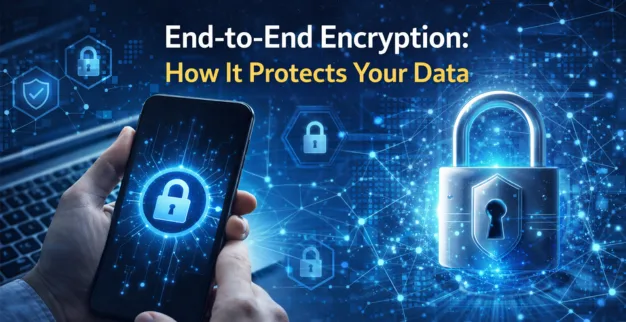
End to End Encryption (E2EE) is a security method which protects data by encrypting it on the sender's device and allows only the designated recipient to decrypt the information.
The transmission process protects information from being viewed by all parties who need to access it which includes internet service providers and application servers and hackers.
End encryption creates a secure pathway for messages and data which protects everything from the moment of sending until the point of delivery to the intended recipient. The original content remains available only to the sender and receiver who possess the necessary keys.
Key characteristics include:
- Data is encrypted before transmission
- Only authorized users can decrypt the information
- Intermediary systems cannot access the content
The system provides powerful defense mechanisms which protect against both interception attempts and cyber security attacks.
How Encryption Works
End-to-end encryption operates through multiple cryptographic steps which convert readable information into encrypted data.
1. Encryption at the Sender’s Device
Before the message is sent the system encrypts the data using cryptographic algorithms and encryption keys.
2. Secure Transmission
The encrypted data travels across the network in a scrambled format that cannot be understood by anyone who intercepts it.
3. Decryption at the Receiver’s Device
The recipient's device uses a special key to decrypt the data which has been sent to them.
This process ensures that even if someone intercepts the data they will need the correct decryption key to read it.
Advantages of End-to-End Encryption
End-to-end encryption provides essential advantages which benefit both companies and individual users.
- Strong Data Privacy – The system restricts information access to authorized personnel only which stops unauthorized users from monitoring activities.
- Protection Against Cyber Attacks – The attackers who capture the data cannot use it because it remains encrypted.
- Increased Trust – The implementation of strong encryption systems by organizations shows their dedication to safeguarding customer information.
- Compliance with Data Protection Regulations – The use of encryption technology enables organizations to meet various privacy and cybersecurity requirements.
- Secure Communication Channels – The system safeguards sensitive information including financial transactions and confidential messages.
Real-World Use Cases
Digital services use end-to-end encryption as their main security method.
- Messaging Applications – Modern messaging platforms use E2EE to protect user conversations between their users.
- Online Banking and Payments – Financial institutions use encryption to safeguard their transactions while protecting their financial information.
- Video Conferencing Platforms – The use of encrypted communication systems protects the confidentiality of all meeting and discussion content.
- Cloud Storage Services – Businesses use encryption to protect their sensitive information by safeguarding their files stored in cloud storage.
- Corporate Communication Systems – Organizations use encrypted tools to secure their internal communication channels and their data sharing processes.
Security Challenges of End-to-End Encryption
End-to-end encryption provides robust protection but presents multiple difficulties for users.
- Key Management – Organizations face difficulties in protecting their encryption keys because of the challenges they encounter with secure key management.
- Device Security Risks – When a user device gets compromised, hackers can access encrypted information through this security breach.
- Law Enforcement Limitations – Authorities find it challenging to access investigation data because only users possess the decryption keys.
- Implementation Complexity – Organizations who implement encryption systems incorrectly will create security gaps through their incorrect implementation practices.
End-to-end encryption provides digital communication protection through its use as an effective security solution despite the existing challenges which it presents.
Conclusion
End-to-End Encryption functions as a fundamental component of present-day cybersecurity because it protects confidential data during its entire process of transmission through digital networks. The technology secures data by encrypting it at the origin point and permitting decryption only at the final destination which prevents unauthorized interception, data breaches, and unauthorized access.
Organizations need to implement strong encryption methods because cyber threats are increasing to safeguard their data, maintain user privacy, and build trust in their digital communication systems.