How SIEM Helps Businesses Detect Cybersecurity Threats
By: Ganesan D
30 Sep 2026
Category:
Cyber Security
Introduction
Businesses generate large amounts of security data every day from servers, endpoints, firewalls, cloud platforms, applications, and network devices. Monitoring all this information manually can make it difficult for security teams to identify suspicious activity quickly.
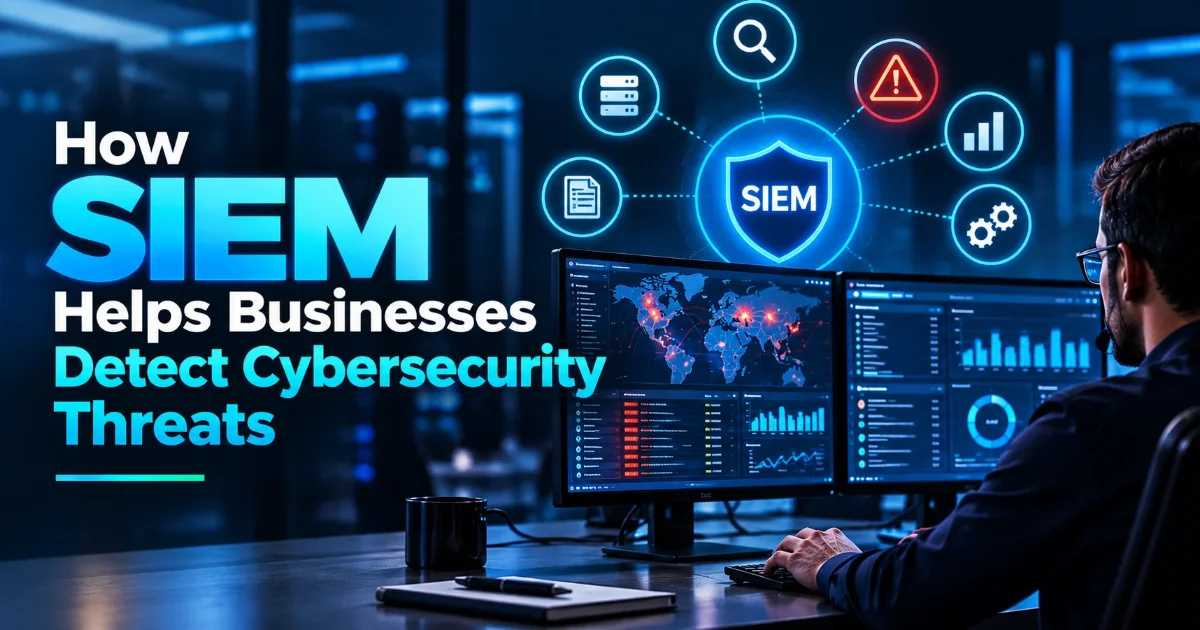
SIEM Cyber Security solutions help organizations collect, analyze, and correlate security information from multiple sources. By bringing security data into a centralized platform, SIEM can help businesses detect potential threats, investigate suspicious activity, and support faster security response.
Understanding What is SIEM, how it works, and how it integrates with a SOC can help organizations build a stronger security monitoring strategy.
What is SIEM?
SIEM stands for Security Information and Event Management. It is a cybersecurity technology that collects and analyzes security-related events and logs from different systems across an organization's IT environment.
A SIEM platform can help security teams:
✔ Centralize security logs
✔ Monitor activity across IT environments
✔ Correlate events from multiple sources
✔ Identify suspicious patterns
✔ Generate security alerts
✔ Support investigation and incident response
✔ Maintain security records for analysis and compliance
SIEM can be deployed in different environments, including on-premises infrastructure and cloud-based environments.
Data and Log Collection
One of the core functions of SIEM is collecting security data from different sources.
Depending on the organization's environment, a SIEM solution may collect logs from:
✔ Firewalls and network devices
✔ Servers and workstations
✔ Endpoint security solutions
✔ Cloud platforms
✔ Applications and databases
✔ Identity and access management systems
✔ VPN and remote-access systems
✔ Security tools and services
Centralizing these logs gives security teams a broader view of activity across the organization.
A Cloud Based SIEM can also collect and analyze security information from cloud infrastructure, applications, and other connected services.
Threat Detection
SIEM helps identify potentially suspicious activity by analyzing collected security events.
For example, an organization may see multiple failed login attempts, followed by a successful login from an unusual location and then suspicious access to sensitive resources.
Individually, these events may not appear highly significant. However, when analyzed together, they may indicate potentially malicious activity.
SIEM can use detection rules, analytics, threat intelligence, and behavioral indicators to identify events that require investigation.
Alert Correlation
A major advantage of SIEM is its ability to correlate events from different systems.
Instead of analyzing thousands of individual log entries separately, SIEM can connect related events and generate a more meaningful security alert.
For example:
Multiple failed logins → Successful authentication → Privileged access → Unusual data activity
These events occurring together may warrant investigation by a security team.
Event correlation can help reduce the volume of isolated alerts and provide analysts with additional context when investigating potential incidents.
SIEM and SOC Integration
SIEM is an important component of many SIEM and SOC environments.
A Security Operations Center (SOC) continuously monitors an organization's technology environment for potential security incidents. SIEM can provide SOC analysts with centralized visibility into security events and alerts.
SOC teams can use SIEM to:
✔ Monitor security alerts
✔ Investigate suspicious activity
✔ Analyze historical events
✔ Identify potential attack patterns
✔ Support incident response
✔ Track security events across multiple systems
SIEM does not replace security analysts. Instead, it provides the data, correlation, and alerting capabilities that can help analysts investigate threats more efficiently.
Benefits for Businesses
Centralized Visibility
SIEM brings security information from multiple systems into a centralized monitoring environment, helping security teams gain broader visibility.
Faster Threat Detection
Automated analysis and event correlation can help identify potentially suspicious activity more quickly than manual log review alone.
Improved Incident Investigation
Security teams can analyze related events and historical logs to better understand what happened during a potential security incident.
Better Security Monitoring
Continuous monitoring helps organizations identify suspicious activity across endpoints, networks, applications, identities, and cloud environments.
Support for Compliance
Centralized logging and security event records can also support certain audit, investigation, and compliance requirements, depending on the organization's industry and applicable regulations.
Conclusion
SIEM Cyber Security solutions help businesses turn large volumes of security logs and events into actionable security information. By collecting data from multiple sources, correlating related events, and generating alerts, SIEM can help security teams identify and investigate potential cybersecurity threats.
When integrated with a SOC, SIEM provides security analysts with centralized visibility and valuable context for monitoring and incident response. For organizations operating hybrid or cloud environments, a Cloud Based SIEM can extend security monitoring across cloud services and infrastructure.