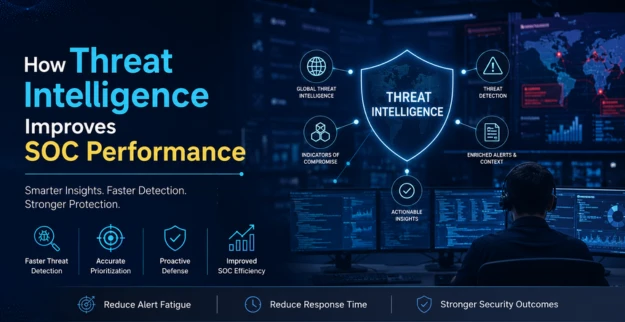
How Threat Intelligence Improves SOC Performance
06 August 2026
Introduction
Cyber threats are evolving faster than ever, making it increasingly difficult for organizations to detect and respond to attacks using traditional security tools alone. Security Operations Centers (SOCs) receive thousands of security alerts every day, making it challenging for analysts to distinguish genuine threats from false positives. Without accurate threat context, valuable time can be lost investigating low-priority alerts while real attacks continue unnoticed.
What is Threat Intelligence?
Threat intelligence is the process of collecting, analyzing, and sharing information about current and emerging cyber threats. It transforms raw security data into actionable insights that help organizations understand attacker behavior, identify indicators of compromise (IOCs), and anticipate potential attacks.
Threat intelligence enables security teams to move from reactive incident response to proactive threat prevention.
Key Functions
- Identifies emerging cyber threats
- Tracks attacker tactics and techniques
- Provides Indicators of Compromise (IOCs)
- Supports faster incident response
- Improves threat detection accuracy
- Enhances security decision-making
By providing valuable context, threat intelligence helps SOC analysts focus on genuine security incidents.
Types of Threat Intelligence
Different types of threat intelligence support different business and security objectives.
1. Strategic Threat Intelligence
Provides high-level insights into cyber risks, industry trends, and emerging threats to support executive decision-making.
2. Tactical Threat Intelligence
Focuses on attacker techniques, malware behavior, phishing campaigns, and common attack methods.
3. Operational Threat Intelligence
Provides information about active cyber campaigns, threat actors, and ongoing attacks targeting specific industries.
4. Technical Threat Intelligence
Includes Indicators of Compromise (IOCs) such as malicious IP addresses, domains, URLs, file hashes, and malware signatures used for automated detection.
Each type contributes to stronger SOC performance by improving threat visibility and response capabilities.
SOC Integration
Integrating a threat intelligence platform into a Security Operations Center significantly enhances security operations.
Threat intelligence can be integrated with:
- Security Information and Event Management (SIEM)
- Endpoint Detection and Response (EDR)
- Firewalls and Intrusion Detection Systems (IDS)
- Security Orchestration, Automation, and Response (SOAR)
- Email security platforms
- Cloud security monitoring solutions
This integration enriches security alerts with real-time threat context, enabling analysts to investigate incidents more efficiently and reduce false positives.
Benefits
Integrating threat intelligence into SOC operations provides several business and security advantages.
Business Benefits
- Faster threat detection and analysis
- Improved incident response times
- Reduced false positives
- Better prioritization of security alerts
- Enhanced visibility into emerging cyber threats
- Stronger protection against ransomware and phishing attacks
- Improved regulatory compliance and reporting
- Increased operational efficiency for SOC analysts
Threat intelligence enables organizations to detect threats earlier and respond before they impact business operations.
Best Practices
Organizations should follow these best practices to maximize the value of threat intelligence.
- Integrate threat intelligence with SIEM and SOAR platforms
- Continuously update threat intelligence feeds
- Correlate threat intelligence with internal security logs
- Prioritize threats based on business risk
- Automate threat detection where possible
A proactive approach helps organizations strengthen cyber resilience and maintain effective security operations.
Conclusion
As cyber threats become increasingly sophisticated, threat intelligence has become an essential component of every modern Security Operations Center. By integrating a reliable threat intelligence platform with existing security tools, organizations can improve SOC performance, reduce alert fatigue, accelerate incident response, and better protect critical business assets.
FAQ
1. What is threat intelligence?
Threat intelligence is the collection, analysis, and sharing of information about cyber threats to help organizations detect, prevent, and respond to attacks more effectively.
2. How does threat intelligence improve SOC performance?
It provides context for security alerts, reduces false positives, improves threat prioritization, accelerates investigations, and enables faster incident response.
3. What is a threat intelligence platform?
A threat intelligence platform collects, manages, analyzes, and distributes threat data from multiple sources, allowing SOC teams to make informed security decisions.