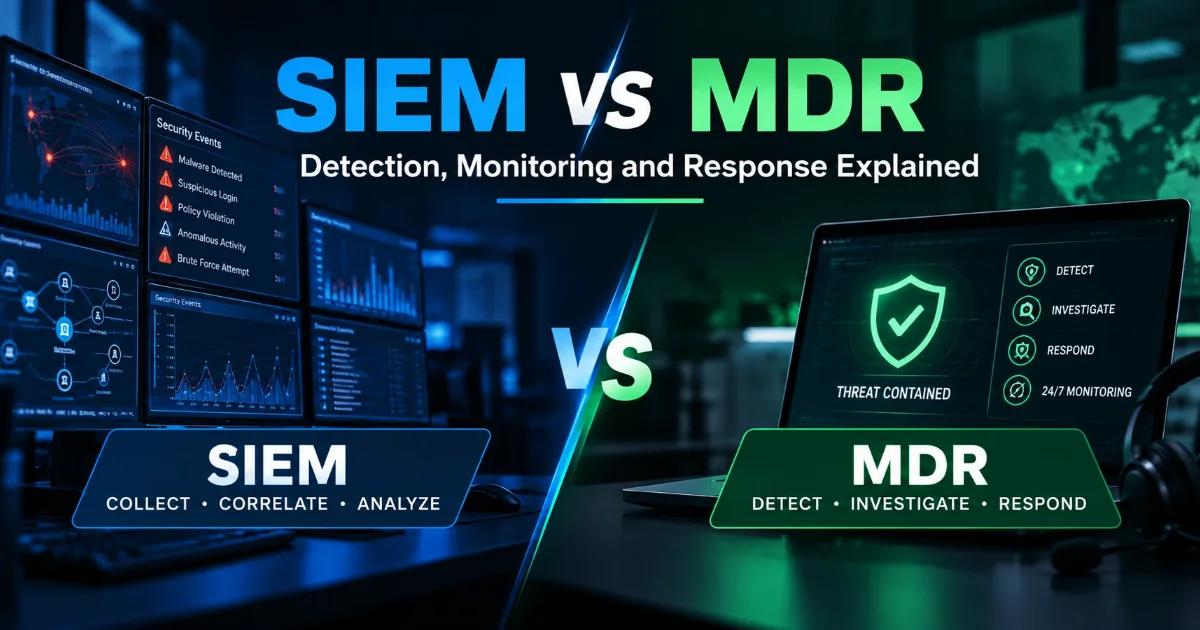
SIEM vs MDR: Detection, Monitoring and Response Explained
By:
Ganesan D
18 Sep 2026
Category:
Cloud Security
Introduction
Modern organizations face a growing number of cyber threats, making effective security monitoring and rapid incident response essential. Security teams need visibility into suspicious activities, potential threats, compromised accounts, and unusual behavior across their IT environments.
Two commonly discussed security solutions are SIEM and MDR. Although they are sometimes considered alternatives, they serve different purposes and can also complement each other.
SIEM security monitoring focuses on collecting, centralizing, and analyzing security data from multiple sources. Managed Detection and Response (MDR) combines security monitoring with human expertise to identify, investigate, and respond to threats.
Understanding MDR vs SIEM can help organizations determine which approach aligns with their security requirements, internal resources, and operational needs.
SIEM Explained
SIEM stands for Security Information and Event Management. A SIEM platform collects and analyzes security-related logs and events from different systems across an organization's environment.
These sources can include:
- Servers and endpoints
- Firewalls and network devices
- Cloud platforms
- Applications
- Identity systems
- Security tools
- Authentication systems
The primary purpose of SIEM is to provide centralized visibility, event analysis, alerting, and security monitoring.
MDR Explained
Managed Detection and Response (MDR) is a security service that combines technology, security monitoring, threat detection, investigation, and response with the expertise of security professionals.
Instead of simply providing security alerts, an MDR service typically helps organizations investigate suspicious activity and determine whether it represents a genuine threat.
MDR may provide:
- 24/7 security monitoring
- Threat detection
- Alert investigation
- Threat analysis
- Incident response support
- Security expertise
- Continuous monitoring
This makes MDR particularly useful for organizations that have limited internal security resources or require additional security expertise.
Key Differences: MDR vs SIEM
SIEM and MDR both support cybersecurity monitoring and threat detection, but they differ in their purpose, operational model, and level of managed security support.
| SIEM |
MDR |
| Security technology/platform |
Managed security service |
| Collects and analyzes security data |
Detects, investigates, and responds to threats |
| Provides centralized visibility |
Provides monitoring with security expertise |
| Requires internal resources to investigate alerts |
Security analysts investigate alerts |
| Highly customizable |
Service-driven and operational |
| Organizations manage the platform |
Provider manages much of the security operation |
The key distinction is that SIEM is primarily a technology platform, while MDR is a managed security service that combines technology and human expertise.
Detection & Monitoring
SIEM and MDR can both contribute to threat detection, but their operational models differ.
With SIEM security monitoring, organizations collect security events and configure detection rules, correlations, dashboards, and alerts. Internal security teams are generally responsible for reviewing and investigating those alerts.
MDR services typically combine automated detection technologies with security analysts who monitor the environment, investigate suspicious events, and help determine the appropriate response.
Incident Response
Detection is only one part of cybersecurity. Organizations must also determine how they will respond when a genuine threat is identified.
A SIEM can provide valuable information for incident response by helping security teams investigate timelines, correlate events, identify affected systems, and understand attacker activity.
MDR extends this process by providing security professionals who can investigate alerts and support response activities according to the service's scope.
Use Cases
SIEM Can Be Useful For
- Centralized log management
- Security event correlation
- Compliance and audit requirements
- Security visibility across multiple systems
- Internal SOC operations
- Detailed security investigations
MDR Can Be Useful For
- 24/7 security monitoring
- Organizations with limited SOC resources
- Threat detection and investigation
- Incident response support
- Access to security analyst expertise
- Organizations seeking managed security operations
SIEM and MDR: Can They Work Together?
Yes. SIEM and MDR do not necessarily need to be competing solutions.
An organization may use a SIEM platform as part of its security architecture while using an MDR provider to monitor, investigate, and respond to security events.
In such an environment:
Security Data → SIEM → Detection & Correlation → MDR Analysts → Investigation → Response
This approach can combine centralized security visibility with external security expertise.
Choosing the Right Solution
When comparing MDR vs SIEM, organizations should consider:
- Size and complexity of the IT environment
- Internal cybersecurity expertise
- Security monitoring requirements
- Required monitoring hours
- Incident response capabilities
- Compliance requirements
- Available security resources
- Budget and operational requirements
Some organizations may benefit from using both SIEM and MDR as complementary components of their security strategy.
Conclusion
Understanding SIEM vs MDR is important when designing an effective cybersecurity monitoring and response strategy.
For many organizations, the question is not simply SIEM or MDR, but how these technologies and services can work together to improve detection, monitoring, investigation, and response.