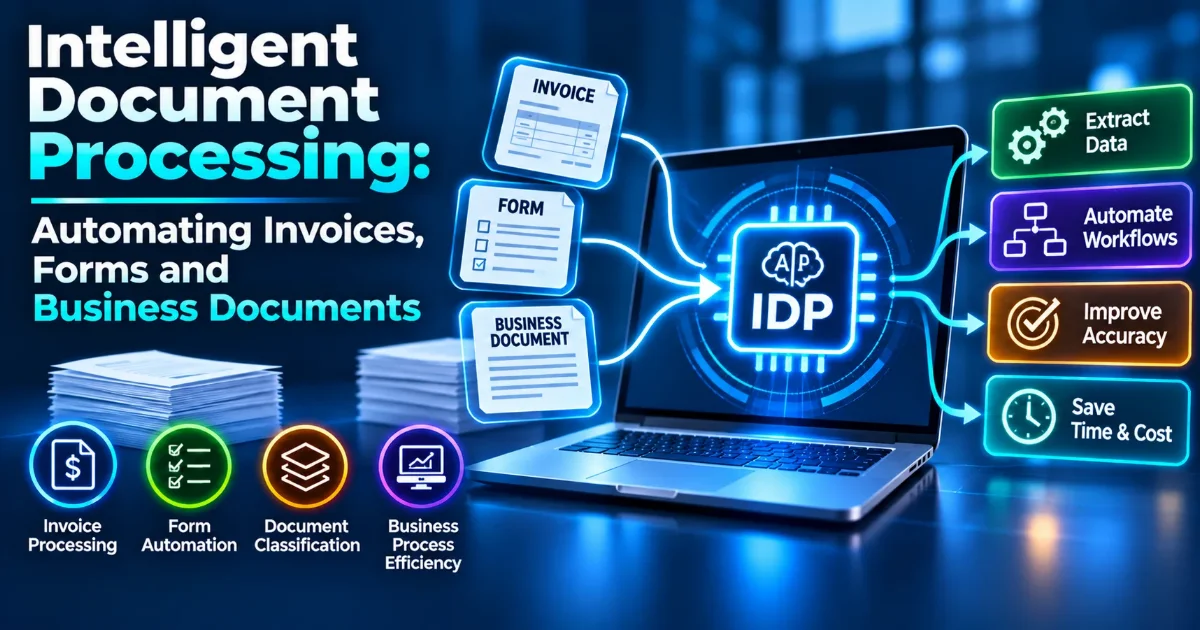
Intelligent Document Processing: Automating Invoices, Forms and Business Documents
By: Ganesan D
14 Nov 2026
Category:
Custom
Introduction
Every day, businesses process huge amounts of documents like invoices, purchase orders, forms, contracts and customer data. Manually processing your documents can be a very time-consuming method that can cause errors. Intelligent Document Processing (IDP) uses AI technology, machine learning and automation to turn unstructured documents into useful data for your business.
If you are looking to utilise AI document processing in Dubai, then Intelligent Document Processing is the solution for you. It makes processing documents easier by reducing monotonous tasks.
What Is Intelligent Document Processing?
Intelligent Document Processing (IDP) is an AI-enabled technology that can capture, read, classify and extract data from various types of documents. As opposed to simply scanning a document or using basic OCR, IDP can understand what the content of the document says, determine which data points are relevant and organise the extracted information.
IDP uses technologies like OCR, NLP, machine learning and workflow automation to help businesses extract data from structured documents (such as forms) and unstructured documents (such as letters and contracts).
How Does Intelligent Document Processing Work?
An IDP solution generally consists of the following stages:
-
Document Capture:
Documents can be captured from a range of sources, including email attachments, scanners, cloud storage, web portals and business applications.
-
Pre-Processing:
This stage ensures the quality of documents is improved by rotating pages, removing noise and preparing files for processing.
-
Recognition:
OCR technology recognises either printed or handwritten text.
-
Classification:
AI identifies what type of document it is. This could be an invoice, contract, application or purchase order.
-
Information Extraction:
Relevant information such as names, dates, invoice numbers and payment amounts is identified and extracted.
-
Validation and Integration:
Extracted data is validated against predefined rules and then sent to connected business systems.
This workflow can be tailored to fit your organisation's document requirements and processes.
Types of Documents Intelligent Document Processing Can Handle
Intelligent Document Processing can process a variety of documents from many departments.
-
Financial Documents:
Invoices, receipts, expense claims and payment records.
-
Business Forms:
Employee applications, customer registration and feedback forms.
-
Procurement Documents:
Purchase orders, delivery notes and supplier records.
-
Legal Documents:
Agreements, contracts and compliance documents.
-
HR Documents:
CVs, employee records, onboarding forms and leave applications.
-
Customer Documents:
Identity records, service requests and attachments.
This means that Intelligent Document Processing can be very useful to organisations with a large volume of information to process.
Data Extraction and Document Classification
One very valuable feature that IDP provides is automated document categorisation and data extraction.
For example, if an invoice is uploaded, you can extract details such as the supplier name, invoice number, invoice date, tax amount and total amount to pay. The AI can also identify different invoice formats.
Using AI to categorise documents will automatically send them to the right department or queue. This saves time on manually sorting documents and makes it easier to find the information.
Workflow Automation and System Integration
IDP becomes much more efficient when integrated with existing business applications. Once you have extracted the information, workflows can be initiated, such as invoice approvals, purchase order matching, updating customer records and onboarding employees.
By integrating IDP with ERP, CRM, accounting and document management systems, you can reduce repeated data entry.
If you are looking at implementing AI intelligent automation in Dubai, adding document management will increase collaboration between your teams and give greater insight into outstanding tasks.
Accuracy, Validation and Data Security
While AI can help to increase efficiency when processing documents, you should always have validation processes in place. The quality of the images, handwriting, layout and completeness of information can impact accuracy.
Implement the following:
-
Date, value and mandatory field validations.
-
Validation with supplier, customer and accounting systems.
-
Manual validation where confidence is low or when exceptions occur.
-
Audit trails to track document processing activities.
-
Role-based access control and data encryption.
Accuracy will depend on the quality of the documents, system setup, training data and validation processes. Critical business processes should still be manually validated.
Business Applications of Intelligent Document Processing
IDP can be used across different business departments to improve document handling and operational efficiency.
-
Automate finance processes, including invoice capture, expense management and payment preparation.
-
Extract employee data and manage recruitment documentation within Human Resources.
-
Process purchase orders and supplier documentation within Procurement.
-
Categorise customer requests and extract information within Customer Service.
-
Manage documentation and support document reviews and retrieval within Compliance.
Automation of document processes can help organisations in Dubai and across the UAE reduce manual and repetitive tasks.
Frequently Asked Questions
1. Are Intelligent Document Processing and OCR the Same?
No. OCR is used to convert text in an image into digital text. IDP uses OCR alongside AI to classify, understand the context of, extract and help automate document-related processes.
2. Can IDP Recognise Handwriting?
Yes. Many IDP platforms have handwriting recognition capabilities. However, accuracy will depend on the quality of handwriting, language and condition of the documents.
3. Can IDP Be Integrated with ERP?
Yes. IDP can be integrated with compatible ERP, CRM and accounting platforms using APIs, connectors or other supported methods.
4. Can Small Businesses Use Intelligent Document Processing?
Yes. Intelligent Document Processing can be used by small and medium-sized businesses to reduce repetitive document-related tasks. Suitability depends on document volume, complexity and budget.
Conclusion
Intelligent Document Processing (IDP) refers to using AI-based technologies such as data extraction, document classification, data validation and process automation to streamline invoice and form processing. This helps reduce the amount of manual work required.
Agan Cyber Security LLC is here to help you find secure technology solutions to meet your business needs. Get in touch with our team to discuss your intelligent automation and document processing requirements in Dubai and throughout the UAE.