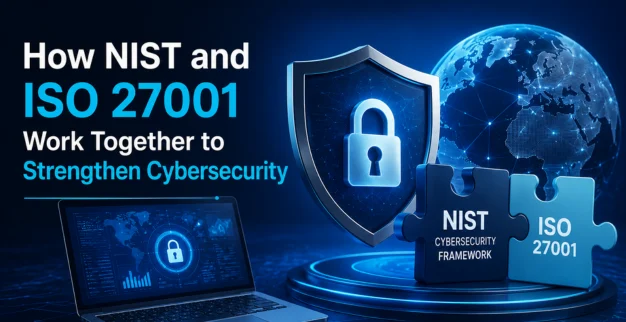
How NIST and ISO 27001 Work Together to Strengthen Cybersecurity
26 May 2026
Modern organizations face increasingly sophisticated cyber threats, regulatory pressures, and operational risks. Businesses today must implement structured cybersecurity strategies to protect sensitive information, maintain compliance, and ensure business continuity.
Two of the most widely recognized frameworks used by enterprises are the NIST cybersecurity framework and ISO 27001. While each framework has its own structure and focus areas, combining both creates a stronger cybersecurity strategy that improves cybersecurity compliance and enhances overall security governance.
What is the NIST Cybersecurity Framework
The NIST cybersecurity framework is a risk-based framework designed to help organizations identify, manage, and reduce cybersecurity risks.
The framework is built around five core functions:
- Identify
- Protect
- Detect
- Respond
- Recover
NIST helps organizations improve operational cybersecurity practices and strengthen incident response capabilities.
Benefits of NIST Framework
- Improves risk identification and management
- Enhances threat detection and response
- Supports continuous monitoring
- Strengthens operational cybersecurity controls
- Improves cybersecurity resilience
NIST is widely used because of its flexible and practical approach to cybersecurity management.
What is ISO 27001
ISO 27001 is an internationally recognized standard for implementing an Information Security Management System (ISMS).
The framework helps organizations:
- Establish security governance structures
- Implement risk management processes
- Protect sensitive business information
- Improve compliance management
- Maintain continuous security improvement
ISO 27001 focuses heavily on governance, documentation, policies, and structured security management.
How NIST and ISO 27001 Work Together
Although both frameworks have different objectives, they complement each other effectively when implemented together.
NIST Focuses On
- Operational cybersecurity controls
- Technical risk management
- Incident detection and response
- Continuous monitoring and recovery
ISO 27001 Focuses On
- Information security governance
- Policy and documentation management
- Compliance and audit readiness
- Organizational accountability
By combining both frameworks, organizations can strengthen both operational security and strategic governance.
Improving Cybersecurity Compliance
Combining the NIST cybersecurity framework with ISO 27001 helps organizations improve cybersecurity compliance across departments and operations.
Key Compliance Benefits
- Better alignment with regulatory requirements
- Improved documentation and audit readiness
- Standardized security controls and procedures
- Enhanced risk management practices
- Continuous monitoring and improvement
Organizations that integrate both frameworks are better prepared to meet industry and compliance standards.
Strengthening Security Governance
Strong security governance ensures cybersecurity aligns with business objectives and operational priorities.
Benefits of Security Governance
- Clear roles and responsibilities
- Improved executive oversight and accountability
- Better cybersecurity decision-making
- Improved incident response coordination
- Stronger alignment between IT and business goals
Governance frameworks help organizations manage cybersecurity as a business priority rather than only a technical issue.
Real-Time Issues Faced by Businesses
- Difficulty managing evolving cyber threats
- Weak governance and accountability structures
- Poor visibility into cybersecurity risks
- Challenges meeting compliance requirements
- Lack of standardized security processes
These issues increase operational and cybersecurity risks for enterprises.
Example:
A healthcare organization struggled with inconsistent security controls and compliance management. After implementing the NIST cybersecurity framework alongside ISO 27001, the organization improved security governance, strengthened incident response capabilities, and enhanced overall cybersecurity compliance.
This demonstrates how combining both frameworks improves enterprise cybersecurity maturity.
Importance of Combining NIST and ISO 27001
- Improves operational cybersecurity controls
- Strengthens governance and accountability
- Enhances compliance and audit readiness
- Supports continuous risk management
- Improves incident detection and response
- Strengthens long-term cybersecurity resilience
Organizations that use both frameworks gain a more comprehensive cybersecurity strategy.
Constraints to Consider
- Limited cybersecurity expertise and resources
- Complexity of framework implementation
- Budget and operational limitations
- Integration challenges with legacy systems
- Rapidly evolving cybersecurity threats
Addressing these challenges requires strategic planning, executive support, and continuous improvement.
Conclusion
The combination of the NIST cybersecurity framework and ISO 27001 provides organizations with a comprehensive approach to cybersecurity management. While NIST strengthens operational security and risk management, ISO 27001 improves governance, compliance, and structured information security management.