SIEM vs SOAR: What's the Difference?
08 July 2026
As cyber threats become more sophisticated, organizations need advanced security solutions that not only detect threats but also respond to them quickly. Traditional security monitoring alone is no longer enough to keep pace with today's rapidly evolving attack landscape.
Two of the most important technologies used in a modern Security Operations Center (SOC) are SIEM and SOAR. While both strengthen cybersecurity, they serve different purposes. Understanding the difference between SOC SIEM, cloud based SIEM, SOAR, and security automation helps businesses build a more effective and resilient security strategy.
What is SIEM?
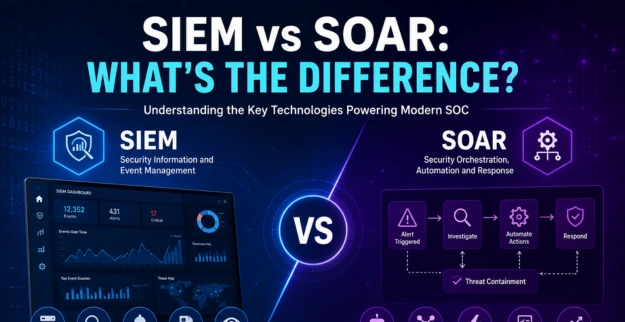
Security Information and Event Management (SIEM) is a security platform that collects, analyzes, and correlates security logs from multiple devices, applications, and network systems.
A SOC SIEM solution provides centralized visibility into security events, enabling organizations to detect suspicious activities and respond to potential threats.
Key Features of SIEM
- Collects logs from multiple security sources
- Monitors network and user activities
- Detects suspicious events using correlation rules
- Generates real-time security alerts
- Supports compliance reporting and auditing
Many organizations now prefer cloud based SIEM because it offers greater scalability, easier deployment, and centralized monitoring across cloud and hybrid environments.
What is SOAR?
Security Orchestration, Automation, and Response (SOAR) is a platform that automates security workflows and incident response processes.
Instead of simply generating alerts, SOAR helps security teams investigate incidents, prioritize threats, and automate repetitive tasks, reducing response times and improving operational efficiency.
Key Features of SOAR
- Automates incident response workflows
- Integrates multiple security tools
- Performs automated threat investigations
- Supports case management
- Reduces manual security tasks
SOAR enables security teams to focus on high-priority threats while routine actions are handled through security automation.
Key Differences
Although SIEM and SOAR work together, they perform different functions within a Security Operations Center.
| SIEM |
SOAR |
| Collects and analyzes security logs |
Automates incident response |
| Detects suspicious activities |
Orchestrates multiple security tools |
| Generates security alerts |
Prioritizes and investigates alerts |
| Improves visibility across the IT environment |
Executes predefined response actions |
| Supports threat monitoring |
Improves operational efficiency through security automation |
In simple terms, SIEM identifies potential threats, while SOAR helps respond to them faster and more efficiently.
Business Use Cases
Organizations often achieve the best results by using SIEM and SOAR together.
| SIEM Use Cases |
SOAR Use Cases |
| Continuous security monitoring |
Automated phishing response |
| Threat detection |
Malware containment |
| Compliance reporting |
Incident investigation |
| Security event analysis |
Alert prioritization |
| Centralized log management |
Security workflow automation |
Together, these technologies strengthen SOC operations, reduce response times, and improve overall cybersecurity effectiveness.
Conclusion
Understanding the difference between SOC SIEM and SOAR is essential for building a modern cybersecurity strategy. While cloud based SIEM provides centralized threat detection and visibility, SOAR enhances security operations through intelligent security automation and faster incident response.
Organizations that combine SIEM and SOAR gain better threat visibility, improved operational efficiency, and stronger protection against evolving cyber threats.