Why Businesses Are Moving to Cloud SIEM
09 July 2026
As cyber threats continue to evolve, businesses need faster, more scalable, and more intelligent security solutions to protect their IT environments. Traditional Security Information and Event Management (SIEM) platforms have helped organizations monitor security events for years, but many businesses now struggle with the complexity, cost, and maintenance required to manage them.
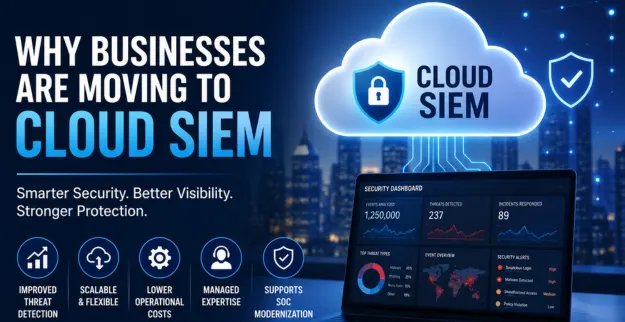
To overcome these challenges, organizations are increasingly adopting cloud based SIEM solutions. Combined with managed SIEM services, cloud SIEM supports SOC modernization by improving threat visibility, simplifying operations, and enabling faster incident response.
Traditional SIEM Limitations
Traditional SIEM solutions have been effective for centralized log management and threat detection. However, modern IT environments have introduced new challenges that on-premises SIEM platforms often struggle to address.
Common Limitations
1. High Infrastructure Costs
Organizations must invest in servers, storage, software licensing, and ongoing maintenance, increasing the total cost of ownership.
2. Limited Scalability
As businesses grow and generate more security logs, traditional SIEM platforms may require costly hardware upgrades to maintain performance.
3. Complex Management
Managing and maintaining a SOC SIEM platform requires skilled cybersecurity professionals, regular updates, and continuous tuning.
4. Slow Deployment
Deploying on-premises SIEM solutions often takes weeks or months due to hardware installation and configuration requirements.
These limitations make it difficult for many businesses to keep pace with today's rapidly changing threat landscape.
Benefits of Cloud SIEM
A cloud based SIEM provides centralized security monitoring without the complexity of managing on-premises infrastructure.
1. Improved Scalability
Cloud SIEM platforms automatically scale as log volumes increase, allowing businesses to grow without major infrastructure investments.
2. Faster Threat Detection
Real-time analytics, artificial intelligence, and advanced correlation rules help security teams identify threats more quickly.
3. Lower Operational Costs
Organizations eliminate expensive hardware purchases while reducing maintenance and infrastructure management costs.
4. Easier Management
With managed SIEM, experienced security professionals handle platform monitoring, updates, tuning, and threat analysis, allowing internal IT teams to focus on business priorities.
5. Supports SOC Modernization
Cloud SIEM integrates with cloud platforms, endpoints, applications, and hybrid environments, making it an ideal solution for organizations modernizing their Security Operations Center.
Business Use Cases
Businesses across industries are adopting cloud SIEM to strengthen cybersecurity and improve operational efficiency.
Common Use Cases
- Continuous security monitoring across cloud and on-premises environments
- Centralized log collection and analysis
- Faster detection of ransomware and malware attacks
- Compliance reporting and audit support
- Security monitoring for remote and hybrid workforces
- Improved incident investigation and response
Organizations that implement managed SIEM gain 24/7 visibility into security events while reducing the burden on internal security teams.
Conclusion
As businesses continue their digital transformation journey, traditional SIEM platforms are becoming increasingly difficult to manage and scale. A cloud based SIEM offers greater flexibility, faster deployment, lower operational costs, and stronger threat detection capabilities.
By adopting managed SIEM as part of SOC modernization, organizations can improve security visibility, strengthen incident response, and build a modern Security Operations Center capable of defending against today's evolving cyber threats.