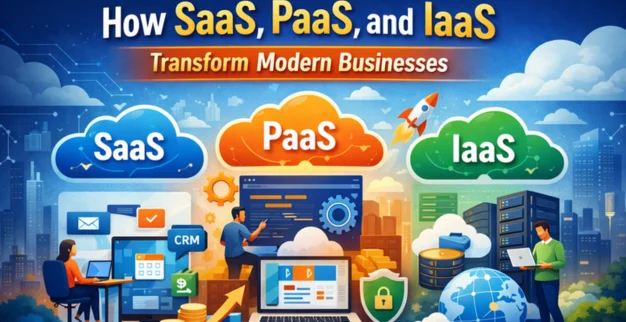
Cloud computing has totally changed the way companies work, grow, and create, new. No more physical servers or complicated infrastructure have to be bought by businesses nowadays. Instead, they use the IaaS, PaaS, and SaaS models to get their work done in an efficient way and at a lower cost.
However, what are these terms anyway, and how do they change businesses of today?
The three main cloud computing service models are each designed to cater to different business requirements:
SaaS (Software as a Service)
They are collectively the core of contemporary cloud, centric IT strategies.
1. SaaS: Ready-to-Use Software for Everyday Operations
Software as a Service (SaaS) is the most popular cloud computing model. With SaaS, users can get fully operational software through the internet.
Here are a few examples of SaaS:
- Google Workspace
- Microsoft 365
- Salesforce
- Odoo Cloud
How SaaS transforms businesses:
- There's no need to install anything or buy hardware.
- Everything updates automatically and is maintained.
- Payment is based on a subscription model.
- You can get to it freely no matter where you are.
Software as a Service helps small businesses and startups a lot by simplifying their IT and enabling their teams to concentrate on being productive rather than on figuring out software.
2. PaaS: Accelerating Application Development
PaaS (Platform as a Service) offers a development platform that allows you to create, test, and implement applications without the hassle of managing the underlying infrastructure.
Some of the popular PaaS platforms are:
- Microsoft Azure App Services
- Google App Engine
- AWS Elastic Beanstalk
How PaaS helps modern businesses:
- Rapid app development
- Embedded tools and frameworks for development
- Less infrastructure management
- Simple scalability
Custom application development companies can benefit from Platform as a Service (PaaS) that helps to accelerate innovation and also reduce the operational burden.
3. IaaS: Flexible and Scalable Infrastructure
Infrastructure as a Service (IaaS) is a cloud computing model that provides virtualized computing resources such as servers, storage, and networking over the internet.
- Amazon Web Services (AWS)
- Microsoft Azure
- Google Cloud Platform
How IaaS transforms IT operations:
- Eliminates the necessity of owning physical data centers
- Cost model based on usage
- Highly scalable for peak demands
- More control over the infrastructure
Companies looking for customization and flexibility usually go for IaaS for greater efficiency in handling their workloads.
Why IaaS, PaaS, and SaaS Matter Together
Most contemporary enterprises do not commit to a single model; instead, they juggle a mixture of all three:
- SaaS for the most frequent apps
- PaaS for the application development
- IaaS for the hosting and infrastructure
Such a tiered strategy gives organizations the flexibility to keep their agility and at the same time, they get the best out of cost and performance.
Business Benefits of Cloud Computing Services
Cloud computing services through IaaS, PaaS and SaaS adoption offer a range of benefits including:
- Lower capital expenditure
- Quick services deployment
- Facilitated collaboration
- More scalable
- Great disaster recovery and backup options
Above all, moving to the cloud empowers businesses to innovate at a higher pace and stay competitive in markets that change rapidly.
Final Thoughts
The move to IaaS, PaaS, and SaaS is more than just a technology change, it is a strategic transformation. In case you are a startup introducing new services or an enterprise updating the infrastructure, cloud models offer the flexibility and efficiency required to expand.
By comprehending the interrelation of these three cloud service models, companies can construct intelligent, scalable, and future, proof digital environments.