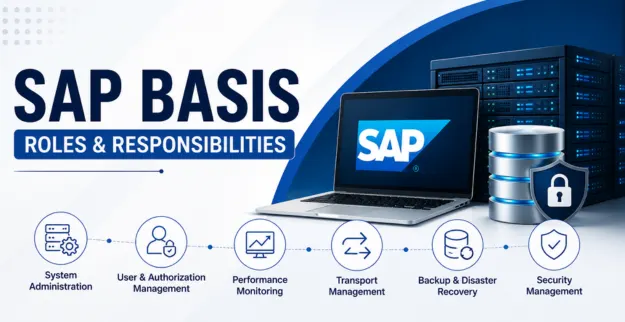
SAP BASIS Roles & Responsibilities
31 July 2026
Introduction
SAP systems are the backbone of many organizations, supporting critical business functions such as finance, procurement, human resources, manufacturing, and supply chain management. To keep these systems running efficiently, businesses rely on SAP BASIS professionals who manage the technical foundation of the SAP environment.
What is SAP BASIS?
SAP BASIS (Business Application Software Integrated Solution) is the technical administration platform that supports SAP applications. It acts as the bridge between the operating system, database, network, and SAP applications, ensuring they work together seamlessly.
Unlike SAP functional consultants who focus on business processes, SAP BASIS administrators manage the technical infrastructure that keeps SAP systems operational.
SAP BASIS Functions
- SAP system installation and configuration
- System monitoring and administration
- User and authorization management
- Database administration support
- Performance tuning and optimisation
- System upgrades and patch management
- Backup and disaster recovery
- Security and compliance management
SAP BASIS is essential for maintaining system stability, performance, and business continuity.
Roles & Responsibilities
An SAP BASIS administrator is responsible for the day-to-day technical management of SAP environments.
1. System Installation and Configuration
Install SAP systems, configure application servers, and prepare environments for development, testing, and production.
2. Performance Monitoring
Monitor system performance, identify bottlenecks, optimise resource utilisation, and ensure high system availability.
3. User Administration
Create and manage user accounts, assign roles and authorisations, reset passwords, and maintain secure user access.
4. System Upgrades and Patch Management
Apply SAP support packages, kernel updates, security patches, and version upgrades while minimising business disruption.
5. Transport Management
Manage the transport of configuration changes and developments between development, quality assurance, and production environments.
6. Backup and Disaster Recovery
Plan and monitor system backups, test recovery procedures, and ensure business continuity during unexpected failures.
7. Security Administration
Implement security policies, monitor system logs, manage access controls, and ensure compliance with organisational and regulatory requirements.
8. Troubleshooting and SAP Support
Identify and resolve technical issues, analyse system logs, coordinate with SAP functional teams, and provide ongoing SAP support to maintain smooth business operations.
Required Skills
A successful SAP BASIS professional combines technical expertise with strong analytical and problem-solving abilities.
Technical Skills
- SAP NetWeaver administration
- SAP HANA and database management
- Linux and Windows server administration
- Operating system and network fundamentals
- Transport Management System (TMS)
- SAP Solution Manager
- System monitoring tools
- Backup and recovery management
- Cloud platforms such as AWS, Microsoft Azure, or Google Cloud
Soft Skills
- Analytical thinking
- Problem-solving ability
- Communication skills
- Attention to detail
- Time management
- Team collaboration
Keeping up with the latest SAP technologies and security practices is essential as enterprise systems continue to evolve.
Career Scope
The demand for SAP BASIS professionals continues to grow as organisations modernise their ERP environments and migrate to cloud-based platforms like SAP S/4HANA.
Career opportunities include:
- SAP BASIS Administrator
- Senior SAP BASIS Consultant
- SAP System Administrator
- SAP Technical Consultant
- SAP Infrastructure Engineer
- SAP Cloud Administrator
- SAP Solution Manager Consultant
FAQ
1. What is SAP BASIS?
SAP BASIS is the technical administration layer of SAP that manages system installation, configuration, monitoring, security, upgrades, and overall system performance.
2. What are the primary responsibilities of an SAP BASIS administrator?
SAP BASIS administrators handle system installation, user administration, performance monitoring, transport management, security, backup and recovery, troubleshooting, and system upgrades.
3. Is SAP BASIS different from SAP functional consulting?
Yes. SAP BASIS focuses on the technical administration of SAP systems, while SAP functional consultants configure SAP modules based on business processes such as Finance, HR, Sales, or Materials Management.
Conclusion
SAP BASIS is the technical foundation that keeps SAP systems secure, reliable, and efficient. From system installation and performance monitoring to security management and disaster recovery, SAP BASIS roles and responsibilities are essential for ensuring uninterrupted business operations.