How SAP and Odoo CRM Modules Transform Customer Engagement
17 Dec 2025
Category:Sap Support
Introduction
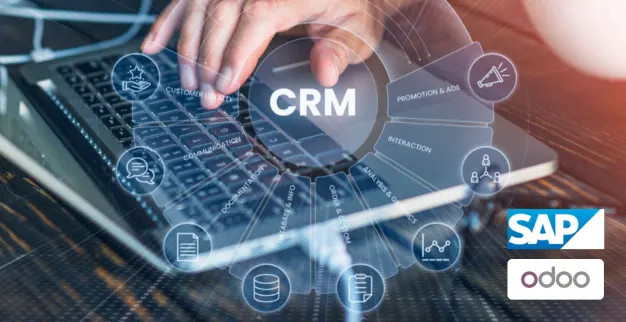
In today’s digital-first economy, customer experience defines business success. Organizations are increasingly turning to advanced CRM software integrated with ERP enterprise resource planning systems to manage customer relationships, streamline operations, and drive growth. Among the most powerful solutions in this space are SAP ERP and Odoo ERP software, both of which offer robust CRM modules that transform how businesses engage with customers.
SAP CRM: Enterprise-Grade Customer Engagement
SAP is an ERP system trusted by global enterprises for its scalability and reliability. Solutions such as SAP Business One, SAP S/4HANA software, and mySAP ERP integrate CRM capabilities directly into the broader SAP enterprise resource planning system. This tight integration allows businesses to align sales, marketing, customer service, and inventory management within one unified platform.
With SAP Business One software and SAP B1 software, companies can gain a 360-degree view of customers—tracking interactions, managing leads, automating follow-ups, and improving customer service management systems. Advanced analytics within SAP enterprise resource planning software help predict customer needs and personalize engagement strategies.
Equally important is ongoing reliability. Services such as SAP application support, SAP BASIS support, SAP technical support services, and access to the SAP support portal ensure continuous system performance. Many SAP Business One companies rely on SAP managed services, SAP remote support, SAP upgrade support, and SAP AMC contracts to maintain and optimize their CRM and ERP systems. This makes SAP ideal for organizations seeking long-term stability and enterprise-level customer relationship management.
Odoo CRM: Flexible and User-Friendly Engagement
For growing and mid-sized businesses, Odoo ERP offers a highly flexible and cost-effective alternative. Formerly known as OpenERP Odoo, the platform provides modular Odoo apps that seamlessly connect CRM with accounting, sales, inventory management, and operations.
The Odoo application includes intuitive CRM systems designed to simplify lead tracking, opportunity management, and customer communication. With features like electronic signature, automated workflows, and pipeline visualization, Odoo CRM software enables faster response times and stronger customer relationships.
Businesses can explore the platform through an Odoo demo or OpenERP demo, review transparent Odoo pricing, and access the system via Odoo login from anywhere. Support services such as Odoo implementation support, Odoo customization support, Odoo module support, and Odoo ERP consulting ensure the CRM aligns perfectly with business needs.
Additionally, organizations benefit from Odoo enterprise support, Odoo SaaS support, Odoo managed services, Odoo remote support, Odoo on-site support, and Odoo AMC contracts, making Odoo a powerful yet accessible customer resource management system.
SAP vs Odoo: Transforming CRM Through ERP Integration
Both ERP and SAP software and Odoo ERP software prove that CRM is most effective when integrated with core enterprise resource planning software. SAP excels in complex, large-scale environments requiring advanced analytics and global compliance. Odoo, on the other hand, shines in agility, customization, and cost efficiency.
Whether you choose SAP ERP consulting services or an Odoo ERP solution support partner, the right CRM-enabled ERP platform empowers businesses to deliver personalized experiences, improve customer retention, and achieve sustainable growth.
By leveraging the combined power of CRM systems and ERP software, organizations can truly transform customer engagement into a competitive advantage.
Feature Comparison: SAP CRM vs Odoo CRM
| Feature |
SAP CRM |
Odoo CRM |
| Business Size |
Large enterprises & global firms |
SMBs & growing businesses |
| Customization |
Structured & controlled |
Highly flexible & modular |
| Cost |
Premium |
Cost-effective |
| Analytics |
Advanced & predictive |
Standard, expandable |
| Deployment |
On-premises / Cloud / Hybrid |
Cloud / On-premises |
| Integration |
Deep with SAP ERP |
Modular with Odoo apps |
| Scalability |
Enterprise-level, global |
Growing businesses, flexible |
| User Experience |
Feature-rich, needs training |
Intuitive, easy to use |
| Support |
SAP BASIS, managed & AMC |
Enterprise, SaaS, remote & on-site |
| Implementation |
Longer cycles |
Faster setup |