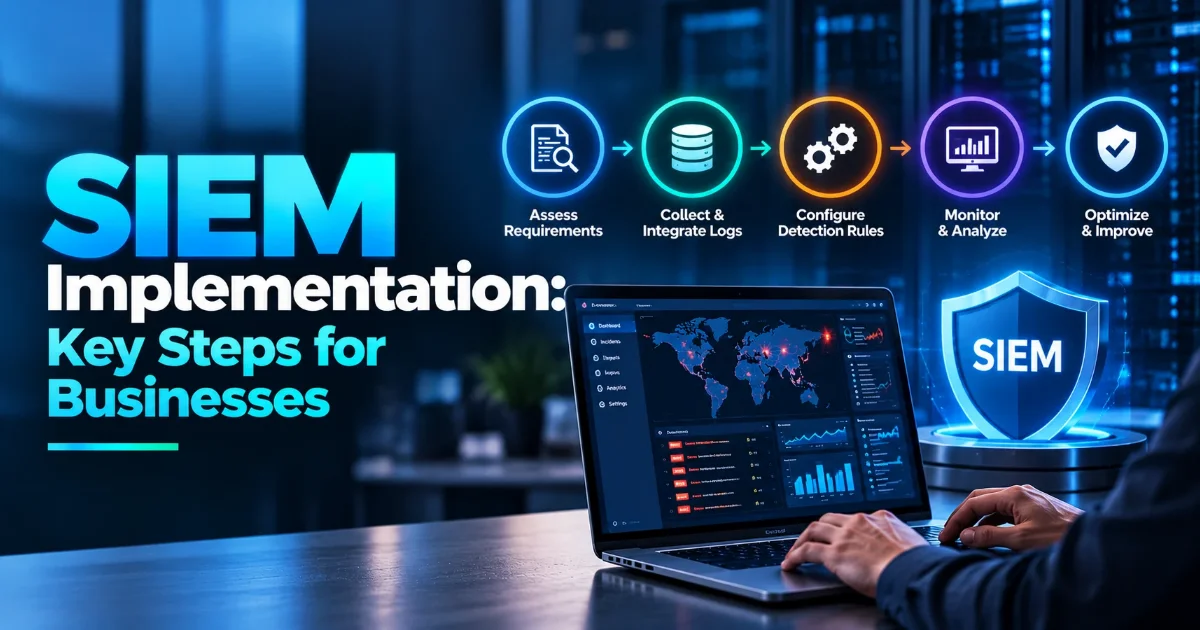
SIEM Implementation: Key Steps for Businesses
By: Ganesan D
1 Oct 2026
Category:
Cyber Security
Introduction
A SIEM Cyber Security solution helps organizations collect, analyze, and correlate security events from across their IT environment. However, implementing SIEM successfully requires more than simply installing a platform. Businesses need to define their requirements, integrate relevant data sources, configure meaningful detection rules, and continuously optimize the system.
Whether an organization uses an on-premises platform or a Cloud Based SIEM, a structured implementation process can help maximize the value of the solution.
Assess SIEM Requirements
The first step is to understand why the organization needs SIEM and what it expects the platform to achieve.
Businesses should evaluate:
✔ Critical systems and applications
✔ Security monitoring requirements
✔ Compliance and audit requirements
✔ Existing security tools
✔ Cloud and on-premises infrastructure
✔ Expected log volumes
✔ Security team capabilities
✔ Incident response requirements
Organizations should also identify the most important assets and security events that need monitoring.
Defining these requirements helps prevent unnecessary data collection and allows the SIEM deployment to focus on meaningful security use cases.
Collect and Integrate Logs
Once requirements are defined, businesses can identify and connect relevant data sources to the SIEM platform.
Common sources include:
✔ Firewalls and network devices
✔ Servers and endpoints
✔ Cloud infrastructure
✔ Identity and authentication systems
✔ Applications and databases
✔ VPN systems
For a Cloud Based SIEM, organizations may also integrate logs from cloud services, SaaS applications, and cloud-native security controls.
Configure Detection Rules
After collecting security data, organizations need to configure detection rules that identify potentially suspicious activity.
Examples include:
✔ Multiple failed login attempts
✔ Unusual authentication activity
✔ Privilege escalation
✔ Suspicious administrative actions
✔ Malware-related events
Detection rules should be aligned with the organization's specific environment and threat scenarios rather than relying only on generic rules.
Threat intelligence and behavioral analytics can also be incorporated where supported by the SIEM platform.
Create and Prioritize Alerts
A SIEM can generate a large number of alerts. Without proper configuration, security teams may face alert fatigue and have difficulty identifying the events that require immediate attention.
Businesses should establish:
✔ Alert severity levels
✔ Prioritization criteria
✔ Escalation procedures
✔ Alert ownership
✔ Response workflows
✔ Suppression rules for known benign activity
Alert tuning is important because unnecessary alerts can consume analyst time, while poorly configured detection rules may allow important events to go unnoticed.
Connect SIEM with SOC
A successful SIEM SOC deployment connects the SIEM platform with the organization's Security Operations Center.
SOC analysts can use SIEM to monitor alerts, investigate suspicious activity, correlate events, and support incident response.
A SOC and SIEM Solution can help establish workflows for:
Detection → Investigation → Escalation → Response → Recovery
The SIEM provides centralized security information, while SOC analysts use that information to investigate and respond to potential security incidents.
For organizations using a Managed SOC, SIEM can also provide security monitoring and event data to external security professionals who manage detection and response activities.
Monitor and Optimize SIEM
SIEM implementation does not end after the initial deployment. Security environments constantly change, and detection requirements need to evolve accordingly.
Organizations should regularly review:
✔ Detection rules
✔ Alert volumes
✔ False positives
✔ Log sources
✔ Data quality
New applications, cloud services, endpoints, and business processes may require additional integrations and detection rules.
Regular tuning can help improve detection accuracy and ensure that the SIEM continues to provide useful security information.
Benefits of Effective SIEM Implementation
A properly implemented SIEM Cyber Security solution can provide businesses with:
Centralized Security Visibility
Security events from multiple systems can be analyzed from a centralized platform.
Improved Threat Detection
Correlation and detection rules can help identify potentially suspicious activity across different systems.
Faster Investigation
Security teams can use related logs and historical events to investigate potential incidents more efficiently.
Better SOC Operations
A well-configured SIEM can provide SOC analysts with relevant alerts and supporting context.
Scalable Security Monitoring
A Cloud Based SIEM can help organizations extend monitoring as cloud services, applications, and infrastructure grow.
Conclusion
Successful SIEM implementation requires a structured approach. Businesses should begin by assessing their security requirements, identifying important data sources, integrating relevant logs, configuring meaningful detection rules, and creating prioritized alerts.
Connecting the SIEM with a SOC and SIEM Solution can further strengthen security monitoring and incident response. However, continuous monitoring, tuning, and optimization are essential to maintain effective detection as the organization's technology environment evolves.
By following these steps, businesses can build a more effective SIEM Cyber Security capability and improve their ability to detect, investigate, and respond to cybersecurity threats.