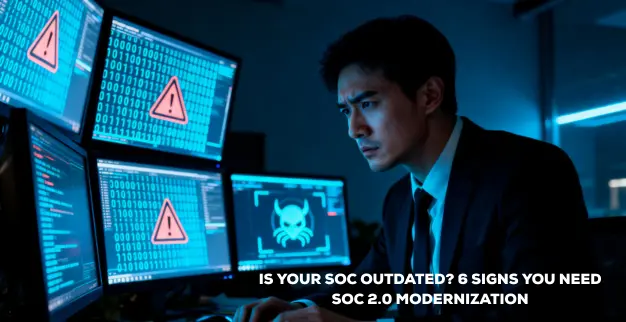
Is Your SOC Outdated? 6 Signs You Need SOC 2.0 Modernization
24 Nov 2025
Category: Security Operation
In today’s rapidly evolving threat landscape, a legacy Security Operations Center (SOC) may no longer be sufficient.
If your SOC still works the way it did half a decade ago, it’s time to ask: Is your SOC outdated?
Here are 6 key signs indicating that you need SOC 2.0 modernization, and why modernizing brings strategic advantages — a must-read for CISOs and SOC leaders.
1. Alert Fatigue & High False-Positive Rates
Traditional SOCs often overwhelm analysts with thousands of daily alerts, most of which are false or low-priority.
This not only drains team resources but risks real threats slipping through. SOC 2.0 modern SOCs address this using AI/ML-powered correlation, intelligent triage, and automation to filter signal from noise.
2. Slow Response Times & Manual Processes
Manual incident response workflows slow your SOC. Analysts spend excessive time investigating, ticketing, or gathering data.
SOC 2.0 modernization leverages automation (SOAR) to reduce mean time to respond (MTTR) and execute playbooks instantly.
3. Tool Sprawl & Disjointed Visibility
Legacy SOCs often rely on disconnected tools — SIEM, EDR, threat intelligence platforms — creating blind spots and inefficient workflows.
Modern SOCs consolidate tools into unified platforms, providing complete visibility across the environment.
4. Inadequate Coverage for Cloud & Hybrid Environments
SOCs built for on-prem environments may miss threats in cloud, SaaS, or hybrid infrastructures.
SOC 2.0 modernization provides cloud-native detection, API threat monitoring, and real-time anomaly detection for distributed environments.
5. Talent Shortages & Analyst Burnout
Skilled SOC analysts are scarce, and repetitive manual tasks lead to burnout.
Modern SOCs automate low-level processes, freeing analysts to focus on threat hunting, investigations, and strategy — improving retention and efficiency.
6. Lack of Strategic Vision or Modern Architecture
Superficial SOC upgrades won’t deliver real benefits. SOC 2.0 modernization involves a holistic approach: people, processes, technology, automation, and a roadmap for evolving threat detection.
How to Begin Your SOC Modernization Journey
- Start with Assessment: Evaluate SOC maturity, identify gaps in alerts, response times, and visibility.
- Define a Clear Strategy: Optimize incrementally or fully transform to SOC 2.0.
- Adopt Automation & AI: Use SOAR, automated playbooks, and ML-based triage.
- Consolidate Tools: Move toward a unified platform for better visibility.
- Upskill Your Team: Train analysts for proactive threat hunting.
- Implement Modern Controls: Use UEBA, XDR, threat intelligence, and advanced detection.
- Measure & Iterate: Track MTTR, false positives, and analyst workload continuously.
Conclusion
If your SOC suffers from alert fatigue, manual processes, tool sprawl, limited cloud coverage, burnout, or lacks strategy, it’s overdue for SOC 2.0 modernization.
By embracing automation, modern tooling, and a forward-looking vision, your SOC transforms from reactive to proactive defense.
At Agan Cybersecurity, we help organizations design, build, and optimize next-generation SOCs — enabling faster detection, smarter response, and scalable operations.