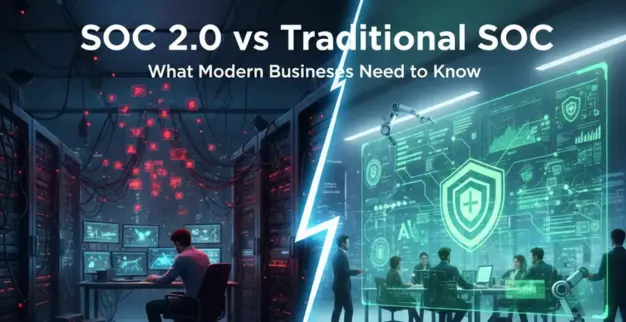
SOC 2.0 vs Traditional SOC: What Modern Businesses Need to Know
17 Nov 2025
Category: Security Operation
Introduction
In today’s rapidly evolving threat landscape, the difference between a traditional SOC and what many are calling SOC 2.0 has never been more important for businesses. If you’re building or updating your security operations centre, understanding this shift is key to staying ahead of cyber risks and safeguarding your data.
What is a Traditional SOC?
A traditional SOC follows the classic model of a central team, established processes, and tools like a SIEM (Security Information and Event Management) platform. It is often reactive: analysts monitor alerts, logs, investigate incidents, escalate, respond. As one source puts it, the model is “built around a ‘helpdesk’ model… a problem appears, a ticket gets raised, and someone eventually looks into it” — which in today’s environment is simply too slow.
Typical limitations of traditional SOCs include: alert overload, high false positives, under-resourced teams, gaps in visibility across cloud/hybrid environments.
Enter SOC 2.0 (or Next-Generation SOC)
SOC 2.0 is a term used by analysts (e.g., Forrester Research) to describe a more modern, distributed, service-oriented, virtualised version of the SOC — no longer just a physical “room” but a function, spanning cloud, hybrid, remote work, and real-time threat intelligence.
In practice, a next-gen modern SOC emphasises:
- Proactive monitoring and threat hunting, not just reacting.
- Automation, orchestration, AI/ML to triage alerts, reduce false positives, speed response.
- End-to-end visibility across hybrid, multi-cloud, remote endpoints—not just on-premises.
- Service model / virtualisation: The SOC becomes a 24/7 operational capability rather than a single physical centre.
Key Differences Businesses Need to Know
| Area |
Traditional SOC |
SOC 2.0 |
| Focus and Approach |
Heavily technology-centric, reactive, often over-invested in tools and under-invested in processes/training. |
Business-driven, outcome-oriented (detecting and responding to threats quickly), with a balance of people, process and technology. |
| Speed & Scale |
Struggles with alert volume, manual triage, and limited scalability. |
Leverages automation and intelligence to triage faster, reduce human burden, and scale operations across larger attack surfaces. |
| Visibility & Environment |
Often operates best in on-premises, siloed networks. |
Covers cloud, remote work, hybrid infrastructure, and integrates new data sources and threat intelligence feeds. |
| Resources & Cost Efficiency |
Much budget goes into maintaining layered tools and large staffing that may burn out. |
Shifts toward fewer manual, repetitive tasks, freeing analysts for higher-value work; cost per risk managed becomes more efficient. |
Practical Steps to Move Toward SOC 2.0
- Evaluate your SOC maturity: are you simply monitoring logs, or are you hunting and responding proactively?
- Introduce automation and orchestration: triage repetitive alerts, enrich context, free analysts for strategic tasks.
- Expand visibility: ensure your cloud, remote endpoints, SaaS apps feed into the same SOC pipelines.
- Shift your staffing/training model: invest more in skilled analysts, threat hunting, process development, not just tools.
- Monitor outcomes: track metrics like time-to-detect, time-to-respond, analyst hours, reduction in false positives.
In Summary
The age of the reactive, tool-heavy, traditional SOC is being left behind. For modern businesses, moving toward a SOC 2.0 model means embracing proactive operations, smarter automation, broad visibility and service-style thinking. If you’re still running a legacy SOC model, now is the time to assess and upgrade.