SOC Analysts: Roles, Skills & Tools in 2025 (Beginner to Expert Guide)
28 Nov 2025
Category: Security Operation
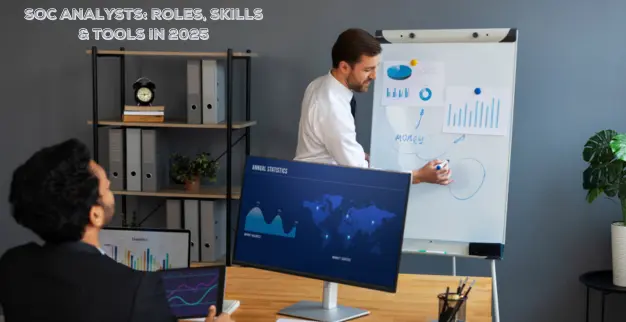
As cyber threats grow more advanced, the Security Operations Center (SOC) has become the backbone of modern digital defense. At the heart of every SOC are SOC Analysts — the professionals who detect, investigate, and respond to cybersecurity threats in real time.
Whether you are aspiring to enter cybersecurity or looking to upgrade your team, here is a 2025-ready guide covering SOC analyst roles, required skills, top tools, and the roadmap from Beginner → Intermediate → Expert.
What Does a SOC Analyst Do?
A SOC Analyst monitors an organization’s IT infrastructure, investigates suspicious activity, and ensures that threats are detected and contained quickly. Their responsibilities include:
- Real-time security monitoring
- Threat detection and analysis
- Incident triage and response
- Log correlation and investigation
- Reporting and documentation
- Collaborating with IR, Threat Intel & Red Teams
- Ensuring compliance and security hygiene
SOC Analyst Roles in 2025
1. Level 1 (L1) – SOC Analyst / Junior Analyst
Best for: Beginners in cybersecurity
Key Responsibilities:
- Monitor SIEM dashboards
- Identify suspicious alerts
- Perform initial triage
- Escalate incidents to L2
- Document findings
What’s New in 2025: AI-assisted alert triage reduces manual workload—L1 analysts now focus more on understanding attack patterns and validation.
2. Level 2 (L2) – SOC Incident Responder / Investigator
Best for: Analysts with 2–4 years’ experience
Key Responsibilities:
- Deep-dive threat investigation
- Malware analysis (basic)
- Threat hunting
- Coordinating with IT teams
- Containment actions
2025 Trend: L2 analysts rely heavily on XDR platforms, automated playbooks, and threat intelligence to accelerate investigation.
3. Level 3 (L3) – SOC Threat Hunter / Senior Analyst
Best for: 5+ years’ experience
Key Responsibilities:
- Advanced investigation & forensics
- Proactive threat hunting
- Identifying unknown threats (zero-day, novel TTPs)
- Designing detection rules
- Guiding junior analysts
2025 Trend: Threat hunters now use AI-driven anomaly detection, behavioral analytics, and custom detection engineering.
4. SOC Manager / SOC Lead / Cyber Defense Manager
Responsibilities:
- Managing SOC operations
- Optimizing tooling & processes
- Incident coordination
- Compliance & reporting
- Team training and development
In 2025: SOC leaders focus on SOC 2.0 modernization, automation, and reducing analyst burnout.
Skills Required for SOC Analysts in 2025
Technical Skills
- SIEM mastery (logs, correlation, alerts)
- Knowledge of OS (Windows/Linux) internals
- Network security fundamentals
- Endpoint security & EDR tools
- Understanding of MITRE ATT&CK
- Basic scripting (Python/PowerShell)
- Incident response procedures
- Threat intelligence analysis
Soft Skills
- Analytical thinking
- Clear communication
- Attention to detail
- Decision-making under pressure
- Curiosity & willingness to learn
Future-Proof Skills (2025 onward)
- AI-driven security tools
- Cloud security (AWS, Azure, GCP)
- Digital forensics
- Detection engineering
- Understanding of SOC automation & SOAR
Top SOC Tools in 2025
SIEM Tools
- Splunk
- Microsoft Sentinel
- IBM QRadar
- Elastic Security
XDR & EDR
- CrowdStrike Falcon
- Microsoft Defender XDR
- Palo Alto Cortex XDR
- SentinelOne
SOAR / Automation
- Palo Alto Cortex SOAR
- Splunk SOAR
- Swimlane
Threat Intelligence Tools
- MISP
- ThreatConnect
- Recorded Future
Forensics & Monitoring
- Wireshark
- Velociraptor
- Autopsy
- SecurityOnion
Roadmap: How to Become a SOC Analyst (Beginner → Expert)
Beginner (0–1 Year)
- Learn networking basics
- Study cybersecurity fundamentals
- Practice Linux & Windows
- Learn SIEM dashboards
- Earn certifications: Security+, CySA+
Intermediate (1–3 Years)
- Start incident investigations
- Learn scripting (Python/PowerShell)
- Understand logs deeply
- Certifications: CEH, Microsoft SC-200
Expert (3–6 Years)
- Threat hunting
- Forensics
- Malware analysis basics
- Certifications: GCIA, GCIH, OSCP, Azure/AWS Security
Conclusion
In 2025, SOC Analysts are no longer just alert reviewers — they are AI-assisted cyber defenders, threat hunters, and strategic defenders of critical infrastructure. Whether you are just starting or aiming to reach the expert level, mastering the right skills and tools will prepare you for a high-demand, high-impact career in cybersecurity.