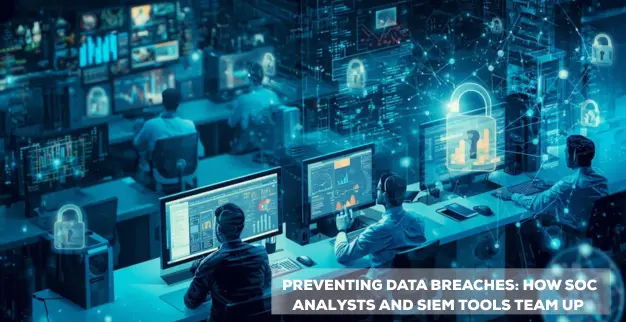
Preventing Data Breaches: How SOC Analysts and SIEM Tools Team Up
19 Nov 2025
Category: Security Operation
In today’s digital world, data breaches aren’t just a possibility—they’re a constant threat. From ransomware attacks to insider threats, businesses of all sizes are at risk. The good news? Organizations can dramatically reduce these risks by combining human expertise with advanced technology. That’s where SOC analysts and SIEM tools come into play. Together, they form a proactive defense system that keeps your sensitive information safe.
The Role of SOC Analysts in Data Breach Prevention
SOC analysts are the human heart of any security operation. Their expertise enables real-time threat detection and fast incident response. Through continuous monitoring, SOC analysts interpret alerts, investigate suspicious behavior, and coordinate containment strategies when needed. By doing so, they greatly reduce mean time to detect (MTTD) and mean time to respond (MTTR) — crucial metrics for minimizing the impact of a breach.
However, SOC analysts alone cannot handle the flood of security data generated by modern IT environments. That’s where SIEM tools come into play.
How SIEM Tools Strengthen SOC Operations
Security Information and Event Management (SIEM) systems collect and aggregate logs, events, and telemetry data from across an organization’s infrastructure—servers, endpoints, firewalls, applications, and more. By bringing together this heterogeneous data into a unified platform, SIEM gives SOC analysts a centralized, real-time view of their threat surface.
But SIEM isn’t just about gathering data—it’s also about making sense of it. Modern SIEM tools use techniques like correlation rules, user and entity behavior analytics (UEBA), and even machine learning to highlight anomalies and suspicious patterns. This helps SOC analysts distinguish real threats from false positives. With fewer irrelevant alerts, analysts can focus on high-priority incidents, improving efficiency and reducing alert fatigue.
How SOC Analysts and SIEM Tools Team Up
1. Keeping an Eye on Everything: Continuous Monitoring
SOC analysts work tirelessly, 24/7, to monitor your networks, endpoints, and cloud environments. SIEM tools aggregate logs and events from all systems, giving analysts a complete view of your digital landscape. This continuous monitoring ensures that suspicious activity is detected early—before it escalates into a serious breach.
2. Detecting Threats in Real Time
With cyberattacks becoming faster and more sophisticated, real-time detection is critical. SIEM platforms use advanced analytics and AI-driven insights to spot unusual behavior immediately. SOC analysts then evaluate these alerts, distinguishing genuine threats from false positives, so organizations can respond without delay.
3. Connecting the Dots: Data Correlation
One of the biggest challenges in cybersecurity is sifting through vast amounts of information. SIEM tools correlate data from servers, endpoints, cloud apps, and network devices. SOC analysts interpret this data to identify patterns, uncover hidden threats, and prevent potential breaches before they happen.
4. Smarter Alerts, Faster Action
Not every alert requires a fire drill. SIEM solutions automate alert triage, reducing noise and letting analysts focus on real risks. This improves efficiency and ensures that critical incidents get the attention they need, right when they need it.
5. Rapid and Effective Incident Response
If a breach is detected, SOC analysts jump into action. They isolate affected systems, investigate the root cause, and mitigate vulnerabilities. By combining human expertise with SIEM automation, response times are faster and more effective, minimizing potential damage.
6. Proactive Threat Hunting
SOC teams don’t just react—they actively hunt for threats. Using SIEM insights, analysts look for subtle signs of compromise and unusual activity that could indicate an impending attack. Proactive threat hunting ensures organizations stay one step ahead of cybercriminals.
7. Compliance and Reporting Made Easy
Regulatory compliance is crucial. SIEM tools generate detailed logs and reports, helping SOC analysts demonstrate adherence to standards like GDPR, HIPAA, and ISO 27001. These reports not only help with audits but also provide actionable insights to strengthen security strategies.
8. Continuous Improvement
Cybersecurity isn’t a “set it and forget it” task. SOC analysts continuously review incidents, refine SIEM rules, and update response plans. This ongoing improvement ensures your defenses adapt to evolving threats, keeping your data safer over time.
Conclusion
Data breaches can have devastating consequences, but they are far from inevitable. By combining the expertise of SOC analysts with the power of SIEM tools, organizations gain real-time visibility, faster response times, and proactive threat detection. This partnership is the key to protecting your most valuable asset: your data.
Investing in a modern SOC with robust SIEM capabilities is no longer optional—it’s essential. Stay ahead of threats, reduce risk, and ensure your business’s security today.