SOC vs Traditional IT Monitoring: What's the Difference?
10 August 2026
Introduction
Businesses rely on IT infrastructure to keep applications, networks, servers, and employees connected and productive. Traditional IT monitoring helps organizations maintain system availability and identify technical issues. However, modern cyber threats require a more security-focused approach.
A Security Operations Center (SOC) provides continuous security monitoring, threat detection, investigation, and incident response. Understanding SOC vs IT Monitoring helps businesses determine whether traditional monitoring is enough or whether they need dedicated 24/7 Threat Monitoring and Managed SOC Services.
What is SOC?
A Security Operations Center (SOC) is a dedicated function that continuously monitors an organization's IT environment for cybersecurity threats.
A SOC focuses on identifying suspicious activity and responding to potential security incidents before they cause significant damage.
Key SOC Activities
- 24/7 security monitoring
- Threat detection and analysis
- Security alert investigation
- Threat intelligence analysis
- Incident response and containment
- Vulnerability and risk monitoring
- Security log analysis
- Post-incident investigation
A SOC combines security technologies with skilled analysts to provide proactive protection.
What is IT Monitoring?
Traditional IT monitoring focuses mainly on the performance, availability, and health of IT infrastructure.
IT teams monitor systems to ensure that servers, networks, applications, and devices are operating correctly.
Typical IT Monitoring Activities
- Server uptime monitoring
- Network performance monitoring
- Application availability checks
- CPU and memory monitoring
- Storage capacity monitoring
- Hardware health monitoring
- Technical issue alerts
The primary objective is to keep IT systems operational and reduce downtime.
Key Differences
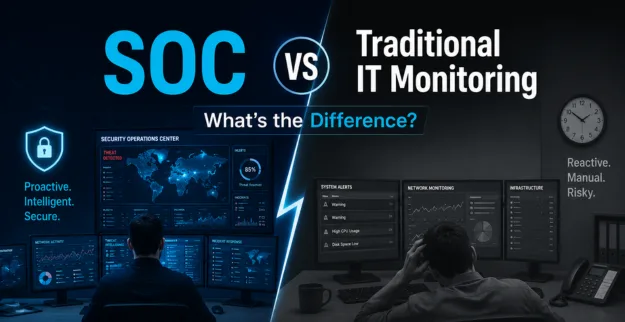
The biggest difference between a SOC and traditional IT monitoring is their primary objective.
SOC Focuses On:
- Cybersecurity threats
- Suspicious user activity
- Malware and ransomware
- Unauthorized access
- Security incidents
- Threat investigation and response
IT Monitoring Focuses On:
- System availability
- Performance issues
- Network connectivity
- Hardware problems
- Application availability
- Technical troubleshooting
In simple terms, IT monitoring asks, "Is the system working?" while a SOC asks, "Is the system secure?"
Benefits
Benefits of SOC
- Continuous threat detection
- Faster incident response
- Improved cybersecurity visibility
- Reduced attacker dwell time
- Proactive threat hunting
- Better protection of sensitive data
- Improved security resilience
Benefits of IT Monitoring
- Reduced system downtime
- Improved infrastructure performance
- Faster technical troubleshooting
- Better resource utilization
- Improved application availability
Both are valuable, but they address different risks.
Business Use Cases
A business may rely on traditional IT monitoring for:
- Server and network performance
- Application uptime
- Infrastructure maintenance
- Capacity planning
A Security Operations Center (SOC) becomes particularly valuable for:
- Ransomware protection
- Phishing and malware detection
- Unauthorized access monitoring
- Cloud security monitoring
- Regulatory compliance
- Security incident response
Businesses with sensitive data, remote users, cloud environments, or significant cyber risk can benefit from Managed SOC Services and 24/7 Threat Monitoring.
Comparison Table
| Feature |
Traditional IT Monitoring |
Security Operations Center |
| Primary Focus |
IT performance and availability |
Cybersecurity and threat detection |
| Monitoring |
Servers, networks, applications |
Endpoints, networks, users, cloud, security events |
| Threat Detection |
Limited |
Advanced and continuous |
| Incident Response |
Technical troubleshooting |
Security investigation and response |
| Monitoring Hours |
Depends on IT team |
Often 24/7 |
| Threat Intelligence |
Usually limited |
Integrated into security operations |
| Best For |
IT reliability and uptime |
Cyber risk management and protection |
Conclusion
Traditional IT monitoring remains important for maintaining reliable infrastructure and reducing technical downtime. However, it is not designed to provide comprehensive protection against modern cyber threats.
A Security Operations Center (SOC) complements IT monitoring by focusing specifically on threat detection, investigation, and incident response. For organizations that require continuous protection, Managed SOC Services and 24/7 Threat Monitoring provide access to security expertise and ongoing monitoring without the need to build a large internal SOC.
The strongest approach for many businesses is to combine reliable IT monitoring with dedicated SOC capabilities, creating both operational stability and cybersecurity protection.