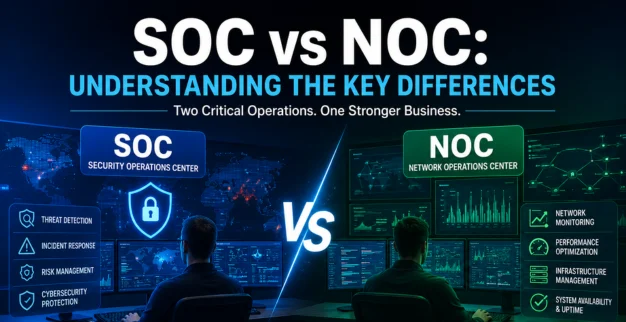
SOC vs NOC: Understanding the Key Differences
12 June 2026
As businesses become increasingly dependent on digital infrastructure, maintaining both cybersecurity and network performance has become critical. Organizations face growing cyber threats, system outages, network disruptions, and compliance requirements that can impact operations and revenue.
To address these challenges, businesses often rely on two specialized teams: the Security Operations Center (SOC) and the Network Operations Center (NOC). While both monitor IT environments, they serve different purposes and play unique roles in maintaining business continuity.
Understanding SOC vs NOC helps organizations build stronger cybersecurity and IT management strategies.
What is SOC?
A Security Operations Center (SOC) is a centralized team responsible for monitoring, detecting, investigating, and responding to cybersecurity threats.
The primary goal of a SOC is to protect business systems, applications, networks, and data from cyberattacks.
Key Functions of SOC Monitoring
- Continuous threat monitoring
- Security event analysis
- Incident detection and response
- Vulnerability management
- Threat intelligence monitoring
- Compliance and security reporting
Effective SOC monitoring helps organizations identify and stop threats before they impact business operations.
What is NOC?
A Network Operations Center (NOC) is a centralized team responsible for monitoring and managing network infrastructure, servers, and system performance.
The primary goal of a NOC is to ensure maximum uptime, performance, and availability of IT services.
Key Functions of NOC
- Network performance monitoring
- Server and infrastructure management
- System availability monitoring
- Network troubleshooting
- Capacity planning
- Performance optimization
A NOC focuses on keeping systems operational and minimizing downtime.
SOC vs NOC Comparison
Although both teams operate around the clock, their responsibilities differ significantly.
Security Operations Center (SOC)
- Focuses on cybersecurity threats
- Detects and responds to cyberattacks
- Protects sensitive business data
- Monitors security events and vulnerabilities
- Uses SIEM, EDR, and threat intelligence tools
Network Operations Center (NOC)
- Focuses on network performance
- Detects and resolves infrastructure issues
- Maintains uptime and availability
- Monitors servers, devices, and connectivity
- Uses network monitoring and performance tools
In simple terms, SOC protects the business from cyber threats, while NOC keeps business systems running efficiently.
Key Responsibilities
SOC Responsibilities
- Threat detection and analysis
- Incident response management
- Security monitoring and investigations
- Risk assessment and mitigation
- Compliance support
NOC Responsibilities
- Network monitoring
- Server management
- Infrastructure maintenance
- Performance optimization
- Downtime prevention
Together, SOC and NOC provide complete visibility into an organization's IT environment.
When Businesses Need SOC & NOC
- Handle sensitive customer or financial data
- Operate cloud and hybrid environments
- Require 24/7 monitoring
- Need regulatory compliance support
- Depend heavily on digital infrastructure
- Face increasing cybersecurity risks
Businesses with growing IT environments benefit significantly from both cybersecurity and operational monitoring.
Benefits of SOC and NOC
Benefits of SOC
- Faster threat detection
- Improved cybersecurity protection
- Reduced risk of data breaches
- Better compliance management
- Enhanced incident response
Benefits of NOC
- Reduced system downtime
- Improved network reliability
- Better infrastructure performance
- Faster issue resolution
- Enhanced business continuity
When combined, SOC and NOC create a stronger, more resilient IT environment.
Conclusion
Understanding the difference between a Security Operations Center and a Network Operations Center is essential for modern businesses. While SOC focuses on cybersecurity protection and SOC monitoring, NOC ensures network stability and infrastructure performance.
Organizations that invest in both SOC and NOC capabilities can improve security, reduce downtime, strengthen compliance, and ensure uninterrupted business operations in an increasingly digital world.