Security Operations Center vs Security Ops Team: What’s the Difference?
25 Nov 2025
Category: Security Operation
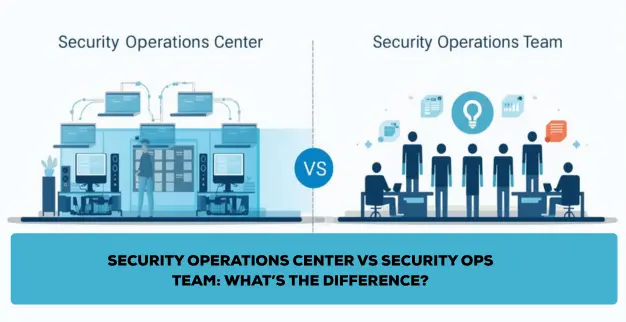
As cybersecurity threats continue to escalate, organizations are strengthening their defense strategies with Security Operations (SecOps). But many businesses often confuse two important terms: Security Operations Center (SOC) and Security Ops Team. While they work toward the same goal—protecting an organization from cyber threats—they are not the same.
This guide explains the key differences, their roles, and when your organization needs each one.
What Is a Security Operations Center (SOC)?
A Security Operations Center (SOC) is a centralized facility where security analysts monitor, detect, analyze, and respond to threats 24/7.
Characteristics of a SOC
- Physical or virtual command center
- Continuous monitoring (24/7 or 24/5)
- Equipped with advanced tools like SIEM, SOAR, XDR, Threat Intel, EDR
- Staffed with a structured hierarchy (L1, L2, L3, Threat Hunters, IR Team)
- Operates with standardized processes and playbooks
- Focuses on real-time threat detection and incident response
What a SOC Does
- Monitors networks, endpoints, cloud, and applications
- Detects suspicious behavior using logs, alerts, analytics
- Investigates incidents and assigns severity levels
- Responds to threats (containment, eradication, recovery)
- Implements automation and detection rules
- Ensures compliance with security frameworks
A SOC is more infrastructure-driven, process-driven, and tool-driven.
What Is a Security Ops Team?
A Security Ops Team (or SecOps Team) is a group of cybersecurity professionals responsible for implementing and managing security operations across an organization — with or without a formal SOC.
Key Characteristics of a Security Ops Team
- May operate without a dedicated command center
- Could be a small, agile team instead of a full SOC structure
- Handles broader security functions beyond alert monitoring
- Focuses on improving security posture and policies
- Works across IT, DevOps, cloud, and business teams
What a Security Ops Team Does
- Develops and enforces security policies
- Manages firewalls, IAM, endpoint security, and configurations
- Conducts vulnerability assessments
- Performs patching and system hardening
- Coordinates major incidents with IT teams
- Implements security controls during deployments
- Supports compliance and governance efforts
A Security Ops Team is people-driven and task-driven, covering overall security operations, not only threat monitoring.
Key Differences Between SOC and Security Ops Team
| Category |
Security Operations Center (SOC) |
Security Ops Team |
| Primary Focus |
Threat detection, monitoring, incident response |
Overall security management & operations |
| Structure |
Formal, tier-based (L1–L3, IR, Threat Hunters) |
Flexible, fewer tiers |
| Environment |
Centralized facility or virtual SOC |
Distributed team |
| Tools Used |
SIEM, SOAR, XDR, EDR, TI platforms |
Endpoint, IAM, firewall, patching, GRC tools |
| Work Model |
24/7 continuous monitoring |
Business-hour or hybrid operations |
| Key Output |
Incident alerts, threat investigations |
Security policies, hardening, risk management |
Do You Need a SOC or a Security Ops Team?
Your choice depends on your organization’s size, maturity, and risk appetite.
- You need a SOC if you:
- Handle sensitive or regulated data
- Require 24/7 threat monitoring
- Face frequent cyberattacks
- Have a large IT footprint (cloud, on-prem, OT/IoT)
- You need a Security Ops Team if you:
- Are a small or mid-sized business
- Need security governance, compliance, and hardening
- Want to improve your security posture without full SOC investment
Many modern organizations use both — a SecOps Team for governance and a SOC for real-time detection.
Conclusion
While the Security Operations Center is the tactical hub for real-time monitoring and incident response, the Security Ops Team focuses on the broader operations needed to secure the organization. Together, they form a powerful defense strategy.