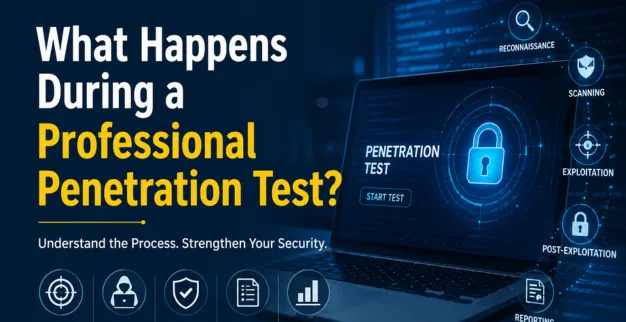
What Happens During a Professional Penetration Test?
20 June 2026
Cyber threats continue to evolve, making it increasingly important for businesses to identify vulnerabilities before attackers exploit them. While firewalls, antivirus software, and monitoring tools provide essential protection, they cannot always reveal how a real attacker might compromise an organization's systems.
This is where penetration testing plays a crucial role. By simulating real-world cyberattacks, businesses can uncover security weaknesses, validate existing controls, and strengthen their cybersecurity posture. Combined with a vulnerability assessment, ethical hacking, and comprehensive security testing, penetration testing provides valuable insights into an organization's security readiness.
What is Penetration Testing?
Penetration testing is a controlled cybersecurity exercise where security professionals attempt to identify and exploit vulnerabilities in systems, applications, networks, or cloud environments.
Unlike automated scans, penetration testing goes beyond identifying weaknesses by determining whether they can actually be exploited by attackers.
The main objectives are:
- Identify security vulnerabilities
- Evaluate security controls
- Test detection and response capabilities
- Assess business risks
- Improve overall cybersecurity resilience
Penetration testing helps organizations understand their real-world exposure to cyber threats.
Planning Phase
Every professional penetration test begins with careful planning.
During this phase, security experts work with stakeholders to define the scope and objectives of the engagement.
Key Activities
- Identifying systems, applications, and networks to be tested
- Defining testing rules and permissions
- Understanding critical business assets
- Establishing communication procedures
- Determining timelines and reporting requirements
Proper planning ensures testing is conducted safely without disrupting normal business operations.
Testing Methodology
A structured ethical hacking methodology is used to evaluate security weaknesses.
Information Gathering
Security professionals collect information about the target environment, including domains, applications, IP addresses, and network architecture.
Vulnerability Assessment
A detailed vulnerability assessment is performed to identify weaknesses such as outdated software, misconfigurations, weak passwords, and exposed services.
Exploitation Testing
Testers attempt to exploit identified vulnerabilities to determine whether unauthorized access can be achieved.
Privilege Escalation
If access is obtained, testers evaluate whether attackers could gain higher privileges or move laterally within the network.
Security Testing Validation
All findings are verified to confirm actual risks and eliminate false positives.
This process provides a realistic view of how attackers might compromise business systems.
Reporting and Remediation
After testing is completed, organizations receive a comprehensive report.
The report typically includes:
- Executive summary of findings
- Risk ratings for identified vulnerabilities
- Proof-of-concept evidence
- Business impact analysis
- Prioritized remediation recommendations
Security teams can then address vulnerabilities based on their severity and potential business impact.
Many organizations perform retesting after remediation to ensure vulnerabilities have been successfully resolved.
Business Benefits
Professional security testing provides significant advantages.
- Identifies vulnerabilities before attackers exploit them
- Reduces cybersecurity risks
- Supports regulatory and compliance requirements
- Improves incident response preparedness
- Protects sensitive business and customer data
- Strengthens overall security posture
Regular penetration testing helps businesses proactively manage cyber risks and improve resilience.
Conclusion
A professional penetration testing engagement provides valuable insight into an organization's security posture. Through vulnerability assessment, ethical hacking, and structured security testing, businesses can identify weaknesses, validate defenses, and reduce the risk of cyberattacks.
Rather than waiting for a security incident to expose vulnerabilities, organizations should proactively conduct penetration testing as part of their cybersecurity strategy.